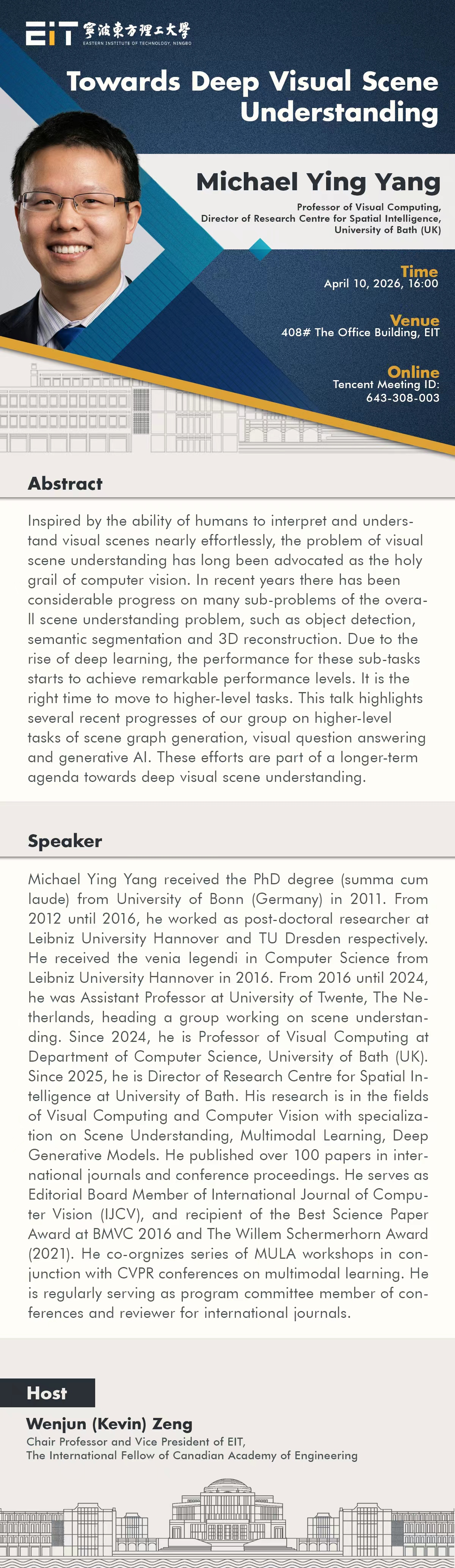
时间:2026-04-10 16:00:002026-04-10 17:00:00
地点:办公楼408
线上链接:腾讯会议: 643-308-003
主讲人:Michael Ying Yang 教授
主持人:曾文军 院士、讲席教授
讲座语言:
主办单位:
品牌栏目:
主讲人
Michael Ying Yang received the PhD degree (summa cum laude) from University of Bonn (Germany) in 2011. From 2012 until 2016, he worked as post-doctoral researcher at Leibniz University Hannover and TU Dresden respectively. He received the venia legendi in Computer Science from Leibniz University Hannover in 2016. From 2016 until 2024, he was Assistant Professor at University of Twente, The Netherlands, heading a group working on scene understanding. Since 2024, he is Professor of Visual Computing at Department of Computer Science, University of Bath (UK). Since 2025, he is Director of Research Centre for Spatial Intelligence at University of Bath. His research is in the fields of Visual Computing and Computer Vision with specialization on Scene Understanding, Multimodal Learning, Deep Generative Models. He published over 100 papers in international journals and conference proceedings. He serves as Editorial Board Member of International Journal of Computer Vision (IJCV), and recipient of the Best Science Paper Award at BMVC 2016 and The Willem Schermerhorn Award (2021). He co-orgnizes series of MULA workshops in conjunction with CVPR conferences on multimodal learning. He is regularly serving as program committee member of conferences and reviewer for international journals.
摘要
Inspired by the ability of humans to interpret and understand visual scenes nearly effortlessly, the problem of visual scene understanding has long been advocated as the holy grail of computer vision. In recent years there has been considerable progress on many sub-problems of the overall scene understanding problem, such as object detection, semantic segmentation and 3D reconstruction. Due to the rise of deep learning, the performance for these sub-tasks starts to achieve remarkable performance levels. It is the right time to move to higher-level tasks. This talk highlights several recent progresses of our group on higher-level tasks of scene graph generation, visual question answering and generative AI. These efforts are part of a longer-term agenda towards deep visual scene understanding.
讲座海报