The rapid advancement of wearable electronics has positioned intrinsically stretchable organic light-emitting diodes (is-OLEDs), capable of accommodating human motion, at the heart of the next-generation smart flexible displays. Yet, a formidable question has long plagued the academic community: How can one simultaneously achieve high brightness, high efficiency, and exceptional stretchability?
Conceptual artwork of future application scenarios for high-performance is-OLED devices (AI-generated)
Recently, a team led by Associate Professor Zijin Huang of the Eastern Institute of Technology, Ningbo, (EIT) in collaboration with partners, has answered this question in a publication in the top-tier optics journal Light: Science & Applications. They innovatively proposed an "elastic-microphase-engineering" approach and combined it with a newly designed "dual-embedded stretchable transparent electrode (STE)" to successfully fabricate an is-OLED that combines ultra-high brightness with outstanding mechanical stretchability.
This device achieves a record luminance of 33,443 cd m⁻² and a stretchability of up to 120%, marking a momentous stride toward the commercial deployment of next-generation "skin-level" wearable electronics.
The Conundrum: When "Flexibility" Clashes with High Brightness
For a display to stretch freely like human skin, every internal layer of the material must be "intrinsically" stretchable. However, routine bodily motions readily generate large strain of 40–100%, placing extremely stringent demands on the mechanical compliance of these devices.
A traditional solution to improve the ductility of the OLED emissive layer involves physically blending in elastomers. But this approach is akin to installing countless insulated speed bumps on an unobstructed highway: it severely impedes charge transport, resulting in a substantial drop in electroluminescent efficiency. Concurrently, existing silver nanowire (AgNW)-based stretchable transparent electrodes often suffer from high surface roughness, limited adhesion, and fracture during peel-off and transfer. These challenges have rendered "mechanical stretchability" and "optoelectronic conductivity" a seemingly irreconcilable contradiction. Yet, the team led by Associate Professor Zijin Huang and his collaborators has delivered a perfect solution to break this impasse.
Embedding "Nanoscale Shock Absorbers": Achieving Both Elasticity and High Conductivity
The researchers systematically compared three elastomers with distinct stretchability and surface energies—styrene-butadiene-styrene (SBS), styrene-isoprene-styrene (SIS), and styrene-ethylene-butylene-styrene (SEBS)—which were respectively blended into a green polyfluorene (GPF) emissive polymer.
Crucially, they found that the elastomer SBS possessed a surface energy highly matched with that of the GPF emissive polymer, enabling excellent miscibility at the molecular level. Driven by this superior compatibility, the blend spontaneously self-assembles to form a unique "three-dimensional microphase separation morphology". Within this architecture, the GPF serves as the continuous host matrix, providing unimpeded charge transport channels and robust electroluminescent functionality, while the SBS uniformly disperses within the 3D structure, acting as a "nanoscale shock absorber".
This continuous and uniform elastic microphase not only drastically mitigates stress concentration during stretching—thereby preventing localized film fracture—but also significantly passivates electronic trap states. Experiments demonstrated that the blend film doped with 10% SBS of the blend film not only saw a doubling in crack-onset strain but also exhibited a more than 300% leap in electron current density compared to the pristine emissive layer.
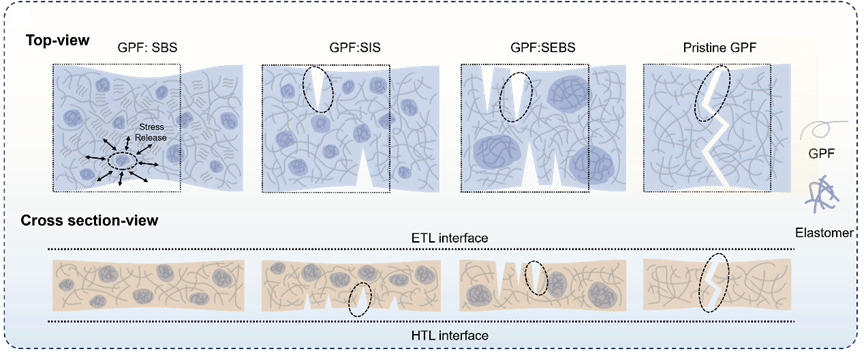
Schematic illustration of the three-dimensional microphase separation
"Floating-on-Water" Process: Crafting an Exceptionally Smooth Flexible Electrode
With the emissive layer perfected, an equally compliant and reliable "power supply line" was essential.
To overcome the persistent roughness and delamination issues of conventional AgNW electrodes, the team adeptly engineered a novel water-assisted transfer "dual-embedded PH1000@AgNWs@TPU (PAT) STE" and developed an elegant "floating-on-water" process. In this method, a water-soluble sacrificial poly layer is pre-coated on a substrate, followed by the sequential spin-coating of a conductive polymer (PH1000), silver nanowires, and a thermoplastic polyurethane elastomer matrix. When immersed in water, the sacrificial layer dissolves spontaneously, allowing the electrode film to float gently onto the water surface, thereby perfectly circumventing the network fractures induced by conventional physical peeling.
The resulting transparent flexible electrode boasts an exceptionally smooth surface, which substantially reduces the interfacial charge-injection barrier. Critically, its electrical resistance remained virtually unchanged after 1,000 stretching cycles at 20% strain, demonstrating remarkable long-term environmental stability.
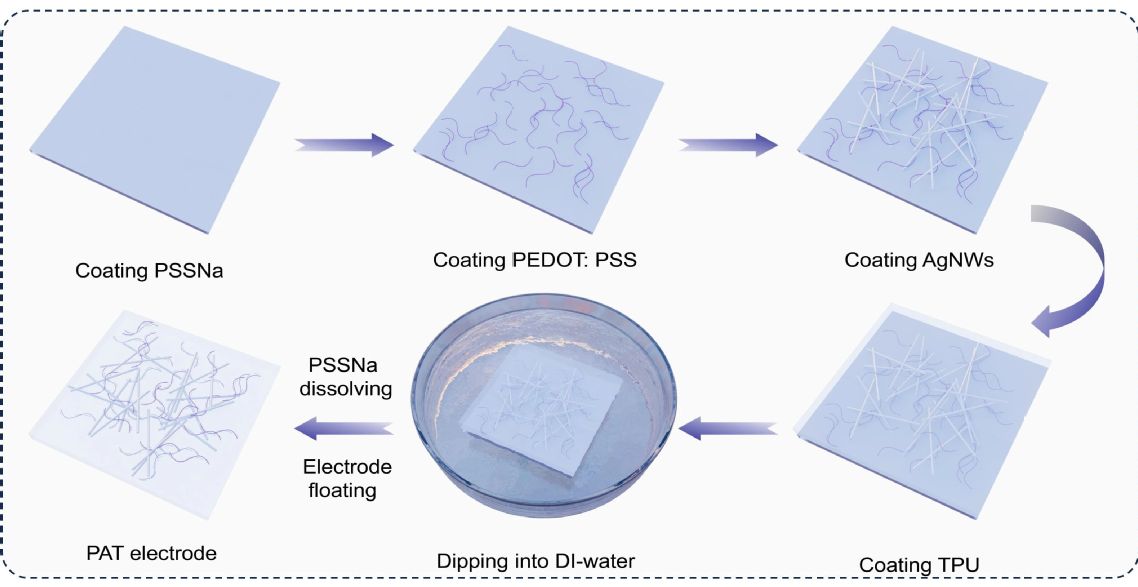
Fabrication process of the PAT STE electrode
Lighting Up the Stretchable Display Era
By integrating the optimized emissive layer with the PAT STE flexible electrode, the research team assembled a complete is-OLED device. Its performance is nothing short of spectacular:
Ultra-High Brightness: A peak luminance of 33,443 cd m⁻², representing one of the highest values reported for stretchable OLEDs to date and rivaling conventional rigid devices.
High Optoelectronic Efficiency: A maximum external quantum efficiency (EQE) of 2.3% and a maximum current efficiency approaching 8 cd A⁻¹.
Extreme Stretchability and Stability: The device maintains stable light emission under mechanical stretchability of up to 120%. More importantly, it retains approximately 90% of its initial luminance after 100 dynamic stretching and releasing cycles at 15% strain. In stark contrast, a pristine undoped device subjected to the same protocol retained only 43%.
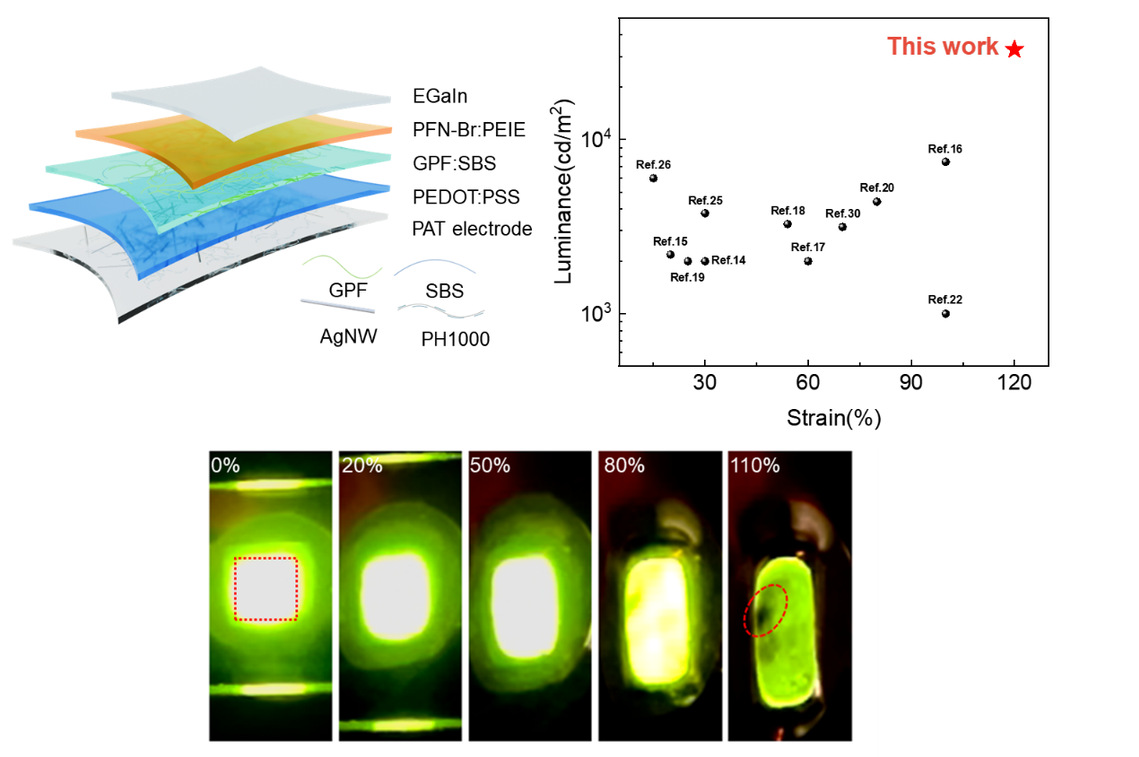
is-OLED device performance metrics and photographic demonstrations of operation under stretching
This research not only profoundly elucidates, through the lens of elastic-microphase engineering, the critical role of miscibility in polymer blend systems for tuning three-dimensional morphology and optoelectronic/mechanical properties, but also delivers a highly efficient and damage-free universal methodology for fabricating flexible transparent electrodes. This breakthrough dispels the long-held myth that high brightness and high stretchability are mutually exclusive in wearable light-emitting devices, paving a bright new path toward the industrial application of next-generation flexible display technologies.
Zheng Lu,a Ph.D. student at EIT is the first author of this paper. Associate Professor Zijin Huang of the College of Information Science and Technology of EIT, Professor Gang Li and Dr. Jiaming Huang of the Hong Kong Polytechnic University are the corresponding co-authors.
This collaborative research was accomplished by the Eastern Institute of Technology, Ningbo, together with the Hong Kong Polytechnic University, Sichuan University, the Chinese University of Hong Kong, and other renowned institutions, and received dedicated support from the National Key R&D Program of China, the Guangdong-Hong Kong-Macao Joint Laboratory Photonic-Thermal-Electrical Energy Materials and Devices, and the Ningbo Yongjiang Talent Program, among other scientific research programs.