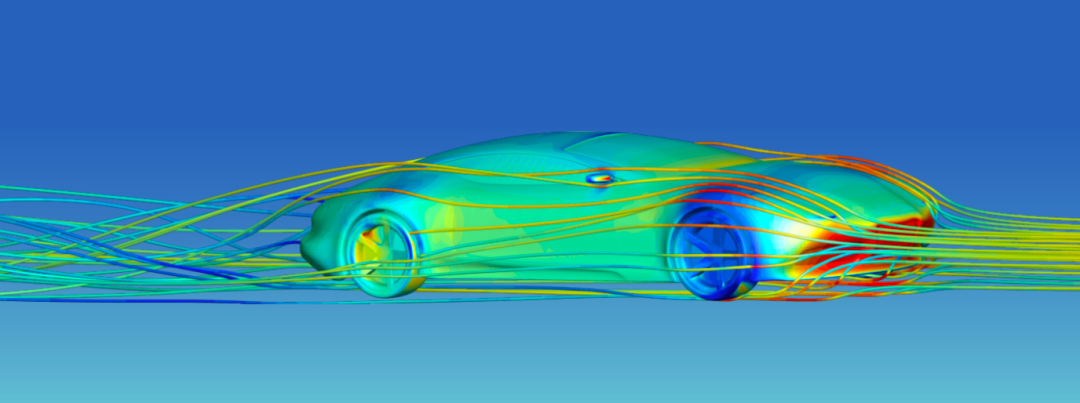
Have you ever wondered why the shapes of new energy vehicles on the market are becoming increasingly sleek? Why some cars offer longer driving ranges and a quieter ride at highway speeds? A critical piece of the answer lies in aerodynamic drag. A vehicle's drag coefficient directly affects its energy consumption, range, and overall performance.
In traditional development cycles, however, automotive aerodynamic design has relied heavily on high-fidelity computational fluid dynamics (CFD) simulations, wind tunnel testing, and manual iterative refinement—a process that is time-consuming, expensive, and difficult to coordinate. Particularly in the early stages of design, quickly determining whether a styling proposal is aerodynamically viable has been far from easy.
Recently, a team led by Assistant Professor Yuntian Chen at the Eastern Institute of Technology, Ningbo, in collaboration with Shenzhen TenFong Technology and IM Motors, has made new advances in intelligent design for automotive aerodynamics, with the potential to completely transform this conventional paradigm. The team has systematically developed an "integrated intelligent agent for rapid automotive drag prediction and shape optimization." The result is an "instant diagnosis" intelligent agent tailored to vehicle drag design. Related achievements have been published in top-tier international conference such as ICML and CVPR and are now quickly moving toward industrial deployment.
The "Instant Diagnosis" Intelligent Agent: A Clever "AI Co-pilot"
What makes this "instant diagnosis" agent so extraordinary? In simple terms, it equips automotive designers with a super-intelligent "AI co-pilot."
First, it is fast. Whereas traditional simulations may take hours, this agent can accurately predict a new car's drag coefficient in a mere 0.9 to 5 seconds—thousands of times faster.
Second, it is knowledgeable. It is not simply an AI model that predicts a drag coefficient; it is an intelligent system constructed to mirror the real-world vehicle development workflow. It supports diverse input modalities—text-based requirements, real vehicle photos, reference images, and three-view drawings—and rapidly outputs the drag coefficient , surface pressure, velocity field, wall shear stress, and other results. In other words, beyond calculating whether the drag is high, it can, much like a physician interpreting a CT scan, pinpoint exactly which specific areas on the 3D vehicle model (e.g., side mirrors, A-pillars, rear end) are generating significant aerodynamic drag, and then provide modification suggestions. This dramatically boosts an engineer's optimization efficiency.
Third, it is hassle-free. With this "AI co-pilot", designers at the very beginning of a project can quickly screen a vast number of proposals, promptly eliminating those designs that clearly contradict aerodynamic principles. Consequently, precious high-fidelity simulation and wind tunnel testing resources can be concentrated on refining only the most promising candidates. It is understood that this technology can reduce the demand for high-fidelity simulation computations by 50% to 80%. After just a few rounds of optimization iterations, an average drag reduction of 2% to 12% can be achieved.
A One-Stop Service: "Rapid Evaluation", "Intelligent Diagnosis", and "Optimization Validation"
At the heart of this technology is a powerful AI model trained on CFD simulation data from roughly 50,000 vehicles. Its prediction accuracy on multiple internationally recognized benchmark datasets substantially surpasses that of existing methods; the associated research papers have been accepted at ICML, CVPR, and other top-tier international AI conferences.
Even more encouraging is that it has moved beyond the laboratory. Solutions developed from these results have already been deployed successfully at IM Motors, helping the company earn recognition as a typical case under Shanghai's "AI + Manufacturing" initiative. The team has also signed cooperation agreements with several other well-known domestic new energy vehicle manufacturers. Automakers do not need to build their own complex computing environments—by simply uploading design proposals to the cloud, they can access a one-stop service that seamlessly covers rapid evaluation, intelligent diagnosis, and optimization validation
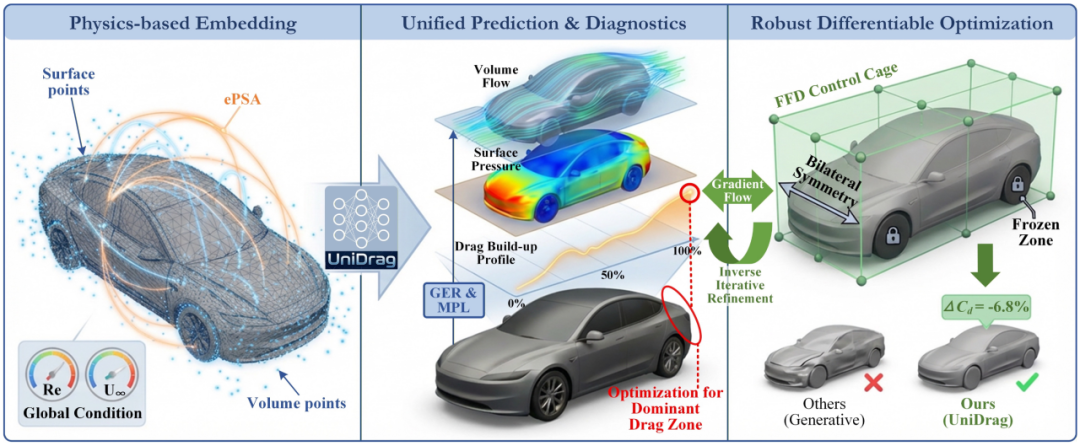
Schematic of the "instant diagnosis" intelligent agent's technical architecture. Image provided by the research team
Moving from dependence on lengthy physical experiments and computations to AI-enabled, seconds-level intelligent analysis, the work of Assistant Professor Yuntian Chen's team illuminates the immense potential of deep integration between artificial intelligence and engineering science. Looking ahead, the team will continue its interdisciplinary research at the AI–engineering interface, pushing more scientific achievements out of the lab and onto the industry's front lines. Cars with even better performance and lower energy consumption are no longer a distant dream.
Related Papers and Patents:
[1] Ye Liu, Yuntian Chen*. DragSolver: A Multi-Scale Transformer for Real-World Automotive Drag Coefficient Estimation. ICML, 2025.
[2] Ye Liu, Shouyi Liu, Huiyu Yang, Jianghang Gu, Wenhao Fan, Zhongxin Yang, Ding Wang, Simeng Chen, Zirun Jiang, Yuanwei Bin, Shiyi Chen, Yuntian Chen*. AeroAgent: A Vision--Physics--Decision Framework for Aerodynamic Vehicle Design. CVPR, 2026.
[3] Ye Liu, Yuntian Chen*, Yuanwei Bin, Shiyi Chen. EMOS: Efficient Multi-Output Aerodynamic Surrogates for Rapid Vehicle Design Iteration. ICME, 2026.
[4] Jianghang Gu, Yuntian Chen*, Yuanwei Bin, and Shiyi Chen. GeoFormer: Mesh-free geometry-to-flow alignment framework for real-time aerodynamics on non-watertight vehicle geometries. Physics of Fluids, 2026.
[5] Huiyu Yang, Jianghang Gu, Yuntian Chen, Yuanwei Bin*, Jianchun Wang*, and Shiyi Chen. Spatially-aware transformer operator for real-time aerodynamic evaluations of arbitrary three-dimensional vehicles. Journal of Computational Physics, 2025.
[6] 陈云天, 刘野, 宾远为. 车辆的风阻系数确定方法、装置、电子设备及存储介质. 中国发明专利, 2025.