Controlling the growth direction and location of different materials at the atomic scale—much like building with LEGO blocks—has been a long-standing goal for materials scientists. Just as a building's architecture determines its function, the morphology, composition, and structure of nanomaterials directly dictate whether they serve as efficient catalysts or sensitive biological probes.
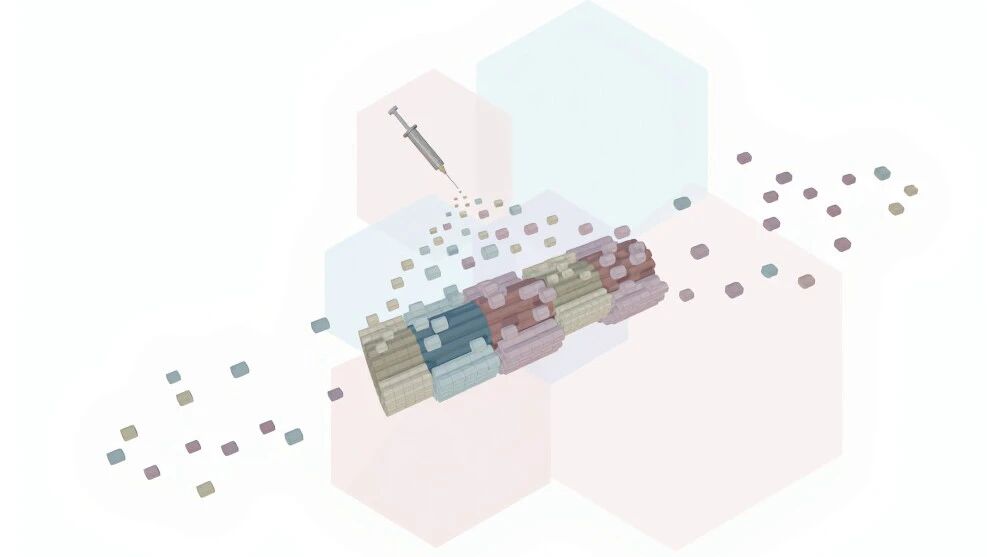
A team led by Associate Professor Shihui Wen from the College of Science at the Eastern Institute of Technology, Ningbo (EIT), has proposed a programmable nano-synthesis paradigm by ingeniously integrating lattice mismatch engineering with site-selective epitaxial growth. They have essentially mastered a set of construction blueprints for the microscopic world, enabling different materials to grow precisely at predetermined locations on demand.
This research was recently published in the prestigious international journal Proceedings of the National Academy of Sciences (PNAS).
Two Major Hurdles in Microscopic Construction
Building in the microscopic world faces two challenges. The first is lattice mismatch: the interatomic spacings in the crystal lattices of different materials vary. If the mismatch is small, the secondary material will uniformly coat the substrate like spreading putty. If the mismatch is too large, however, it will ball up into isolated islands, much like water beading up on a polished floor. The second hurdle is site control. Without a crane in the nanoworld, directing new material to grow precisely at designated sites on a nanorod instead of randomly everywhere has been a persistent challenge.
Atomic-Scale "Precision Targeting"
Addressing these two core bottlenecks, Associate Professor Shihui Wen's team has delivered an elegant construction guide—achieving precisely on-demand growth of heterogeneous nanocrystals through the dual regulation of physical lattice strain and chemical ligand adsorption.
A key highlight of this work lies in exploiting the rare-earth "family", whose members are numerous and offer continuously tunable ionic radii. The team systematically investigated the effects of pairing materials with different "statures" and established a precise quantitative criterion: when the lattice mismatch is below 2.0%, the secondary material "smoothly conforms", forming a uniform coating; when the mismatch falls between 2.0% and 5.1%, it results in "precision decoration", where island-like structures neatly stud the rod like a string of rubies on a stick; and once the mismatch exceeds 7.1%, the new material "goes its own way", nucleating independently to form separate particles. This finding provides the fundamental physical logic for programmable synthesis.
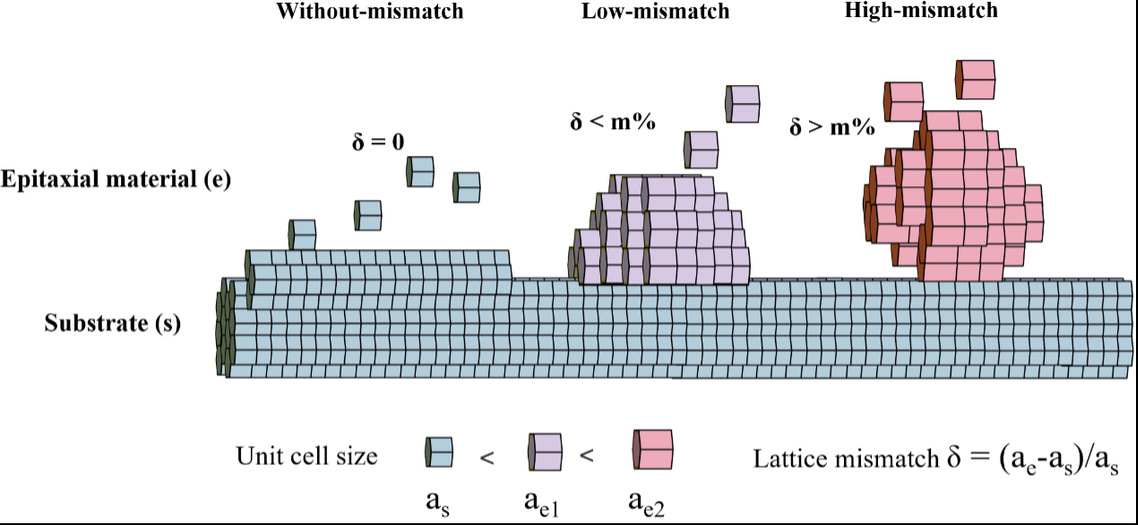
Lattice-mismatch-dependent morphological evolution
Furthermore, the team uncovered the magical power of a type of "chemical glue"—surface ligands. By employing strongly binding ligands such as oleate for surface-selective protection, they effectively equipped the incoming material with a navigation system, directing growth exclusively onto the edges of the nanorods to form regular island structures. In contrast, when weakly binding ligands were used, growth became random, with material arbitrarily spreading out. By tuning the reaction temperature, the researchers could even control the number and spacing of these "decorative features", realizing truly exquisite on-demand regulation.
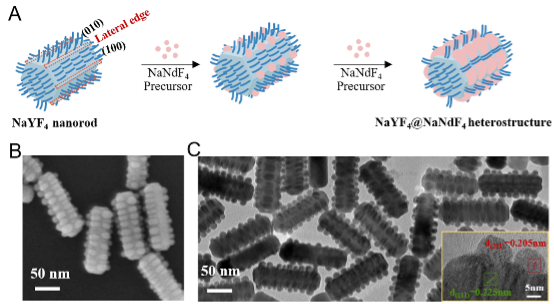
Ligand-mediated ordered island growth
Based on these principles, the team executed a remarkable feat of "micro-sculpture" in the laboratory: on a single nanorod merely 160 nanometers in length and 50 nanometers in width, they integrated four different rare-earth elements and constructed a complex 3D hierarchical architecture comprising 14 functional tiers. This is analogous to building a functionally sophisticated modern complex on a plot of land one five-hundredth the diameter of a human hair, with each element precisely residing in its pre-designed room without interfering with others.
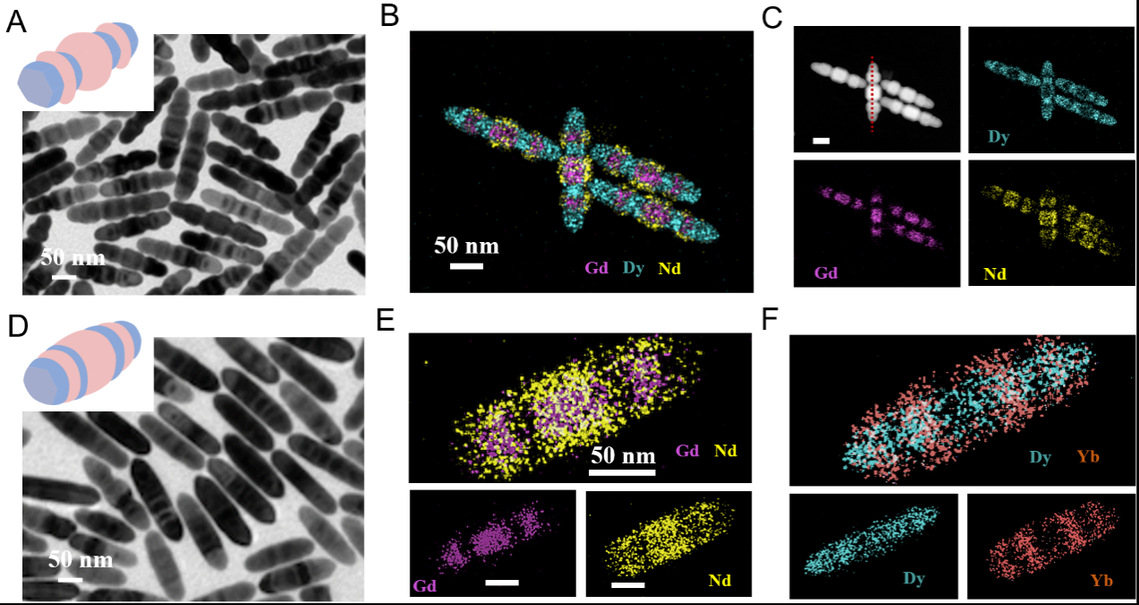
Programmed synthesis of nanocomposite structures containing 14 functional tiers
Traditional nanomaterials were once limited by simple design and rigid functionality. The "programmable" nano-synthesis paradigm proposed by Associate Professor Shihui Wen's team now opens infinite possibilities for "materials-on-demand." Whether for high-efficiency catalysts harnessing sunlight, biological probes penetrating tissues for disease diagnosis, or high-performance light sources powering quantum computing, this LEGO-like synthesis method is poised to inspire many more unexpected innovations in the future.
Dr. Rui Wang, a postdoctoral researcher at EIT, and visiting student Mengxiang Qiao at EIT are the co-first authors of the paper. Associate Professor Shihui Wen of EIT, is the corresponding author. This research was supported by the Major Program of the National Natural Science Foundation of China and the Senior Visiting Scholar Program of the Key Laboratory of Fudan University, among others.