In quantum communication, optical fibers serve as the information superhighway, with single photons acting as the vehicles carrying information. However, most existing single-photon sources can only travel along the visible or near-infrared sections of this highway, preventing them from directly entering the telecommunication band (1260–1625 nm). This limitation severely compromises transmission efficiency.
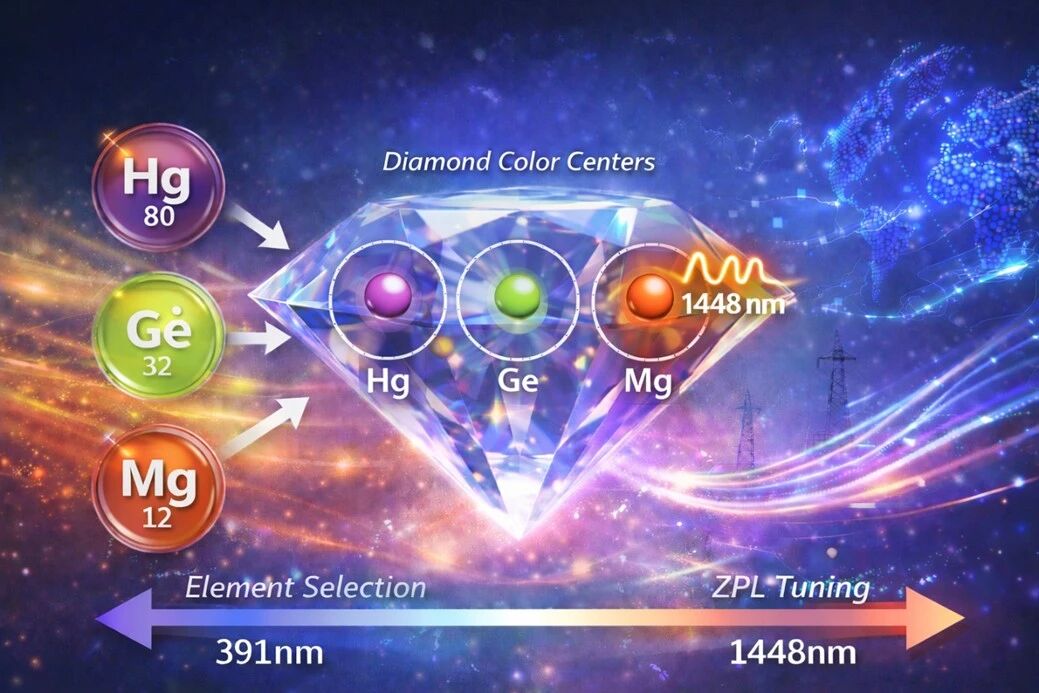
A research team led by Professor Suhuai Wei, Chair Professor at the School of Physics, College of Science, Eastern Institute of Technology, Ningbo, in collaboration with other researchers, has for the first time established a chemical design rule for the zero-phonon line wavelength of color centers in diamond. Using this rule, they predicted a new type of color center single-photon source with intrinsic telecommunication-band emission. This work introduces a new approach for the rational design of quantum materials. The findings were recently published in the Journal of the American Chemical Society, a premier international journal.
Finding a "Native" Messenger for Quantum Communication
Quantum networks rely on single photons to transmit information. If single-photon sources could operate directly in the telecommunication band, they would be inherently compatible with existing fiber-optic infrastructure, substantially reducing transmission losses.
However, ideal single-photon sources in nature—such as diamond color centers—typically exhibit zero-phonon lines in the visible or near-infrared regions. Although quantum frequency conversion can adapt these emitters to meet telecommunication requirements, this approach introduces additional system complexity and efficiency losses.
Thus, directly designing novel color center single-photon sources that emit in the telecommunication band has emerged as a key scientific challenge in the field.
From "Needle in a Haystack" to "Design on Demand"
The team focused on a class of color centers in diamond known as “vacancy–impurity–vacancy” centers, which possess inversion symmetry. Such centers naturally suppress spectral diffusion, offering inherent advantages including narrow linewidths and high coherence—attributes that make them ideals candidates for single-photon emitters.
By combining first-principles calculations with group-theoretical analysis, the team elucidated the mechanism that governs the emission wavelength of these color centers:
Two Key Factors: The atomic size and orbital energies levels of the impurity atom together determine the energy gap between the bonding and antibonding states, which in turn defines the zero-phonon line wavelength.
A Unified Chemical Design Rule: For heavier elements with filled d orbitals, hybridization and strain effects increase the energy splitting, leading to shorter-wavelength emission. In contrast, for lighter elements lacking d orbitals, longer-wavelength emission is more readily achieved.
This rule directly connects the emission wavelength of color centers to the microscopic properties of the impurity atom, marking a fundamental shift from empirical screening to targeted design.
A New "Messenger" for the Telecommunication Band
Following this design rule, the team identified a highly promising telecommunication-band color center single-photon source: the triply negative charged V–Mg–V color center (MgV³⁻).
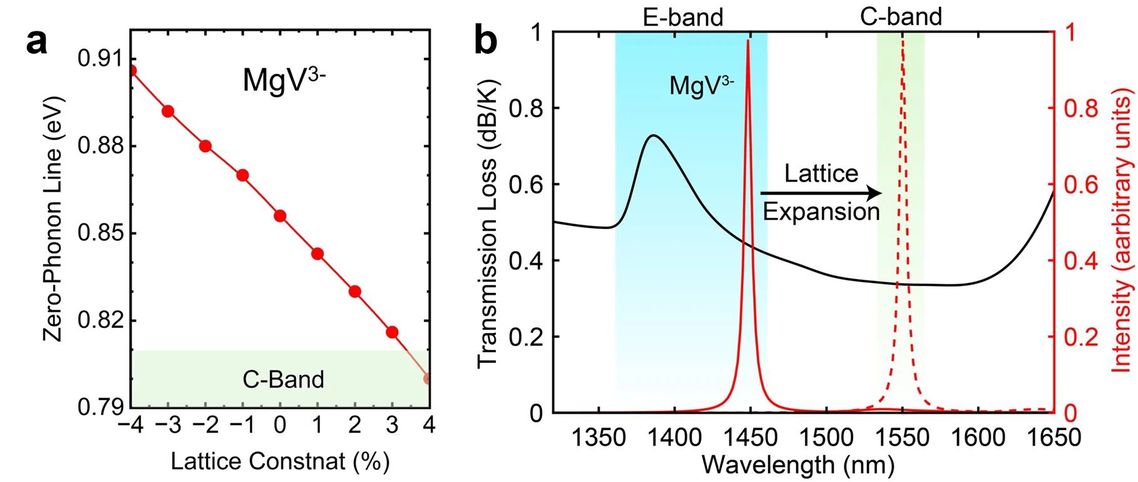
Intrinsic optical properties of the MgV³⁻ color center and the variation of its zero-phonon line with lattice strain
Calculations show that its zero-phonon line lies at 1448 nm, perfectly covering the telecommunication band. More remarkably, it exhibits extremely weak electron–phonon coupling, with a Huang–Rhys factor of only 0.0607 and a corresponding Debye–Waller factor as high as 94.1%. This indicates that the vast majority of its emission is concentrated in the zero-phonon line channel, implying excellent optical coherence and high-quality single-photon emission potential.
Illuminating the Path for Quantum Material Design
This study establishes, for the first time, a direct link between the atomic size and orbital energies levels of impurity atoms and the optical transition wavelength of color centers, providing a clear theoretical foundation for the targeted design of color centers emitting in the telecommunication band, said Dr. Chen Qiu, the first author of the paper.
This work not only reveals the microscopic origin of the zero-phonon line in diamond color centers but also provides theoretical methods and design principles that can be extended to other wide-bandgap materials and solid-state defect systems. It offers a general approach for discovering and optimizing new quantum light-emitting materials, thereby potentially accelerating the practical realization of solid-state quantum devices.
Dr. Chen Qiu, a postdoctoral researcher in Professor Suhuai Wei's group, is the first author of the paper. Professors Suhuai Wei and Huixiong Deng from the Institute of Semiconductors, Chinese Academy of Sciences, are the corresponding authors. Hanpu Liang, Songyuan Geng, Ying Chen, and Xiaolan Yan also contributed to this work.