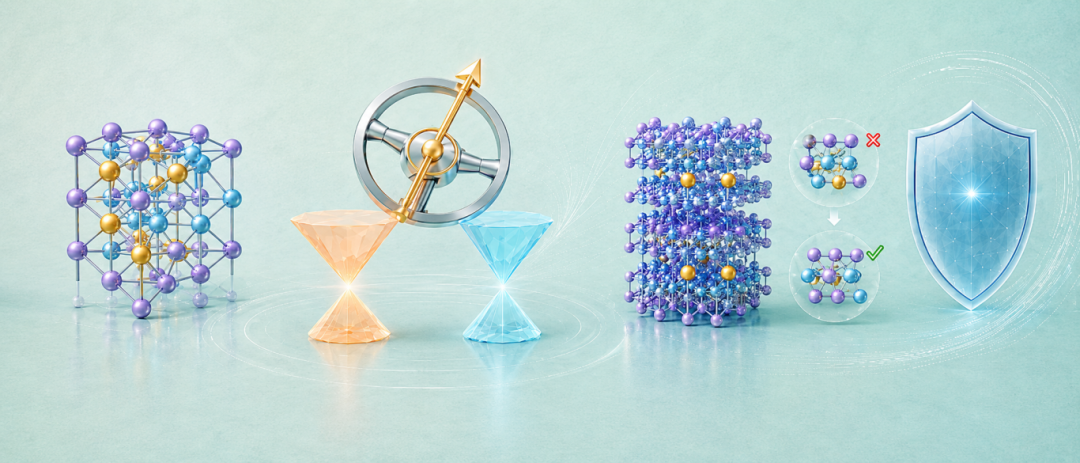
In the long history of humanity's exploration of magnetism, scientists have continuously discovered new forms of magnetism, driving the development of information technology. Recently, the team led by Assistant Professor Jiawei Ruan from the School of Physics at the Eastern Institute of Technology, Ningbo, in collaboration with several Chinese universities, has achieved a significant breakthrough in the field of light-matter interactions. They have successfully used circularly polarized light to "drive" ordinary magnetic materials, designing a novel magnetic state termed the odd-parity magnet.
The results were recently published in the prestigious international physics journal Physical Review Letters (PRL) and were selected as an "Editors'Suggestion."
What exactly is an odd-parity magnet? To understand this, we must look at the family tree of magnetism. For a long time, ferromagnets and antiferromagnets have been the two main protagonists. In recent years, a new type of magnet combining the advantages of both—the altermagnet—has rapidly gained prominence. Altermagnets possess the zero net magnetization characteristic of antiferromagnets while exhibiting ferromagnet-like spin splitting in momentum space, making them an ideal candidate for next-generation ultra-high-density, ultra-fast, ultra-low-power magnetic memory devices.
However, current research has largely focused on a class known as even-parity altermagnets. The more promising odd-parity counterpart has proven difficult to realize in simple materials. Previous views held that such odd-parity spin splitting could only exist in structurally complex noncollinear magnets, severely limiting their application prospects.
The research conducted by Jiawei Ruan’s team has broken this limitation, using light to "rewrite" the magnetic rules of materials. Starting from symmetry principles, the team devised an ingenious approach: using a periodic circularly polarized light field to “illuminate” ordinary collinear antiferromagnetic materials, thereby breaking the existing symmetry and driving the material to generate odd-parity spin splitting.
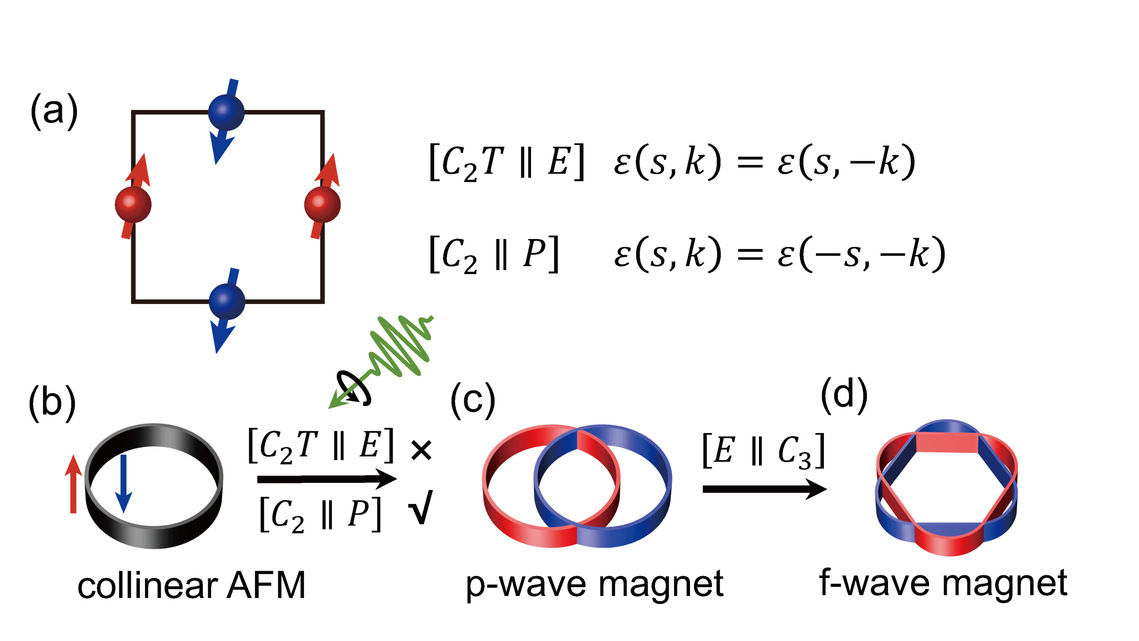
Symmetry mechanism of circularly polarized light realizing odd-parity magnetism in collinear antiferromagnets. Image provided by the research team
Using theoretical models and first-principles calculations, Jiawei Ruan's team successfully realized p-wave and f-wave spin splitting in two common lattice structures—rhombic and honeycomb lattices. Under specific conditions, they also induced a topologically nontrivial Chern insulator state. Notably, they verified this mechanism in a real material—monolayer manganese phosphorus triselenide (MnPSe₃)—and found that the magnitude of the spin splitting can be flexibly controlled by tuning the light's intensity and frequency, providing clear guidance for future experiments.
This research not only extends the study of altermagnets from the "even-parity" to the "odd-parity" but also demonstrates the powerful capability of periodic light-field driving as a "switch" and "regulator." It offers a new pathway toward realizing efficient, ultra-fast spintronic devices and illuminates the immense potential for deeply integrating light and magnetic materials.
The first author of the paper is Dr. Tongshuai Zhu, lecturer at China University of Petroleum (East China). Assistant Professor Jiawei Ruan of Eastern Institute of Technology, Ningbo, and Associate Professor Huaiqiang Wang of Nanjing Normal University are the co-corresponding authors. Chair Professor Suhuai Wei of Eastern Institute of Technology, Ningbo, provided crucial guidance for this work, and Di Zhou, a Ph.D. student in the research group, also participated in the study. This work was supported by grants from the National Natural Science Foundation of China, the National Key Research and Development Program of China, the Natural Science Foundation of Jiangsu Province, and Shandong Provincial Natural Science Foundation, among others.
Link: https://doi.org/10.1103/7ywb-ml2q