Confronted with a disordered graph of nodes and edges, one might think it has "no symmetry at all"—neither rotational symmetry nor mirror symmetry. Yet those seemingly "crooked" discrete systems may simply have their symmetry "hidden"; with a different mathematical "lens," the hidden geometric beauty reveals itself.
A team led by Associate Professor Wenlong Gao of the College of Science at Eastern Institute of Technology, Ningbo (EIT), in collaboration with groups from The Hong Kong Polytechnic University, The University of Hong Kong, Shanghai Jiao Tong University, and Shenzhen University, has published a systematic study of hidden symmetry groups. They demonstrated that discrete systems that appear to lack geometric symmetry may simply have their symmetry "hidden" in an unsuitable representation; after an appropriate transformation, these latent symmetries can be restored to clearly visible geometric symmetries.
On July 28, the results were published in Physical Review Letters, a top-tier physics journal.
Latent symmetry is geometric symmetry in disguise
Symmetry is a fundamental organizing principle of physical laws: it determines conserved quantities, constrains interactions, and profoundly influences the structure and phase transitions of matter. The crystals, snowflakes, and hexagonal honeycombs familiar to us exhibit special physical properties precisely because they possess obvious rotational or mirror symmetry.
Yet many real systems—such as complex molecular networks, artificial metamaterials, and quantum dot arrays—do not take on regular geometric shapes. Does that mean they are not "entitled" to the physical benefits of symmetry? The answer is no.
Latent symmetry refers to symmetry that is not obvious in the original system but it becomes visible after performing isospectral reduction (ISR) of selected degrees of freedom.
All of this originates from graph theory: networks are represented by vertices, edges, and their matrices, so that spectral and structural information can be analyzed together. Previous studies have found that latent symmetry can produce effects such as energy degeneracy, flat bands, and topological states. However, its deep connection to explicit spatial symmetry—that is, its physical nature—has lacked a unified answer.
This study establishes a "latent–geometric correspondence": any system with latent symmetry can be mapped by a similarity transformation to an equivalent system with an unchanged spectrum but explicitly visible geometric symmetry; under general conditions, the converse also holds. Taking the 11-vertex model in the paper as an example, the original structure has only C₃ᵥ geometric symmetry, but after isospectral reduction of four of its vertices, the tetrahedral Td latent symmetry group emerges, thereby explaining the previously seemingly "accidental" threefold degeneracy.
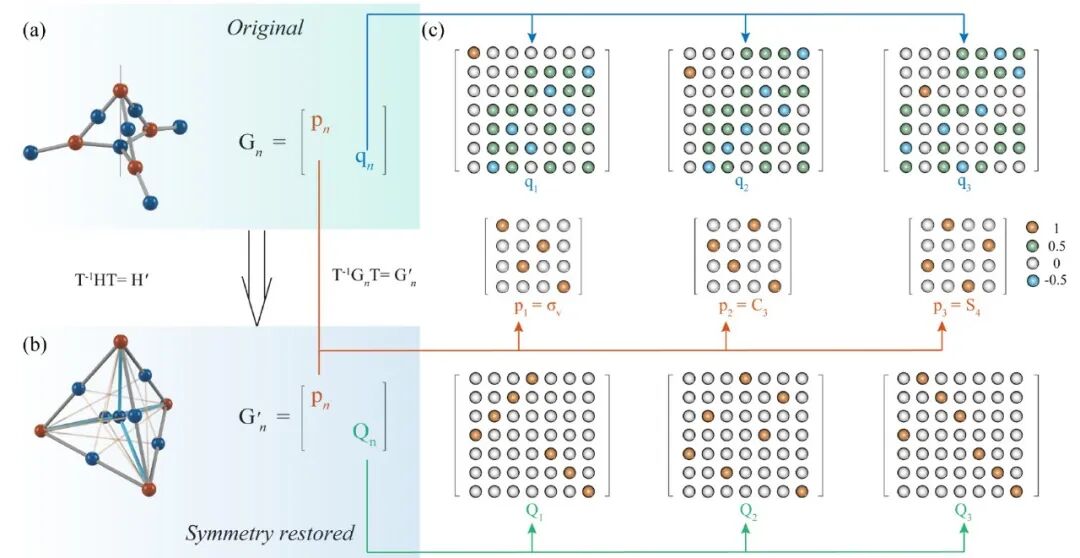
Symmetry restoration: similarity transformations convert the abstract symmetry operations in the original model into pure permutation matrices, making the hidden tetrahedral Td geometric symmetry explicit. Image provided by the research group
From chemical graph theory to topological physics: identifying spectra from graphs
The practice of representing complex objects as graphs and then extracting physical and chemical information from graphs and invariants has deep roots in Chinese theoretical chemistry.
Beginning in the 1970s, Yuansheng Jiang, Member of the Chinese Academy of Sciences, developed molecular orbital graph theory, using graph-theoretic rules to summarize the essential content of simple molecular orbital theory as the “three theorems.” He later developed graph contraction methods to study molecular graph invariants, adjacency matrices, and isospectral graph problems, aiming to trace the connection between molecular structure and properties. This study recovers geometric symmetry from asymmetric networks using isospectral reduction and group representations, revealing the physical nature of cospectral vertices. It echoes Yuansheng Jiang’s methodology of “identifying spectra from graphs and identifying structure from spectra,” demonstrating the explanatory power of graph theory across chemistry and physics.
From symmetry to topology: latent symmetry protects higher-order topological states
A direct implication of the latent–geometry correspondence is that effects relying on geometric symmetry can in principle also be realized in systems with latent symmetry. The team used the 11-vertex latent-symmetric structure as a unit cell to construct a tetrahedral lattice, and fabricated a three-dimensional topological circuit consisting of 10 unit cells built from three-layer printed circuit boards (PCBs). Impedance measurements showed characteristic corner-state peaks near 1.00 and 1.12 MHz; the spatial distribution of impedance at 1.12 MHz further showed that energy was concentrated at the corners.
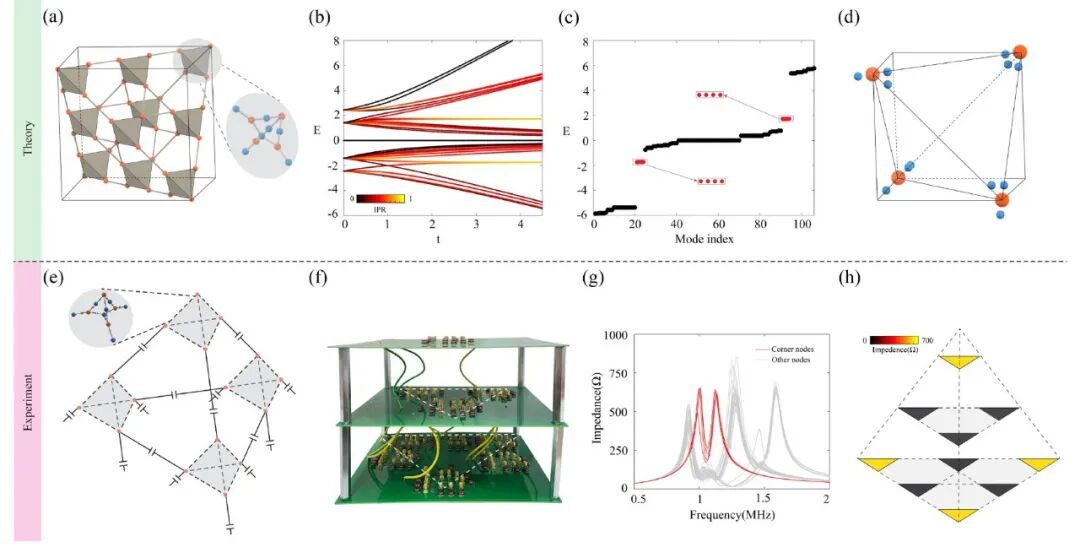
Three-dimensional latent-symmetry-induced higher-order topological insulator: upper row, theoretical model and corner states; lower row, circuit design, sample, and impedance measurements. The red curve corresponds to corner nodes, and the experiment clearly shows the corner-state distribution at 1.12 MHz. Image provided by the research group
This work advances latent symmetry from an algebraic diagnostic into a designable, experimentally verifiable physical tool. The framework is applicable to a wide range of discrete systems and is expected to be useful for classical waves, solid-state materials, condensed matter, quantum information, and quantum simulation. It also provides a new entry point for identifying hidden symmetric structures in more complex platforms such as moiré systems and periodically driven (Floquet) systems.
The Eastern Institute of Technology, Ningbo (EIT) is the first affiliation of the paper. Xinyu Zhang and Ruotao Ye, PhD students of the 2023 cohort collaboratively trained by EIT and The Hong Kong Polytechnic University, are the first authors. Associate Professor Wenlong Gao, Professor Menglin Chen of Shenzhen University, and Malte Röntgen, a Postdoctoral researcher at EIT are the corresponding authors. Collaborators include Suhuai Wei, Chair Professor and Dean of the School of Physics in the College of Science at EIT, and Shuang Zhang, Chair Professor in the Department of Physics and the Department of Electrical and Computer Engineering at The University of Hong Kong and a New Cornerstone Investigator. This work was supported by the National Natural Science Foundation of China and the Ningbo Yongjiang Talent Programme, among others.