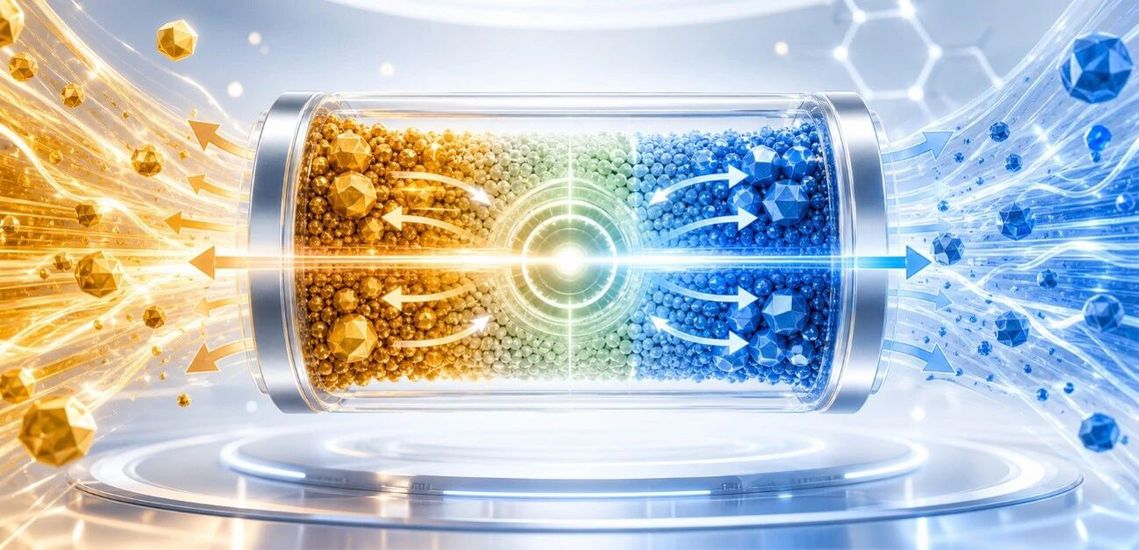
All-solid-state lithium–sulfur batteries (ASSLSBs), combining high theoretical energy density with intrinsic safety advantages, are regarded as a highly promising next-generation energy storage technology. In practical operation, however, they typically require external stack pressures of tens to even hundreds of megapascals to alleviate interfacial mismatch, contact loss and mechanochemical failure induced by electrode volume changes. This reliance on high pressure not only complicates engineering implementation but also hinders the scalable application of all-solid-state lithium-sulfer batteries.
The team led by Chair Professor Xueliang Sun, Foreign Member of the Chinese Academy of Engineering and Assistant Professor Changhong Wang at the Eastern Institute of Technology, Ningbo (EIT) has proposed a "strain-coordination" strategy. By coordinating the opposite volume changes of electrodes during cycling, this approach markedly reduces the need for high external pressure, offering a new pathway toward next-generation solid-state batteries that deliver high energy density, high safety and long lifetime. The findings were recently published in the journal Nature Communications.
Core Innovation
Strain-coordination design: constructing a self-compensated zero-strain all-solid-state lithium–sulfur batteries
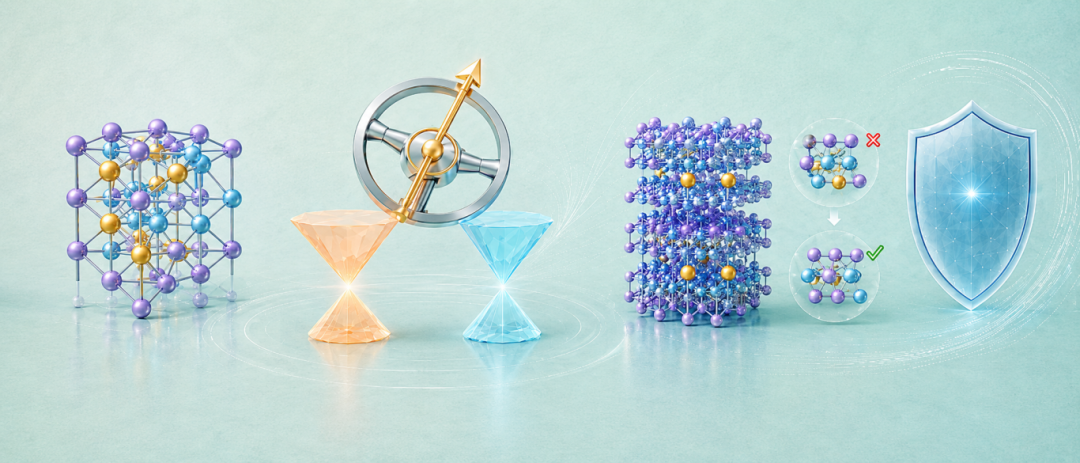
The team selected a high-capacity FeS₂ positive electrodes and a prelithiated Si negative electrode as a representative system. By tuning the Li/Si ratio to form Li₂Si, the expansion of FeS₂ during discharge is compensated by the contraction of Li₂Si, while the reverse occurs cooperatively during charge. Compared with the conventional Li||FeS₂ system, which shows an overall volume change of about −17.2%, the Li₂Si||FeS₂ system optimizes the volume change to only approximately +2.6%, thus fundamentally alleviating the accumulation of mechanical stress at solid–solid interfaces.
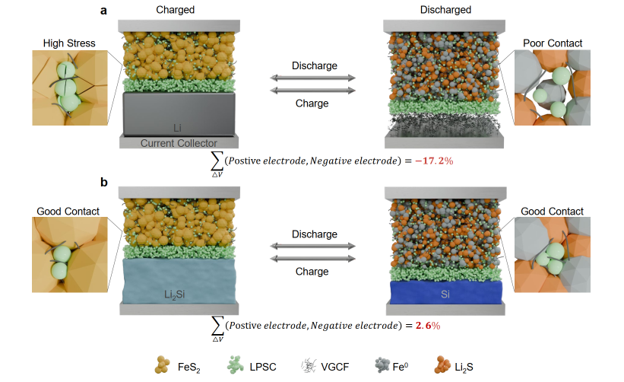
Design principle of additive zero-strain in all-solid-state lithium–sulfur batteries. Image provided by the research group
Robust mechanism validation: overall electrode stress variation reduced by 80%
Using stress analysis, in situ optical microscopy, X-ray computed tomography and in situ impedance analysis, the team systematically verified the effectiveness of the design. The results show that the overall stress variation of the Li₂Si||FeS₂ cell is reduced by roughly 80% compared with the un-coordinated system, the total thickness change during cycling is only about 1.4 μm, the interfacial contact is more stable, and the Li-ion transport kinetics are significantly improved.
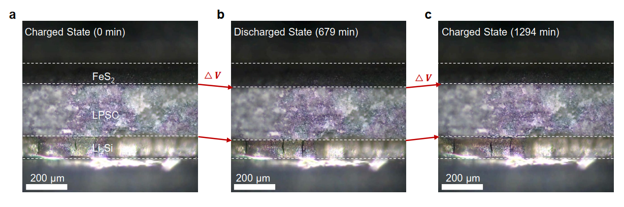
Strain analysis of the electrodes during cycling: a–c, in situ optical microscopy images showing the electrode thickness changes in (a) the charged state, (b) the discharged state and (c) the subsequent re-charged state. Image provided by the research group
Outstanding performance under low external pressure: stable operation achieved at 15 MPa
Under a low external pressure of merely 15 MPa, the system delivers an initial discharge capacity of 740.0 mAh g⁻¹ at 0.1 C and room temperature; at 55 °C, the capacity further increases to 868.4 mAh g⁻¹. An all-solid-state pouch cell adopting the same design attains a discharge capacity of 615.8 mAh g⁻¹ at 15 MPa and cycles stably for more than 500 cycles at 1 C, validating its potential for practical applications.
Long cycling combined with high areal loading: from 4,500 to 140,000 cycles
Under a stack pressure of 100 MPa, the Li₂Si||FeS₂ cells achieve ~4,500 and ~140,000 ultra-long cycles at 1 C and 15 C, respectively, and retain a discharge capacity of 73.8 mAh g⁻¹ even at the high rate of 40 C. Meanwhile, high-loading cells demonstrate an ultrahigh areal capacity of 21.7 mAh cm⁻² over 100 cycles, highlighting the system’s combined advantages in long lifetime, high rate capability and high energy output.
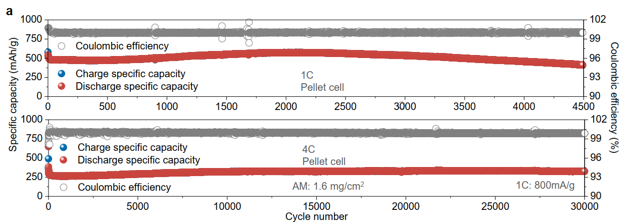
Electrochemical performance of all-solid-state lithium–sulfur batteries under low pressure: cycling performance of Li||FeS₂ and Li₂Si||FeS₂ cells at 25 °C.Image provided by the research group
The core value of this work lies in proposing a new structural design route for low-external-pressure all-solid-state batteries: rather than simply relying on higher stack pressure to maintain interfacial stability, it actively regulates internal stress through the “self-compensation” of positive electrodes and negative electrodes volume changes. The study also integrates a commercial micro-sized FeS₂ positive electrode and a low-cost Li₂Si negative electrode, balancing performance with economic viability. This achievement provides an important theoretical foundation and technical support for the application of all-solid-state lithium–sulfur batteries in large-scale energy storage and high-safety traction batteries.
The Eastern Institute of Technology, Ningbo is the first affiliation of the paper. Professor Xueliang Sun and Assistant Professor Changhong Wang are the corresponding authors. Postdoctoral researcher Jiaxu Zhang and doctoral student Shengjie Xia of EIT are the co-first authors.