Will lithium batteries in smartphones swell or deform during fast charging? Can the alloy steel used in automobile bodies withstand crash impacts? Will rubber tires harden and lose grip in the bitter cold of winter? Behind these ubiquitous material-performance questions in everyday life lies the same underlying mechanics—constitutive laws.
They are like a material's "instruction manual for load response," precisely specifying the mathematical relationships among temperature, deformation rate, applied stress, and material response. They are the core basis for all engineering design, from smartphone components to bridges and dams.
However, constrained by the assumptions of traditional empirical models and the limits of human intuition, the search for constitutive equations that are both accurate and broadly applicable has long remained a challenge.
A team led by Dongxiao Zhang, Chair Professor at the Eastern Institute of Technology, Ningbo (EIT) and Member of the U.S. National Academy of Engineering, and Associate Professor Yuntian Chen, proposed a new graph-based equation discovery(GraphED), enabling automated mining of high-precision, interpretable constitutive equations for solids directly from multi-source experimental data.
On September 12 Beijing time, the research was published in Science Advances.
The GraphED Framework Opens a New Path
In engineering mechanics and materials design, accurately characterizing the mechanical behavior of materials under different temperatures, strain rates, and loading conditions is crucial.
For a long time, the establishment of constitutive models has mainly relied on two types of methods. One is traditional empirical/semi-empirical models constructed by experts through experimental fitting. They are relatively simple in form, but their generalizability is often insufficient beyond the calibration range. The other is black-box AI models based on neural networks. Although they achieve high fitting accuracy, they lack physical interpretability and cannot directly provide explicit algebraic guidance for scientific research.
Symbolic regression, which has emerged in recent years, aims to mine explicit mathematical formulas directly from data. However, constitutive relations for solid materials usually contain material-specific parameters. Traditional tree-based symbolic regression algorithms find it difficult to directly handle complex algebraic structures with undetermined coefficients across multi-source datasets, and are prone to generating lengthy or physically meaningless formulas.
To address this challenge, Professor Dongxiao Zhang and Professor Yuntian Chen's team innovatively proposed the GraphED framework, opening a new path for data-driven discovery of physical laws. The framework can simultaneously analyze data from multiple materials and loading conditions. While searching for formula structures, it synchronously identifies the material parameters corresponding to each dataset, thereby integrating material data under different conditions, reducing reliance on a single dataset, and improving the model's applicability.
"Constitutive models are foundational to solid mechanics. Traditionally, researchers derive mathematical forms based on physical intuition and subsequently calibrate model parameters using experimental data," said Hao Xu, EIT postdoctoral researcher and lead author of the study. "Although this paradigm has achieved great success in mechanics research, predetermined equation structures inherently restrict the model’s descriptive and predictive capability. Our framework shifts the research paradigm: it starts purely from experimental data and employs artificial intelligence to autonomously search for and identify optimal constitutive equations."
A New Representational Paradigm: "Equations as Graphs"
"The core of the GraphED framework likes in representing mathematical equations as graph structures," said Professor Chen and co-corresponding author of the study.
In this graph architecture, nodes correspond to mathematical operators and physical variables, while directed edges define their logical and computational connections. These edges can further accommodate fixed physical constants and tunable material-dependent parameters.
Xu said that this design overcomes the limitation of traditional tree-based structure representations, which cannot effectively represent parameterized formula families, enabling the algorithm to directly learn expressions with both a general structure and material-related parameters from multi-source datasets containing multiple materials.To prevent the generation of overly complex or implausible expressions, graph templates are introduced, which define structural patterns for different operators by imposing structural constraints on the subgraphs associated with specific operators.
The algorithm then continuously proposes candidate formulas through graph generation, crossover, and mutation, fits the parameters for each material separately, and evaluates the formulas by the mean error across multiple datasets. Finally, it obtains explicit constitutive relations that balance accuracy, conciseness, and generalizability.
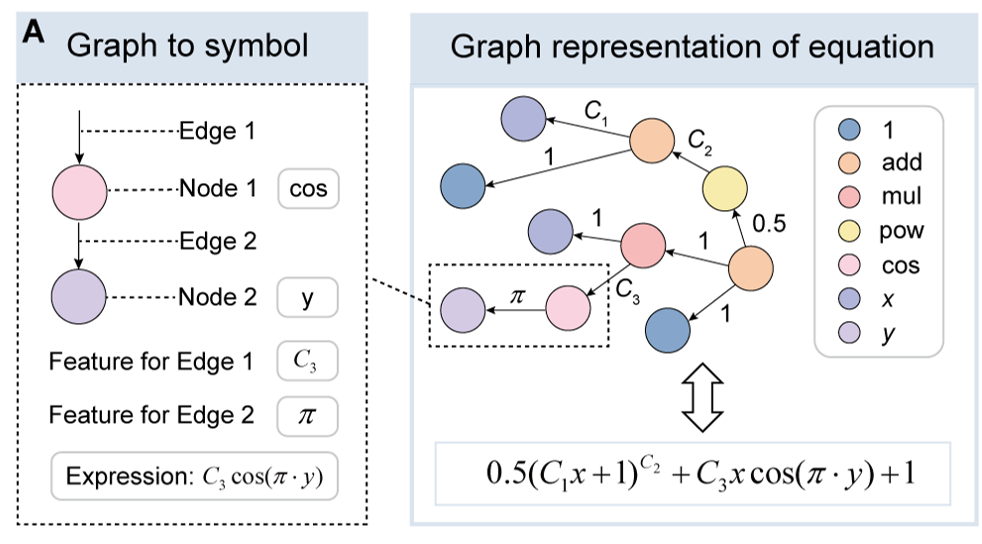
Graph representation of the proposed equations. Image provided by the research team.
Alloy Steel, Lithium Metal, Filled Rubbers… Scientific Discoveries Across Multiple Scenarios
The research team applied the GraphED framework to real experimental data from multiple complex material systems and achieved discoveries that surpass traditional empirical models in all cases.
The team used alloy steel as a validation case. For experimental data from 44 distinct alloy steel covering eight orders of magnitude of strain rate, GraphED separately discovered a new dynamic increase factor and a strain-hardening equation, and combined them into a rate-dependent constitutive model. The prediction error of this model was reduced by nearly half compared with the classical Johnson-Cook model, and it also showed better adaptability at extremely low and extremely high strain rates.
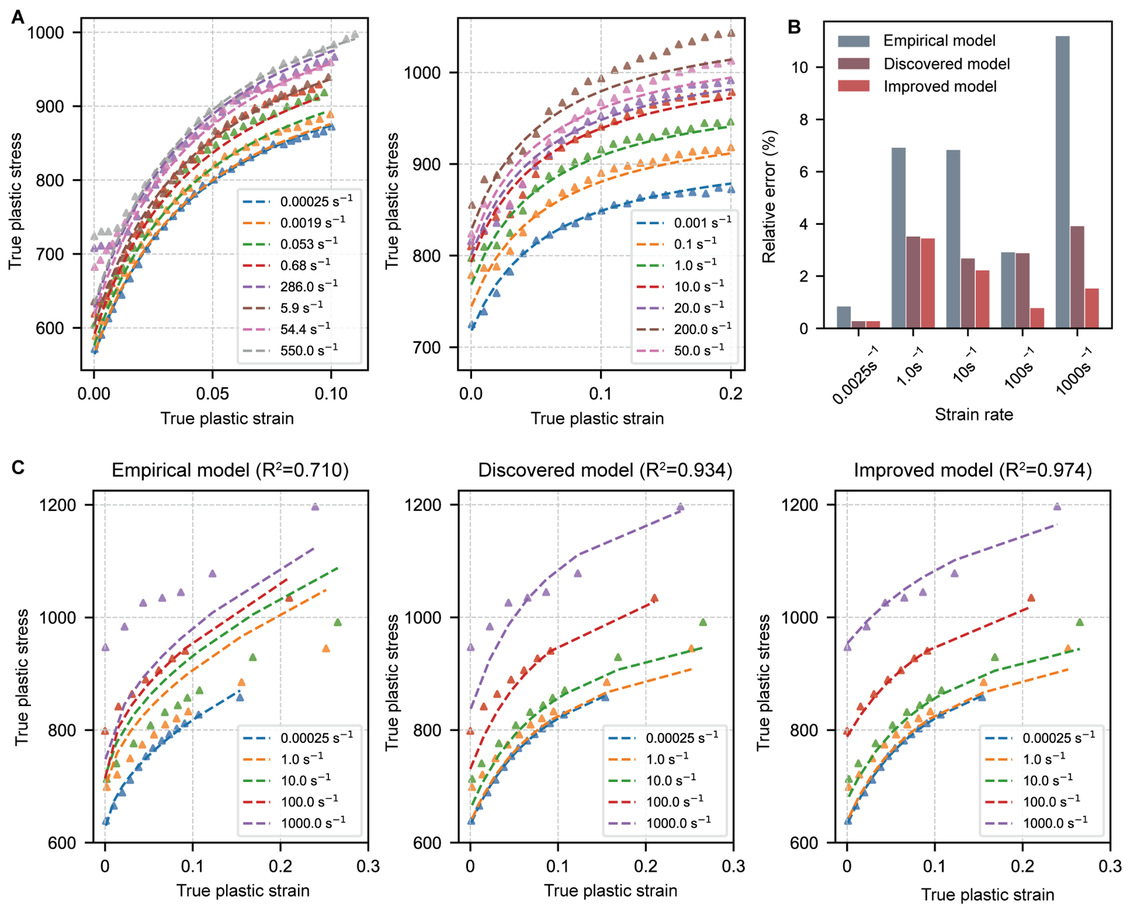
The constitutive model for synthetic steel discovered by GraphED and its comparison with empirical models. Image provided by the research team.
The team further investigated lithium metal, a critical material for energy devices whose mechanical behaviors are more complex. GraphED identified new plastic-flow relations from data at different temperatures and strain rates, indicating that the stress response is modulated by temperature and that stress sensitivity also varies with strain rate. The relative errors of the two types of models were 1.86% and 0.533%, respectively, and the extrapolation trends are consistent with the viscoplastic and creep characteristics of lithium metal.
In experiments on filled rubber, a non-metallic system, they observed that GraphED automatically discovered a compact hyperelastic constitutive equation using only a small number of free parameters. Further analysis showed that the material parameters in the equation exhibit a highly regular quadratic function with temperature, achieving extremely high fitting accuracy on the test set.
"The value of this research goes far beyond computational mechanics and materials modeling. From extracting climate patterns from meteorological observational data to summarizing the laws of celestial motion from astronomical observational data, many fundamental scientific fields face the common challenge of ‘distilling interpretable physical laws from massive datasets,’" said Professo Zhang, corresponding author of the study.
EIT is the first affiliation of the paper, and Hao Xu is the first author. Professor Zhang and Professor Chen are the corresponding authors. This work was supported by the National Natural Science Foundation of China and other projects.