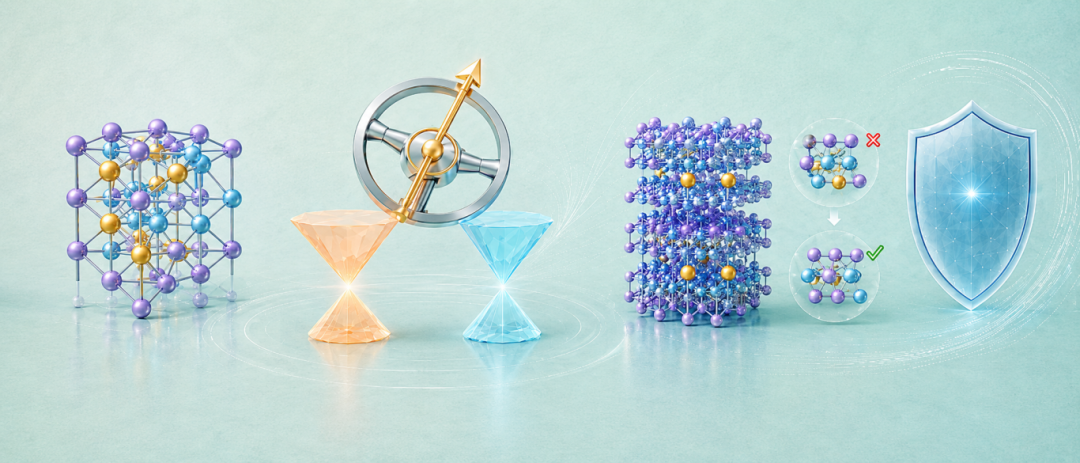
Recently, Chair Professor Run-Wei Li of the Eastern Institute of Technology, Ningbo, Associate Professor Ri He of the Ningbo Institute of Materials Technology and Engineering, Chinese Academy of Sciences, and Professor Hongwei Wang of the School of Physical Science and Technology, Ningbo University, together with collaborators, achieved an important breakthrough in the study of two-dimensional sliding ferroelectrics. For the first time, they installed a "steering wheel" on atomically thin sliding ferroelectrics, enabling precise directional sliding in this new class of two-dimensional ferroelectric materials.
The related results were published in Physical Review Letters, a top-tier international journal in physics.
The "Triple Challenge" of Information Storage
In the race for information storage and intelligent devices, "smaller, faster, and more energy-efficient" are three critical challenges. Devices fabricated from sliding ferroelectrics, owing to their unique switching in interlayer sliding and atomic-scale thickness, exhibit ultralow energy consumption, ultrafast response, and excellent fatigue resistance, making them important candidates for next-generation nonvolatile memory.
Sliding ferroelectrics are a new class of two-dimensional ferroelectric materials in which the upper (lower) atomic layers can slide relative to each other between "aligned" and "misaligned" stacking configurations, thereby achieving out-of-plane polarization switching that naturally corresponds to the two states required for information storage.
However, in an ideal monodomain sliding ferroelectric, multiple symmetry-equivalent sliding pathways exist internally. Taking bilayer boron nitride as an example, its hexagonal lattice possesses C3 rotational symmetry, giving rise to three symmetry-equivalent sliding pathways; along which pathway the atomic layers slide is not determined by the material itself.
This means that under an applied electric field, the atomic layers may slide along any one of the equivalent pathways, or may fail to slide altogether, making the polarization state of the material difficult to control precisely. How to make atomic layers slide along a designated direction in the two-dimensional world remains a challenge in this field.
A One-Way Street for Interlayer Sliding in an AI for Science Digital Laboratory
Using bilayer boron nitride as a model system, the research team employed AI-assisted cross-scale simulation methods to construct a "digital laboratory" on a supercomputer.
First-principles calculations, starting directly from the fundamental equations of quantum mechanics, were used to map out the electronic and microscopic structural properties of the material. Then, AI-assisted deep potential molecular dynamics simulations, akin to setting up an ultrahigh-resolution microscopic camera, tracked the collective motion trajectories of millions of atoms at femtosecond resolution.
On this basis, the team applied uniaxial strain along a single direction to break the C3 rotational symmetry of the material, establishing a directional-locked interlayer sliding governed by an improper mechanism.
The simulation results clearly show that under electric-field driving, the atomic layers can only slide from BA stacking to AB stacking, as if entering a preset one single pathway, achieving directional-locked sliding and polarization switching. A single polarization switching event takes only about 1.7 picoseconds, which is three to four orders of magnitude faster than traditional ferroelectric materials. Furthermore, during the directional interlayer sliding process, coherent lattice oscillations occur, thereby inducing a dynamical magnetic moment and terahertz light emission.
From Theoretical Model to Device Validation
This study establishes a new paradigm that unifies directional interlayer sliding, directional polarization control, and ultrafast response in two-dimensional materials through strain engineering, providing a new pathway for developing ultrafast, low-power, high-precision nonvolatile information devices and sub-nanometer electromechanical devices.
Professor Hongwei Wang is the first author of the paper, and Associated Professor Ri He and Professor Run-Wei Li are the corresponding authors.
This project was supported by the National Natural Science Foundation of China and Zhejiang Provincial Natural Science Foundation of China