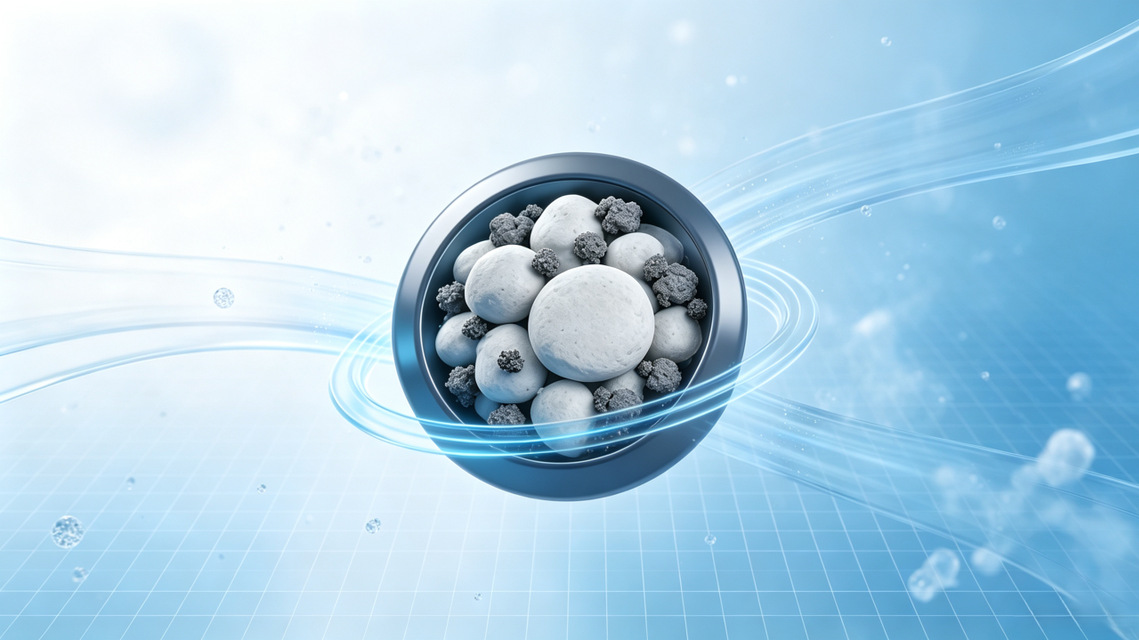
The teams led by Chair Professor Zhongchao Tan, Fellow of the Canadian Academy of Engineering; Chair Professor Zhangxing Chen, Foreign Member of the Chinese Academy of Engineering, and Assistant Professor Heng Zhao at the Eastern Institute of Technology, Ningbo, report a carbon-coated TiO₂-supported Ru subnano cluster catalyst that achieves excellent photothermal dry reforming of methane (PDRM) performance.
In this catalyst, the carbon layer provides a transport channel for the migration of photogenerated charge carriers from TiO₂ to Ru clusters under illumination. Strong metal–carrier interactions generates the coexistence of metallic Ru⁰ and oxidized Ruδ⁺ sites within suitable proximity on homologous heterostructured Ru clusters. During PDRM catalysis, photogenerated electrons migrate from TiO₂ through the carbon layer and accumulate on the Ru clusters; as a result, Ruδ+sites serve as the active sites for CH₄ activation, while electron-enriched Ru⁰ sites activate thermodynamically favorable CO₂ activation. Adjacent Ru⁰-Ruδ⁺ interfaces allow direct coupling of *CHx and *CO2 intermediates, thereby altering the traditional thermal catalytic reaction pathway, suppressing the reverse water–gas shift (RWGS) side reaction, and ultimately improving catalytic activity and stability.
The findings were recently published in the prestigious international journal Journal of the American Chemical Society.
Photothermal dry reforming of methane (PDRM) combines external heating with photocatalysis, simultaneously utilizing photo-excited charge electrons and thermally induced vibrational states to convert CH₄ and CO₂ into syngas under mild conditions. This photothermal coupling method alleviates the substantial energy consumption associated with the high energy input required in conventional thermal catalysis. Although significant progress has been made in the activity and stability of PDRM, it still faces major challenges from side reactions, including catalyst deactivation caused by carbon accumulation covering active sites due to methane cracking and the Boudouard reaction, as well as H₂/CO ratio imbalance induced by the reverse water–gas shift (RWGS) reaction, which severely limits its further efficient and large-scale development.
Catalyst Structure and Interface Design
A Ru/TiO₂ catalyst comprising metallic and oxidized Ru subnano clusters supported on carbon-coated TiO₂ was constructed. AC-HAADF-STEM images revealed that Ru subnano clusters were uniformly dispersed on the anatase TiO₂ substrate. Electron energy loss spectrum (EELS) confirmed that the Ru nanoparticles formed coordination structures with TiO₂. X-ray photoelectron spectroscopy (XPS) combined with X-ray absorption near-edge structure (XANES) confirmed the coexistence of Ru⁰ and Ruδ⁺ species and revealed an interaction between TiO₂ and the Ru clusters, forming a Ru⁰–Ruδ⁺–TiO₂ interfacial structure.
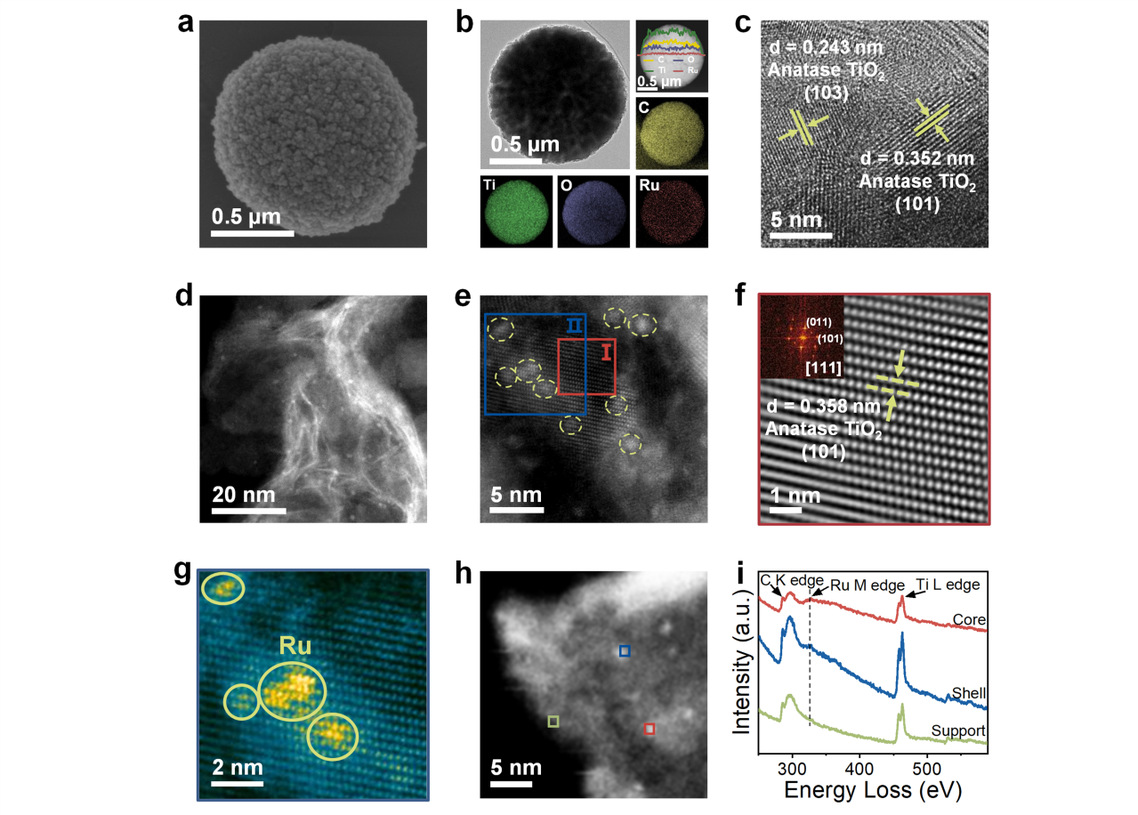
Morphological characterization of the catalyst. Image provided by the research team
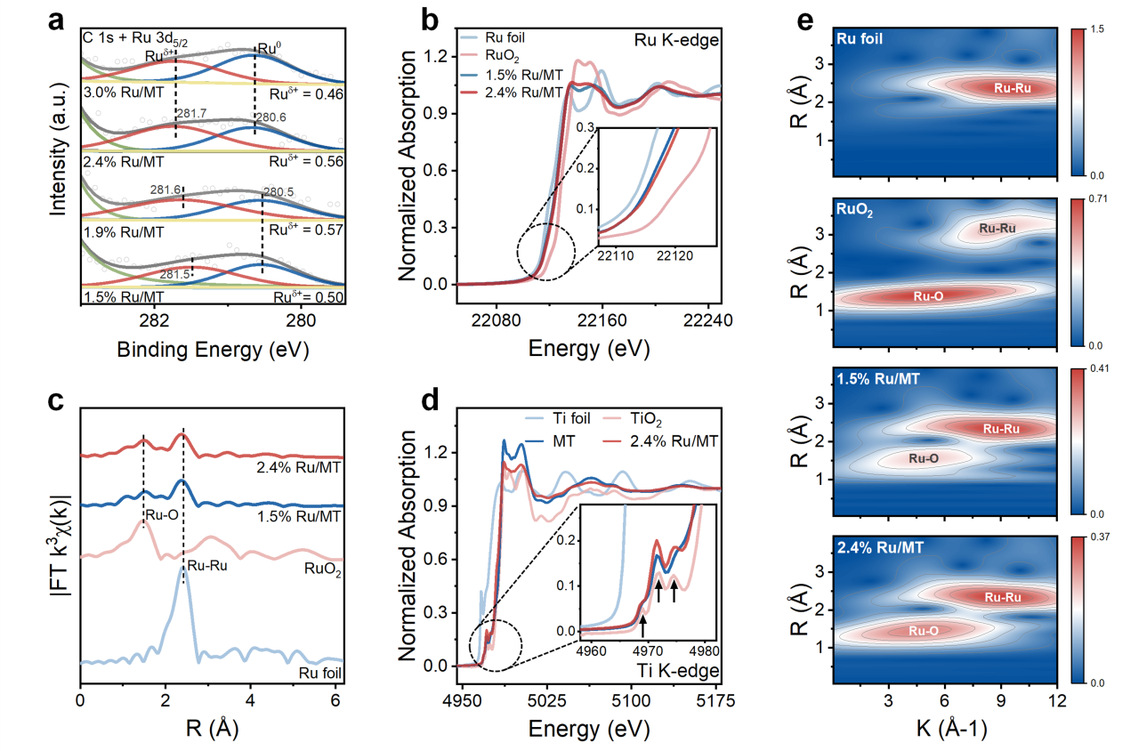
Structural characterization of the catalyst. Image provided by the research team
Excellent Photothermal Dry Reforming Catalytic Performance
Experimental results showed that under photothermal catalytic conditions, the optimal catalyst, 2.4% Ru/MT, achieved excellent catalytic activity. The CO and H₂ production rates reached 416.9 mmol g⁻¹ h⁻¹ and 344.0 mmol g⁻¹ h⁻¹, respectively, which are 2.0 and 1.8 times higher than those under thermal catalysis at the same temperature. The conversion rates of CH₄ (~60%) and CO₂ (~51%) were 1.8 and 2.0 times higher, respectively, than those under purely thermal conditions. The light-to-chemical energy efficiency (LTCEE) of 51.3% was achieved. Moreover, the H₂/CO ratio increased from 0.68 to 0.82 at 54°C, and the catalyst remained stable for 100h without deactivation.
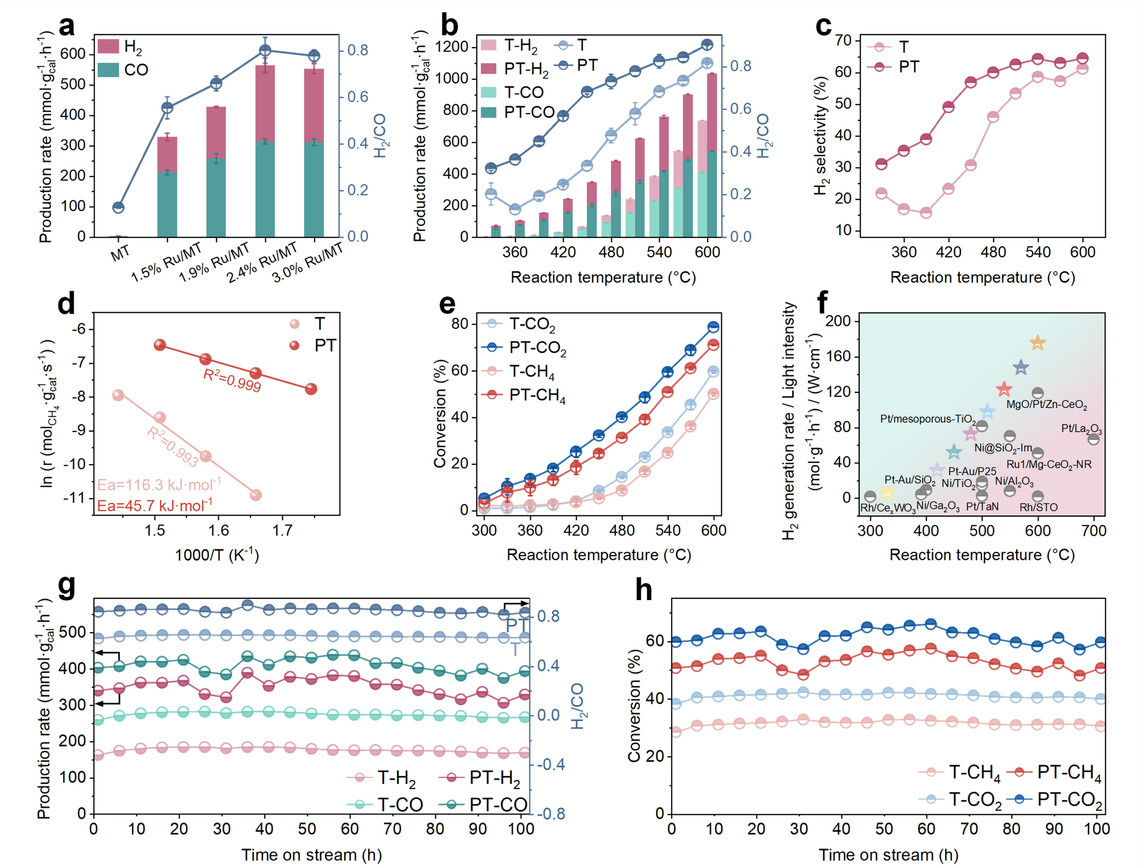
Photothermal DRM catalytic performance of the catalyst. Image provided by the research team
Elucidating the Role of Light in Photothermal Coupled DRM Catalysis
Reaction pathways and intermediates:
In situ infrared (IR) spectroscopy experiments revealed that the presence of light enhances the adsorption and activation of CO₂ and CH₄, thereby demonstrating the promoting effect of light on the DRM reaction. More importantly, the *CHx intermediates from methane dehydrogenation and the *CO2 intermediates from CO₂ activation were found to couple directly, promoting product formation and minimizing the RWGS reaction. Isotope labeling experiments further confirmed that the presence of light promotes CH₄ dissociation, thereby achieving better-matched activation rates of CO₂ and CH₄ and reducing the occurrence of the RWGS side reaction. Analysis of quasi-in situ XPS results under different atmospheres showed that CH₄ and CO₂ undergo oxidation and reduction at Ruδ+ and Ru⁰ sites, respectively, thereby enabling coupling of intermediates at the Ru⁰–Ruδ+ interface to ensure high activity and stability.
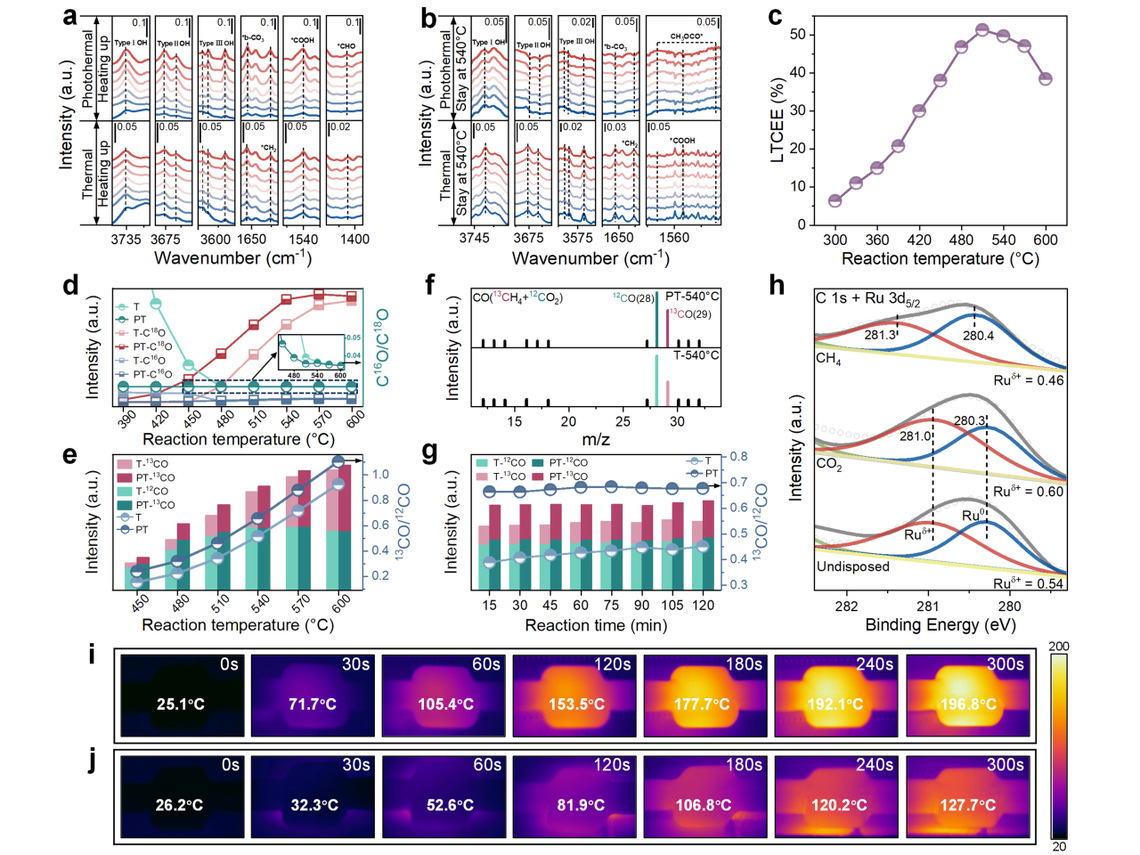
In situ experiments reveal new light-induced reaction pathways. Image provided by the research team
Theoretical calculations and catalytic mechanism:
Quasi-in situ XPS and in situ EPR, combined with other relevant in situ characterizations, confirmed the distinct roles of Ru nanoparticles as electron-accepting sites and the carbon layer as an electron transport channel, thereby promoting the separation and utilization of photogenerated charges. A density functional theory (DFT) surface model of TiO₂-supported Ru subnano clusters with coexisting metallic and oxidized states was constructed, in which electronically excited states were used to simulate the generation of photogenerated electrons under illumination. Based on experimental and DFT results, the reaction mechanism responsible for the light-enhanced DRM performance under photothermal coupling conditions was successfully traced: under illumination, CH₄ dissociation at Ruδ+ active sites is promoted, producing more *H species, and light-induced accumulation of photogenerated electrons at Ruδ+ sites facilitates H₂ production. More importantly, the introduction of light assists the progressive dehydrogenation of *CH2 to *CO2, which then combines with *CO2 at Ru⁰ sites, enabling C–O coupling between *CH2 and *CO2 intermediates at the Ru⁰–Ruδ+ interface and suppressing the COOH pathway, thereby altering the reaction pathway.
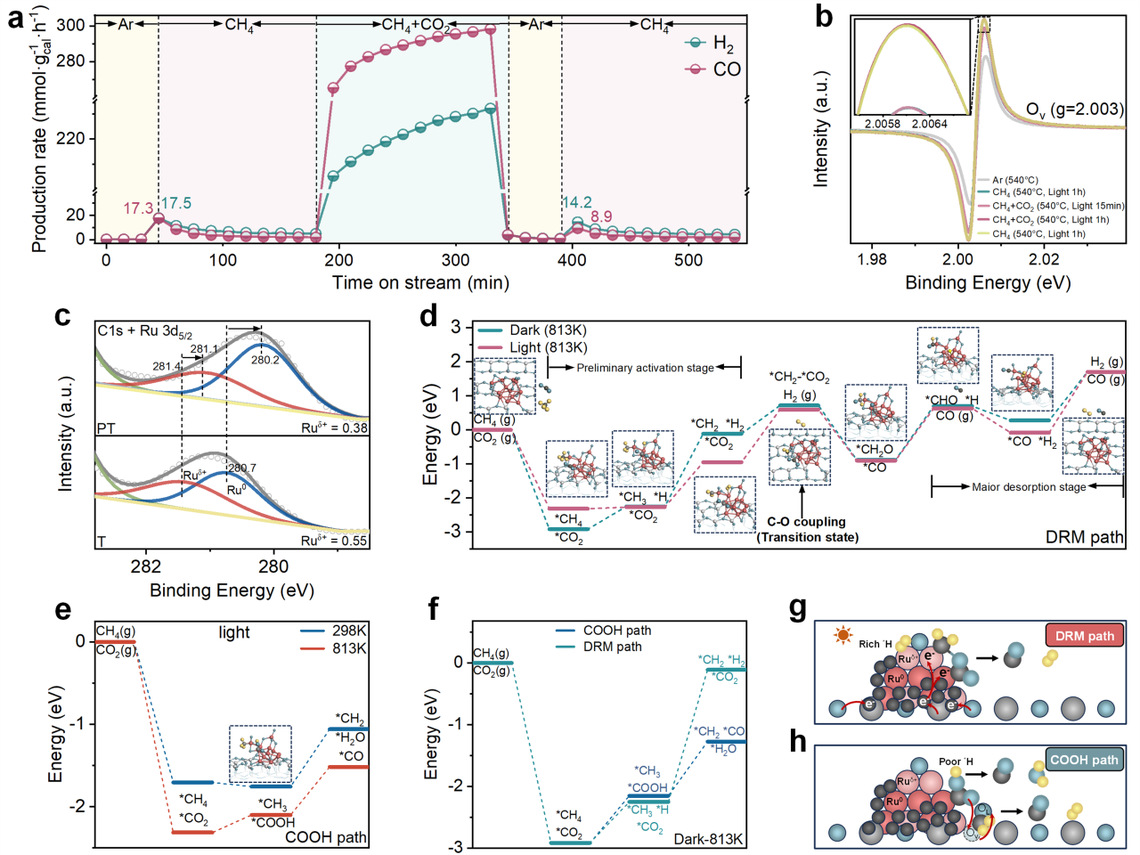
In situ experiments combined with DFT calculations elucidate the catalytic mechanism. Image provided by the research group
This work constructed a Ru subnano cluster catalyst with homologous heterostructures supported on carbon-coated TiO₂. Combined in situ spectroscopy and DFT calculations demonstrated that the introduction of light enables coupling of intermediates at the Ru⁰-Ruδ+ interface, thereby altering the conventional thermal catalytic reaction pathway and suppressing the RWGS side reaction. This work provides insights for the design of subnanometer homologous cluster catalysts with active-site confinement effects for sustainable PDRM processes.
Haiyan Zou, a doctoral student in the 2024 collaborative Ph.D training program between EIT and the University of Science and Technology of China, is the first author of the paper. Professor Zhongchao Tan, Assistant Professor Heng Zhao, and Professor Zhangxing Chen from EIT are the co-corresponding authors. This work was supported by Eastern Institute of Technology, Young Innovative Talent of the Yongjiang Talent Project.