On August 22, at the National Speed Skating Oval in Beijing, the 100-meter preliminaries of the World Humanoid Robot Games 2026 were underway.
When the timer froze at 9.34 seconds, a roar erupted from the stands. On the track, a humanoid robot had just completed a 100-meter sprint—a time that surpassed the 9.58-second human world record held by Usain Bolt.
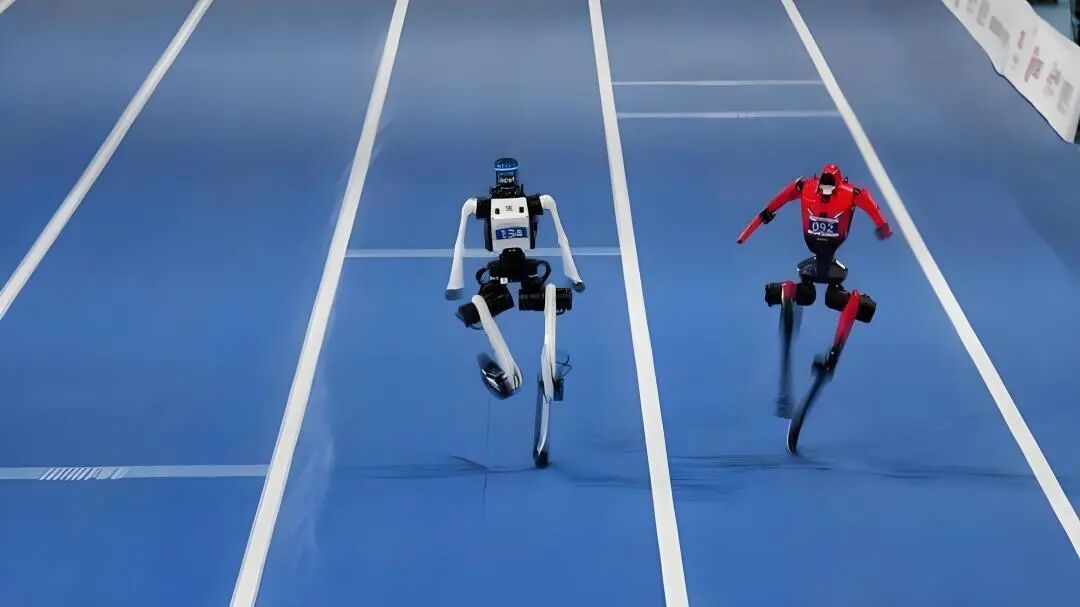
The 100-meter preliminaries on site.
Beside the track stood a 26-year-old young man. His task was to press the start button the moment the referee gave the command. After that, everything was up to the robot—but he had to remain on high alert. If the robot showed any sign of veering off course or losing balance, he had to take over within a fraction of a second.
His name is Rongpeng Cui, a doctoral student in the 2024 cohort of the collaborative Ph.D. training programme between Shanghai Jiao Tong University and the Eastern Institute of Technology, Ningbo (EIT). At the games, where humanoid robots took center stage, he served as captain of the Tiangong-Jingfong Technology Joint Team and as one of two on-field operators.
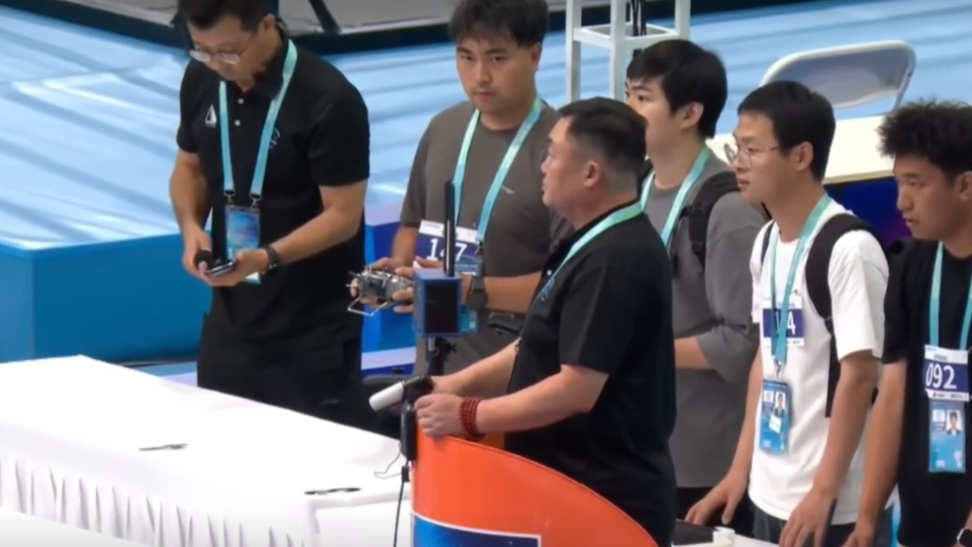
Rongpeng Cui (second from the right)
"That 9.34-second run was by no means the work of the operator alone," Cui says. Behind that single press of the button lay months of code debugging, simulation training, and hard engineering by a team of more than a hundred people.
A year ago, the public still regarded humanoid robots as slow and clumsy. Just one year later, a robot had truly broken through the physical limits of the human body on the track.
Behind this breakneck race to "outrun humanity" stands a doctoral student from EIT
A Ferryman Between the Virtual and the Real
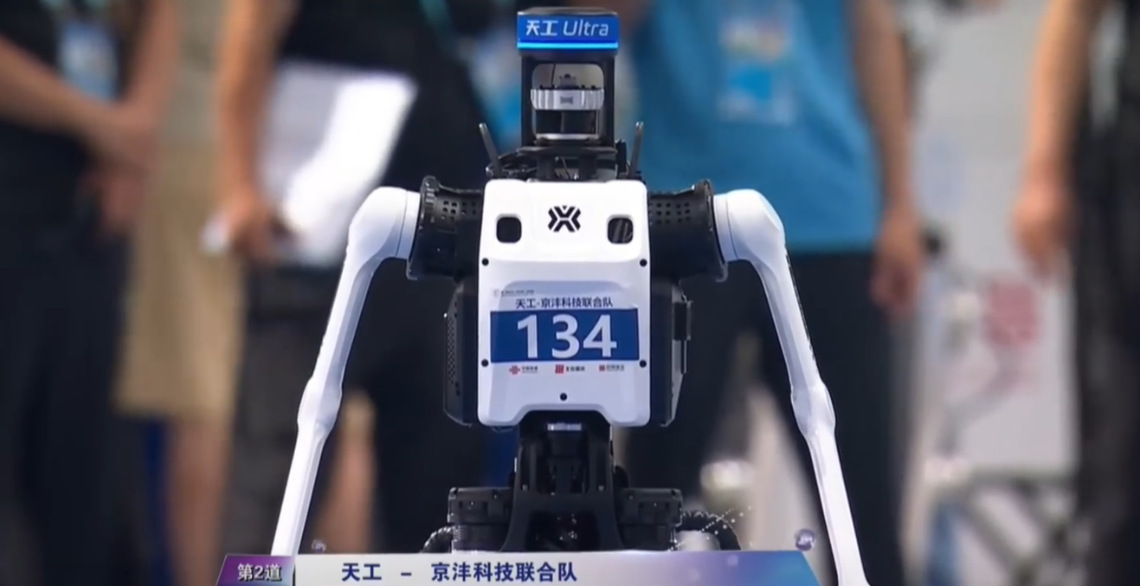
The joint team's competing robot.
For a humanoid robot to run in the physical world, it takes both a powerful hardware "body" and a smart AI "cerebellum" working in tandem. The Tiangong team engineered the high-performance hardware, while Cui's team at Jingfong Technology was tasked with refining that cerebellum.
His day-to-day research focus sounds like a mouthful:"high-fidelity robot dynamics algorithm development" and "locomotion control training."
Put simply, he builds a highly realistic virtual training ground for robots. Before a robot ever steps onto a real track, it must fall, get up, and sprint thousands upon thousands of times inside this virtual world. Locomotion control training, meanwhile, uses AI to teach the robot how to coordinate every joint, apply force with precision, and maintain dynamic balance, honing the optimal sprinting gait.
The hard part is that the virtual world has to be realistic enough.
In the real world, wind resistance, ground friction, and even the slightest deformation of a robot's carbon-fiber lower leg during a stride can all affect balance.
Currently, robot training in China relies heavily on commercial simulation software from abroad. If access were ever cut off, the entire R&D pipeline could come to a standstill. Cui's team at Jingfong Technology is working to break through at the foundational level, building a fully self-developed, domestically controlled simulation engine.
"Mainstream foreign solutions often hit bottlenecks when it comes to rigid-flexible coupled simulation," Cui explains. After repeated testing and refinement, the team cracked this module, successfully training a robot with carbon-fiber lower legs in a high-fidelity virtual environment and deploying the results seamlessly onto the physical machine.The moment the code ran successfully on the real robot came long before the cheers at the track.
What Cui does, in essence, is serve as a ferryman between the virtual and the real. Only when the simulated world is credible enough can a robot dare to challenge the limits of physics on a real track.
A Steep Climb for a Cross-Disciplinary Newcomer
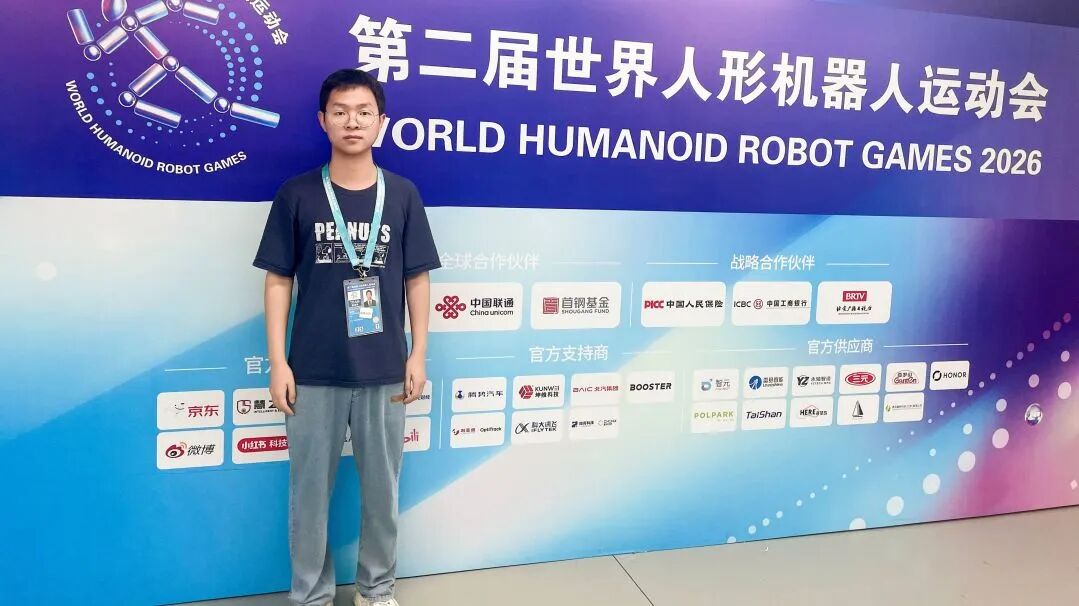
Rongpeng Cui at the games
Cui earned his bachelor's degree in naval architecture and marine engineering.
Moving from the study of massive ocean-going vessels to the fine-tuning of humanoid robot gaits is, without question, a huge leap.
"The main reason is that robotics and AI sit at the very frontier of technological development, and I have a genuine passion for them," he admits.
Switching fields is never easy. New bodies of knowledge, a cross-disciplinary path—the climb was bound to be steep. The turning point came when he joined EIT.
He says he was initially drawn by the faculty and ultimately stayed for the environment.
After learning about EIT's Collaborative Ph.D Training Programme, the high degree of academic freedom, the innovative atmosphere, and the platform's potential led him to apply without hesitation—transitioning from a master's program to a Ph.D. and officially becoming part of EIT.
Cui's doctoral advisor at EIT is Professor Shiyi Chen, President of EIT and Member of the Chinese Academy of Sciences.
During the growing pains of the transition, the university and his advisor stepped in to help. When he hit a wall, his advisor connected him with senior experts in the field; when he needed to validate his theories, the university opened doors for him to work on the front lines of industry. That openness and freedom from constraints gave Cui the confidence to test, fail, and try again.

Rongpeng Cui working on the industry front line
"What attracts me most about EIT is the extraordinary degree of research freedom it offers," Cui says. "Here, whether you want to immerse yourself in the lab for cutting-edge academic work or take your research into the front lines of industry, the university and your advisor will back you with full-spectrum resources."
As a new type of research university, EIT's doctoral training is defined—by Cui's repeated account—by two words: freedom and industry-academia integration. Together, they have helped carry a cross-disciplinary Ph.D. student from naval architecture to the frontier of humanoid robotics.
Cui's story is a vivid snapshot of EIT's industry-academia-research integration model: one that encourages free exploration, supports interdisciplinary convergence, and ultimately plants the seeds of scholarship in the most fertile soil of industry—turning research into real momentum for the field.
From Flat Tracks to the Open Ocean
The 9.34-second mark on the 100-meter track is a milestone—but only a beginning.
"The track is not the destination. Going forward, the core focus must shift to real-world deployment in industry settings," Cui says. As the games wound down, his sights were already set further ahead.
Fittingly, his next research focus circles back to where he started—ships.
He wants to solve the problem of robot locomotion control in "non-inertial systems." In simple terms, he wants robots to do more than run on flat ground—he wants them to operate steadily in demanding environments like ships pitching and rolling at sea. Achieving that will require deeper, high-fidelity multi-physics coupling so robots can bridge the virtual-real divide, applying the skills learned in simulation seamlessly to complex real-world conditions and truly achieving general-purpose deployment.
From building ships, to building a robot's cerebellum, to putting robots on ships—Cui's research trajectory has drawn a circle brimming with imagination.
His expectations for the future are refreshingly grounded: "I hope the underlying technologies I develop can truly become a driving force for the robotics industry—helping robots cross the deployment gap and deliver real value across industries."
The roar of the arena has faded. Cui is back at his desk. On the screen, lines of code flicker as a virtual robot begins another run in the simulated world. This time, it is running toward the broader real world.