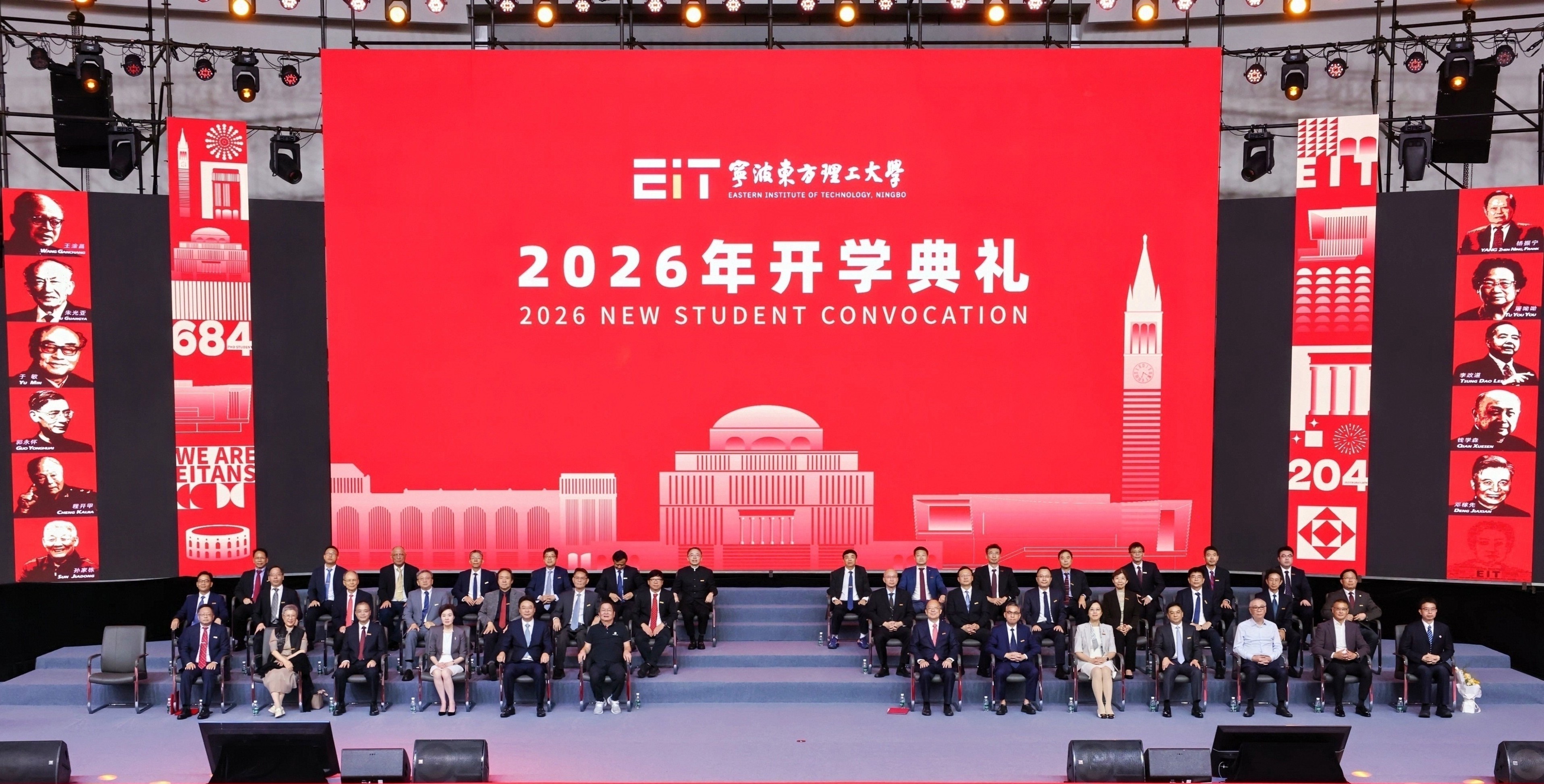
As the tidal of the Yong River rolled in against the last wave of August heat, and as the lights along the waterfront were kindled one by one into a galaxy—on the evening of August 30, the Eastern Institute of Technology, Ningbo (EIT), struck nine deep, resonant chimes to open a reunion with its "family."
Yong Yang, Member of the Standing Committee of the Ningbo Municipal Party Committee and Secretary of the Yinzhou District Party Committee; Jiong Huang, Vice Mayor of Ningbo; Renrong Yu, Chairman of the Board of Trustees of EIT; representatives of donors, partner universities, and high schools from within and beyond Zhejiang Province; 130 undergraduate freshmen; more than 200 doctoral students; and all university leaders, faculty, staff, and students gathered together.
With a thousand people assembled, what they witnessed was not merely the opening of a ceremony, but a generation's declaration to the age of AI.
In the AI Era, Be a Pioneer in Leading Educational Transformation
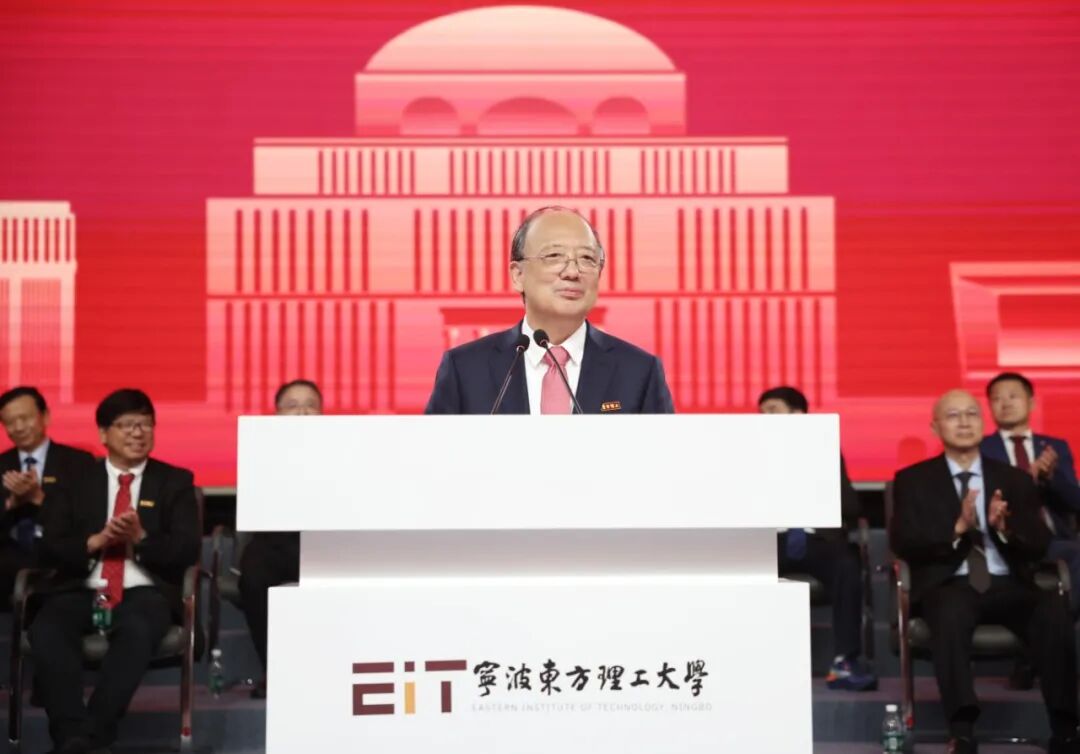
Speech by President Shiyi Chen
"Welcome to the most important family gathering of the year!" Professor Shiyi Chen, President of EIT and Member of the Chinese Academy of Sciences, set a warm tone from the very beginning.
When AI can instantly access vast amounts of knowledge, and technology has torn down the barriers to knowledge, what becomes the core value of a university?
DeepSeek changed the global AI competitive landscape overnight."A new type of university born for this era is fully capable of standing at the forefront of global higher education. EIT must become an influential university and a leader in innovation and change," President Shiyi Chen declared with conviction.
"In the age of AI, anything is possible!"
"I am confident that among you there will be those who change the world and define the era," Pesident Shiyi Chen said.
The 2026 New Student Convocation was hosted by Professor Dongxiao Zhang, Executive Vice President and Provost of EIT and Member of the U.S. National Academy of Engineering.
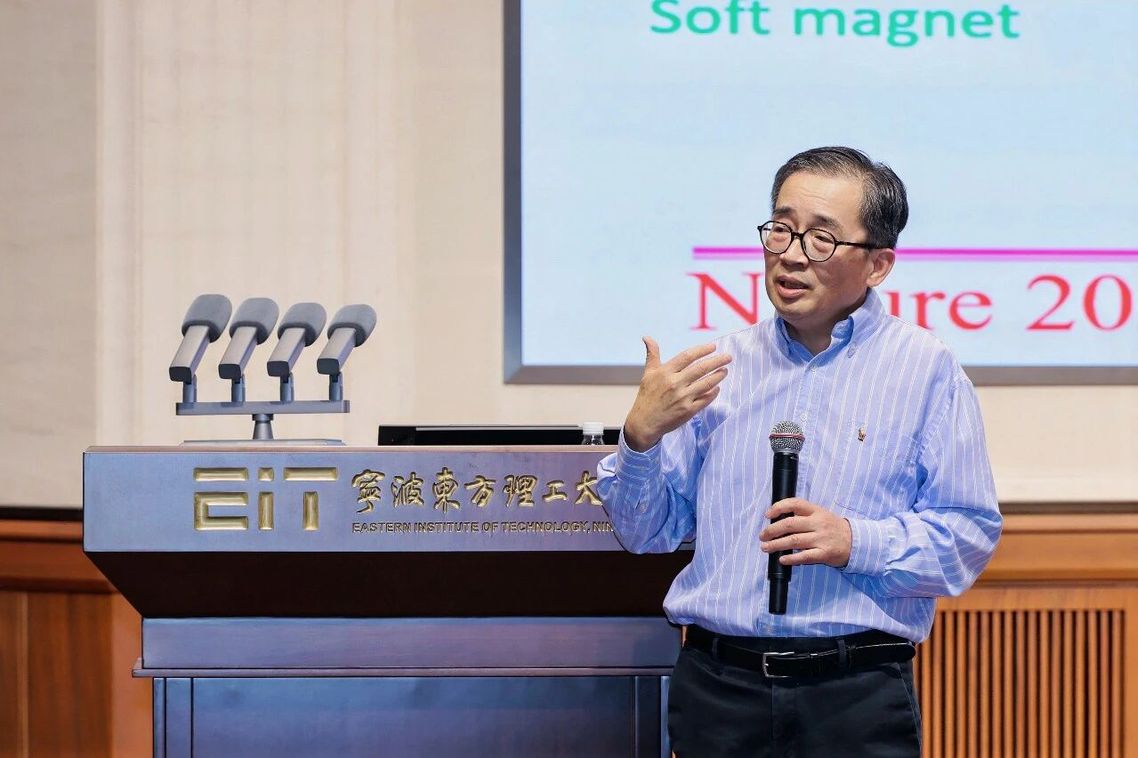
Address by Professor Chen Zhu, Faculty Representative
In a laboratory on the fourth floor of the Chemistry and Materials Science Building by the Yong River, a robot in the lab of Chen Zhu, Associate Professor of College of Science, was still running experiments. It does not rest, and it does not mind staying up late. With every round, it becomes a little smarter. What this robot is doing is precisely his research—using artificial intelligence to drive chemistry, or what is commonly known as AI for Science.
"In our field, we have a term called the ‘Dry-Wet Loop.’ The ‘Dry’ side—models, code, and data in the computer—iterates extremely fast; the ‘Wet’ side—the bottles and jars in the laboratory—is slow and often fails," Associate Professor Chen Zhu told the freshmen. "During your four years of university, build such a loop for yourselves as well."
In his "AI for Chemistry" course, students are using AI to take the initiative in exploring the unknown. Meanwhile, the "EI Kick" robotics team, made up of 10 first-year undergraduates, used AI to search the literature and write code, and found its way from EIT’s laboratories all the way to the Capital International Exhibition & Convention Center, where, as the only first-year undergraduate team, it reached the final six of the RoboCup China Open 2026.
Rongpeng Cui, a doctoral student collaboratively trained by Shanghai Jiao Tong University and EIT, studied naval architecture and marine engineering as an undergraduate. For his doctoral studies, he chose interdisciplinary research on robot dynamics algorithms and motion control training. A few days earlier, at the World Humanoid Robot Games 2026, he operated the Tiangong-Jingfong robot to run 9.34 seconds in the 100 meters, surpassing the human world record held by Usain Bolt and pushing the running speed of bipedal robots to a new limit.
"Algorithms can simulate millions of possible approaches, but whether you dare to take on the hardest one still depends on genuine curiosity and the courage to venture and act," said President Shiyi Chen.
"A hundred years ago, Mr. Shi Hu said: Make bold hypotheses and seek careful verification. In the age of AI, I would like to add: If you fail, turn it into data," Associate Professor Chen Zhu said firmly.
Co-op University-Industry Collaboration Gives Students Exposure to Real Industrial Settings
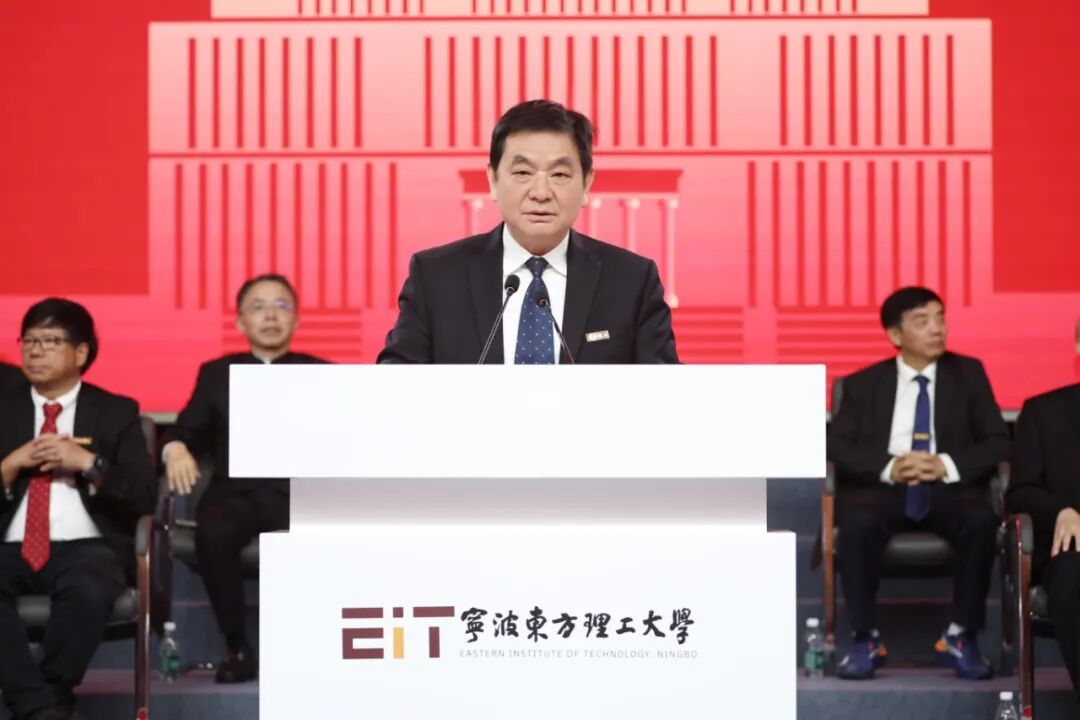
Speech by Dr. Nanxiang Chen, Trustee
"You are the founding class of EIT—the first generation of alumni. You will grow alongside the university, and your names will be written into its history forever," said Dr. Nanxiang Chen, a trustee of the university and chairman of Yangtze Memory Technologies Co., Ltd. He opened by saying how much he admired the new students. As one of the first university students after the gaokao was resumed in 1977, he understands the weight of the words "founding class."
Today, China and the most technologically advanced Western countries stand at the same starting line of the intelligent revolution. Dr. Nanxiang Chen described a new ecosystem of university-industry collaborative education: Yangtze Memory and EIT have established the "YMTC Class," as well as the YMTC Scholarship, Excellence Scholarship, and Innovation Fund. He expressed his earnest hope that twenty years from now, EIT graduates will be among the highest-caliber talent at Yangtze Memory.
This deep integration of industry and education is embedded into the university's day-to-day approach to cultivating students. The Co-op program offered during the summer term places undergraduates in companies for real, hands-on training. In June this year, the first cohort of undergraduates joined 33 companies, including Geely Auto and Goneo Group, honing their skills in industry environments driven by intelligent manufacturing and AI.
At the same time, the university's own innovation ecosystem is flourishing. To date, faculty members have founded 21 companies, and papers published in collaboration with industry account for 9.1 percent of the total.
Earlier this year, Renrong Yu, EIT's lead donor and Chairman of OmniVision Group, said at a discussion with university leaders and faculty representatives:"This is an era of rapid development. We must choose the most cutting-edge tracks, bring in the very best talent, and strive to build disciplines that are first in the world or unique in the world."
Mr. Jianfeng Wang of Joyson Electronics donated to name the "Joyson Building"; Mr. Ruiwu Chen ofZhejiang Hengrun Tongda Supply Chain Management Co., Ltd. donated to name the "Chen Ruiwu Building." With Renrong Yu leading the donations, entrepreneurs responded enthusiastically, and broad segments of society gave active support—a relay of donations to help build a world-class new type of research university.
"The more AI can do, the more precious the unique value of human beings becomes."
"AI can calculate the cost of constructing a building, but it cannot see the patriotism and sense of duty of an entrepreneur," President Shiyi Chen said.
"Rather Than Choosing a Road, Choose an Open Field"
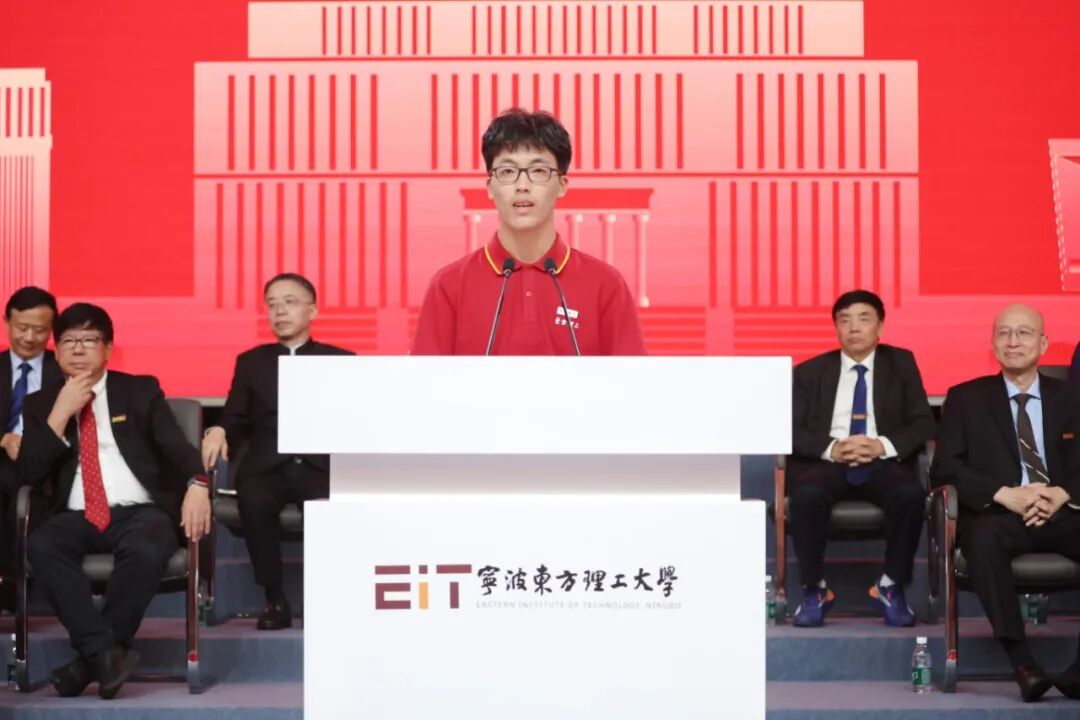
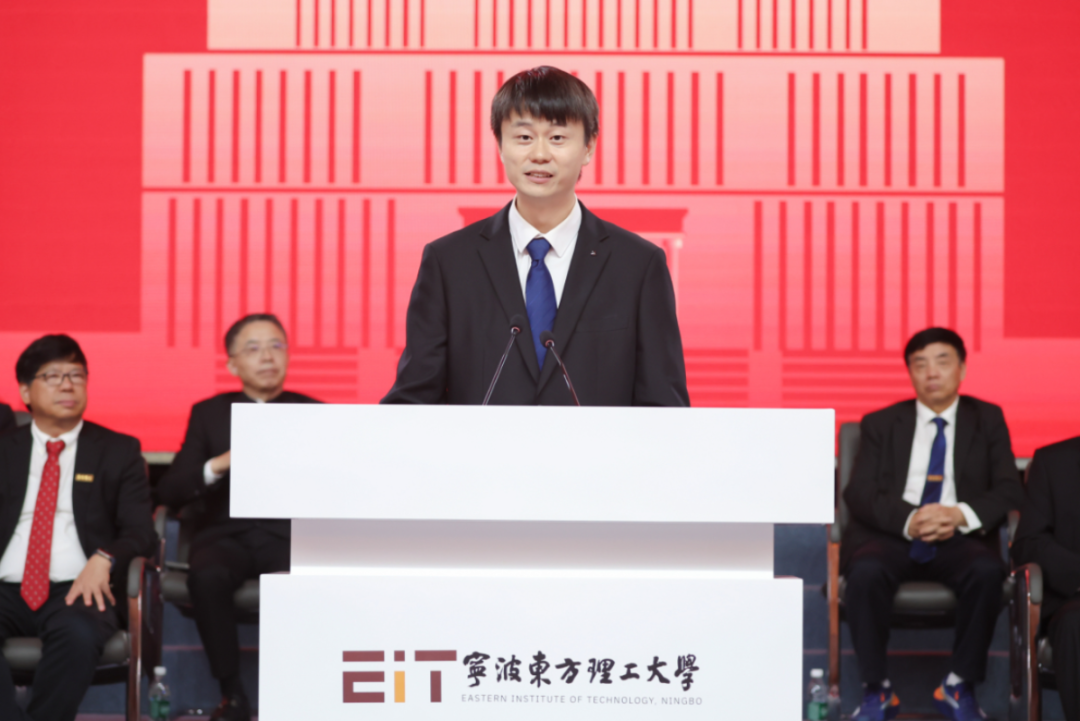
Address by Chenlin Shen, Undergraduate Freshman Representative
At a college application consultation after the gaokao results were released, Chenlin Shen, then a high school student at Zhenhai High School, was holding a stack of brochures from various universities when his classmates suddenly began gathering near the entrance. Curious, he squeezed into the crowd and saw President Shiyi Chen of EIT talking with Guoping Wu, Principal of Zhenhai High School. Before he could react, his homeroom teacher gave him a gentle push from behind—and just like that, he shook hands with the academician and added President Shiyi Chen on WeChat.
That afternoon, he went to the EIT campus for the first time. Later, he deliberately made EIT his only college application choice. With a score of 688, he chose to "walk his own path and do something interesting." This year, EIT's minimum admission score was 662.
This year, the university was approved for college comprehensive evaluation admission. It now has two admissions models: regular application through the gaokao and college comprehensive evaluation admission.
The university has recruited 120 full-time teaching and research faculty members as independent principal investigators, including 16 academicians and 75 national-level talents. Ninety-four percent of the PIs have overseas academic experience. All students enter the university as computer science and technology majors in their first year and may declare any major in their second year. The university uses a three-mentor system to provide personalized guidance.
Speaking at the opening ceremony as the representative of freshmen, Chenlin Shen said:"At eighteen, I honestly do not have a fixed academic direction. If that is the case, why not change the perspective? Rather than choosing a single dedicated path, it is better to choose an open field where I am free to experiment and make mistakes."
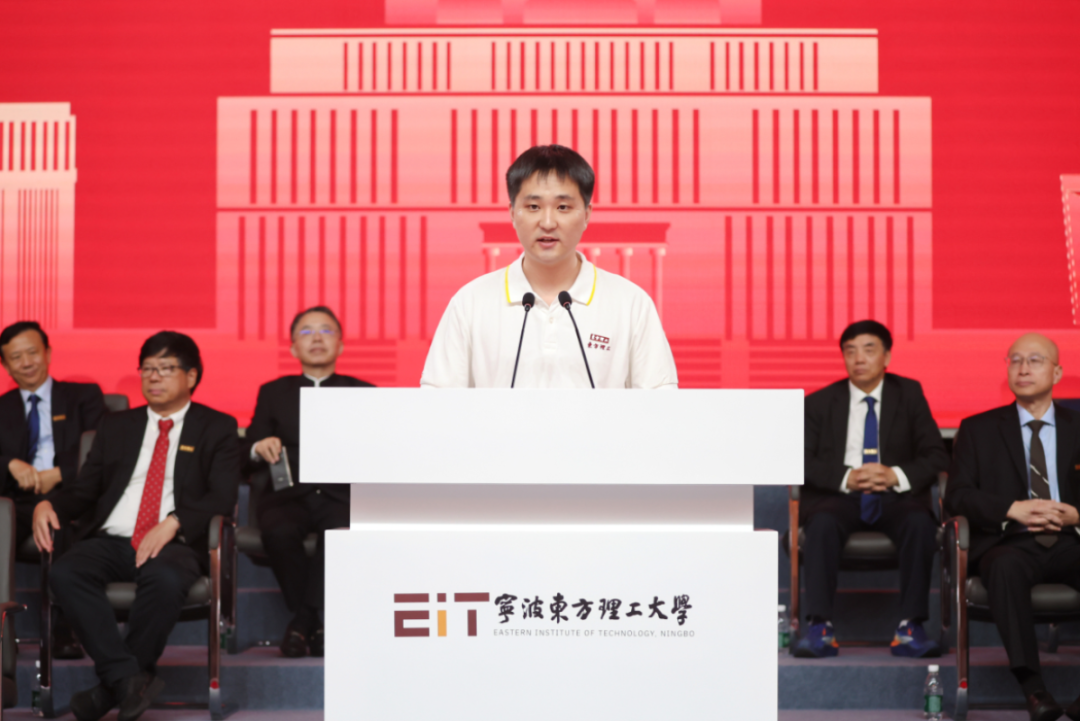
Address by Yifan Shi, Doctoral Student Representative
Exploring unknown territory requires extraordinary courage
Yifan Shi, a doctoral student collaboratively trained by Shanghai Jiao Tong University and EIT, shared a research framework proposed by Yuntian Chen, an assistant professor in EIT's College of Engineering: "yesterday's research"—making incremental contributions to mature fields; "today's research"—working with the mainstream in popular areas; and the most valuable of all, "tomorrow's research"—breaking new ground in uncharted territory.
Yifan Shi once emailed Assistant Professor Yuntian Chen and received a long voice call in response. "Shanghai Jiao Tong University taught me to buckle down and work through rigorous derivations, while EIT taught me the courage to tackle problems that no one has clearly defined yet. Together, these two qualities capture what I believe doctoral training should be—the perseverance to embrace long, painstaking work and the courage to blaze a trail into uncharted territory," Yifan Shi said at the ceremony.
With support from the Ministry of Education, EIT began admitting doctoral students under collaborative training programmes in 2022. To date, 17 students have graduated. They have secured positions at institutions such as the Shanghai Artificial Intelligence Laboratory, the Institute of Automation of the Chinese Academy of Sciences, and Tencent, and have gone on to pursue postdoctoral research at institutions including Rice University in the United States, the University of Hong Kong, the Hong Kong University of Science and Technology, The Hong Kong Polytechnic University, and the Academy of Mathematics and Systems Science of the Chinese Academy of Sciences.
Realizing Dreams, Changing the World
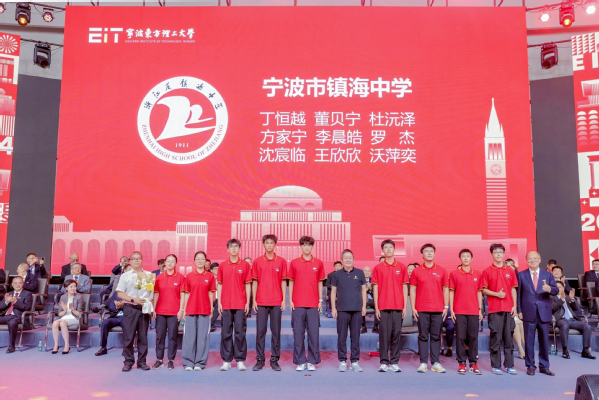
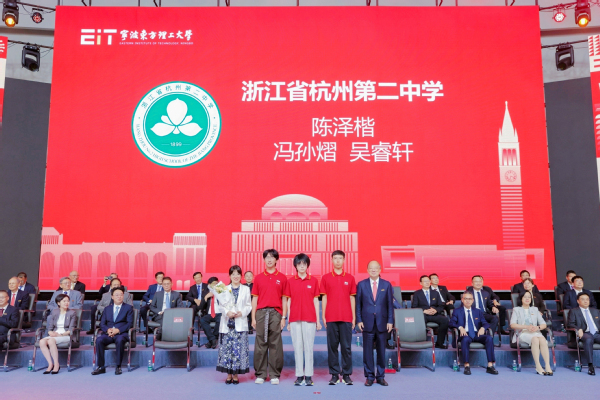
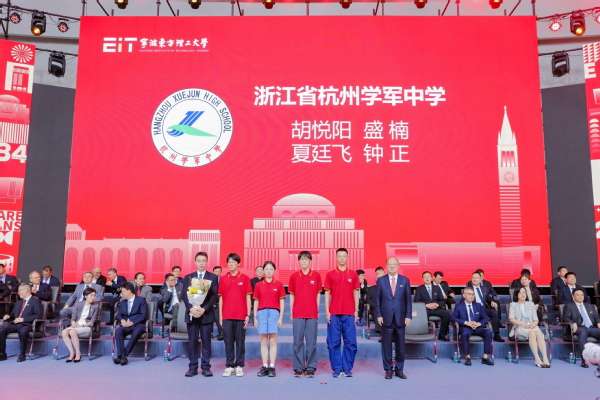
New Student Induction Ceremony
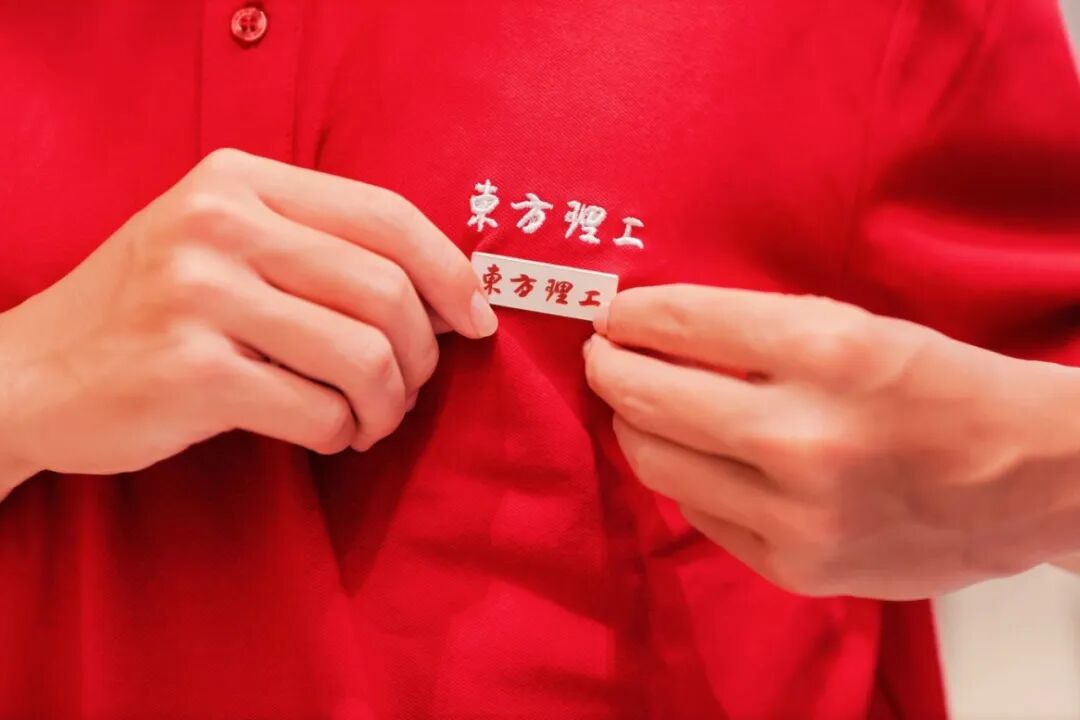
At the convocation, a special group of guests drew particular attention—principals and teachers from the high schools that the 130 undergraduates graduated from, who had traveled from 58 high schools to witness this milestone. During the induction ceremony, the new students presented bouquets to the teachers who had guided and supported them through high school, and expressed their gratitude by shaking hands with President Shiyi Chen.
Facing the question of talent development in the AI era, the mutual support and trust between high schools and universities inspired everyone present.
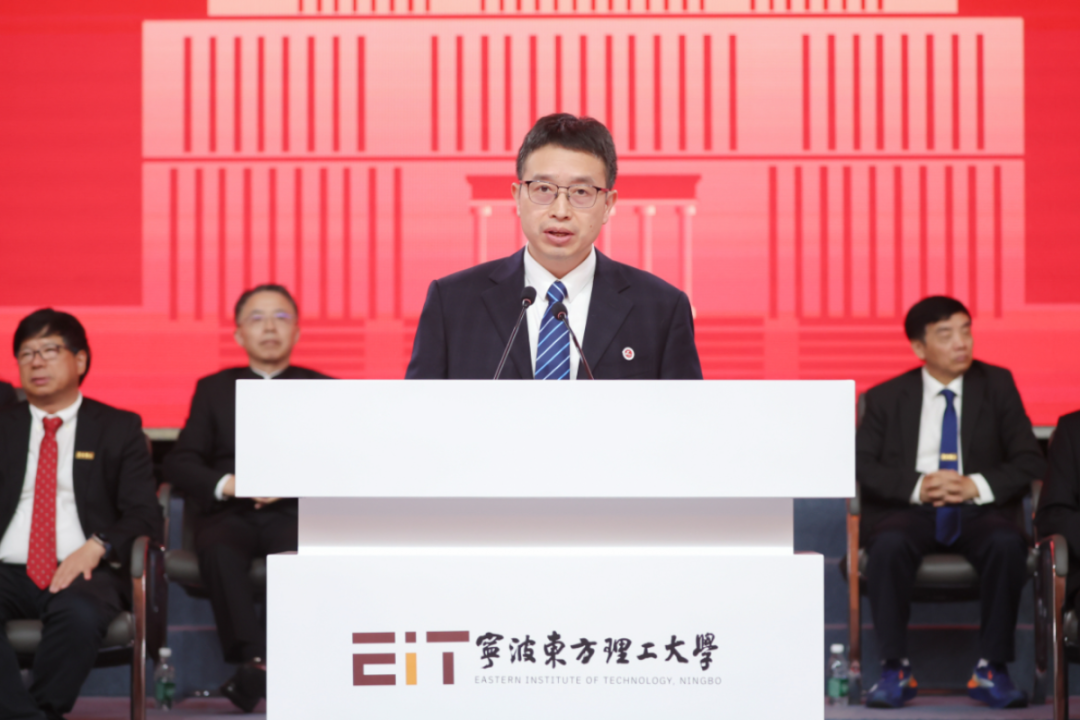
Speech by Mr. Rungen Fang, Principal of Xuejun High School
"May your hard work light the way ahead. May you ask truly good questions, dare to ask why, and dare to walk a path no one has walked before."
"May you be trailblazers. The trail you blaze becomes the road; what takes root there will become part of the university's history."
"May you move with the rhythm of the times in your youth. Anchor your passions and hard work in the larger arc of the era, and let being needed give your youth both steadiness and far-reaching purpose."
In his speech, Mr. Rungen Fang, Principal of Xuejun High School, offered the new students three hopes. "Dedicate the best of your time to a country that is growing stronger by the day," he urged.
President Shiyi Chen also offered the students three hopes: First, build a solid foundation and learn to learn together. Second, keep your curiosity alive and push beyond your limits. Third, aim high and keep the world in mind.
"Curiosity, imagination, and values can never be replaced by AI. I hope you will identify problems, create what is good, and steer AI toward the good—serving national development and advancing social progress," Chen Shiyi said.
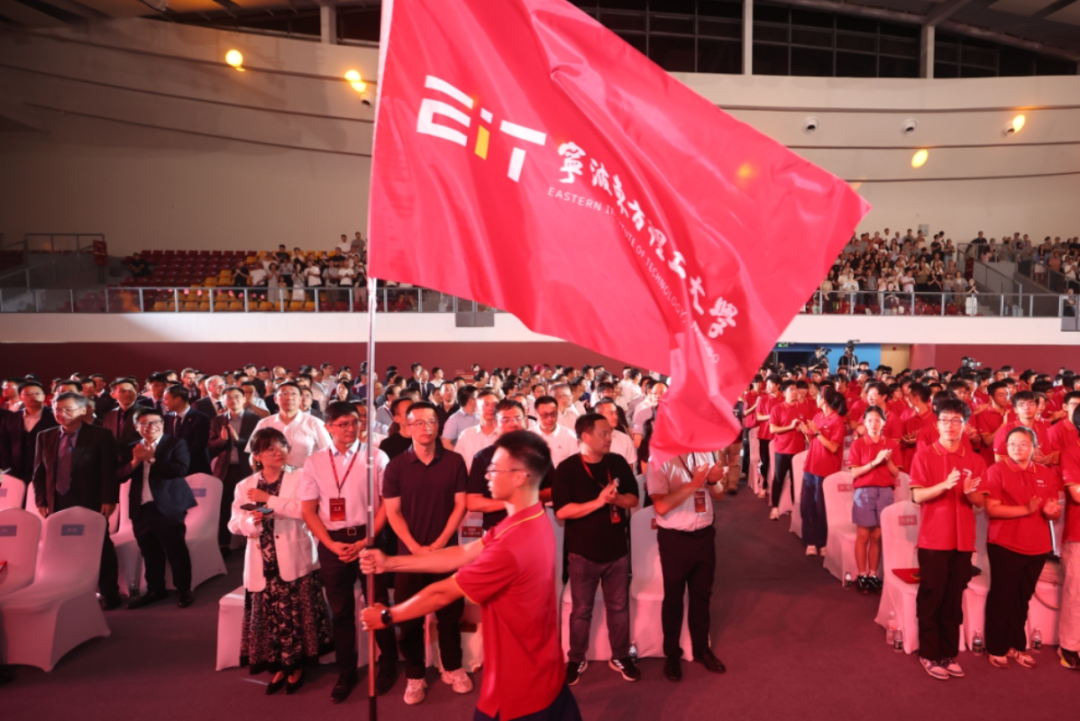
Scene from the Convocation
From a youthful beginning along the Yong River to the courage to blaze trails in uncharted territory—EIT was born for this era, and its students have come for the future.
We push the boundaries of the AI era.
We hold fast to the spirit of devotion to country.
We carry on the courage to blaze trails in the unknown.
A young university, young students, and a young faculty and staff—at this moment, we stand at the same starting line, charging at full speed toward endless possibilities.