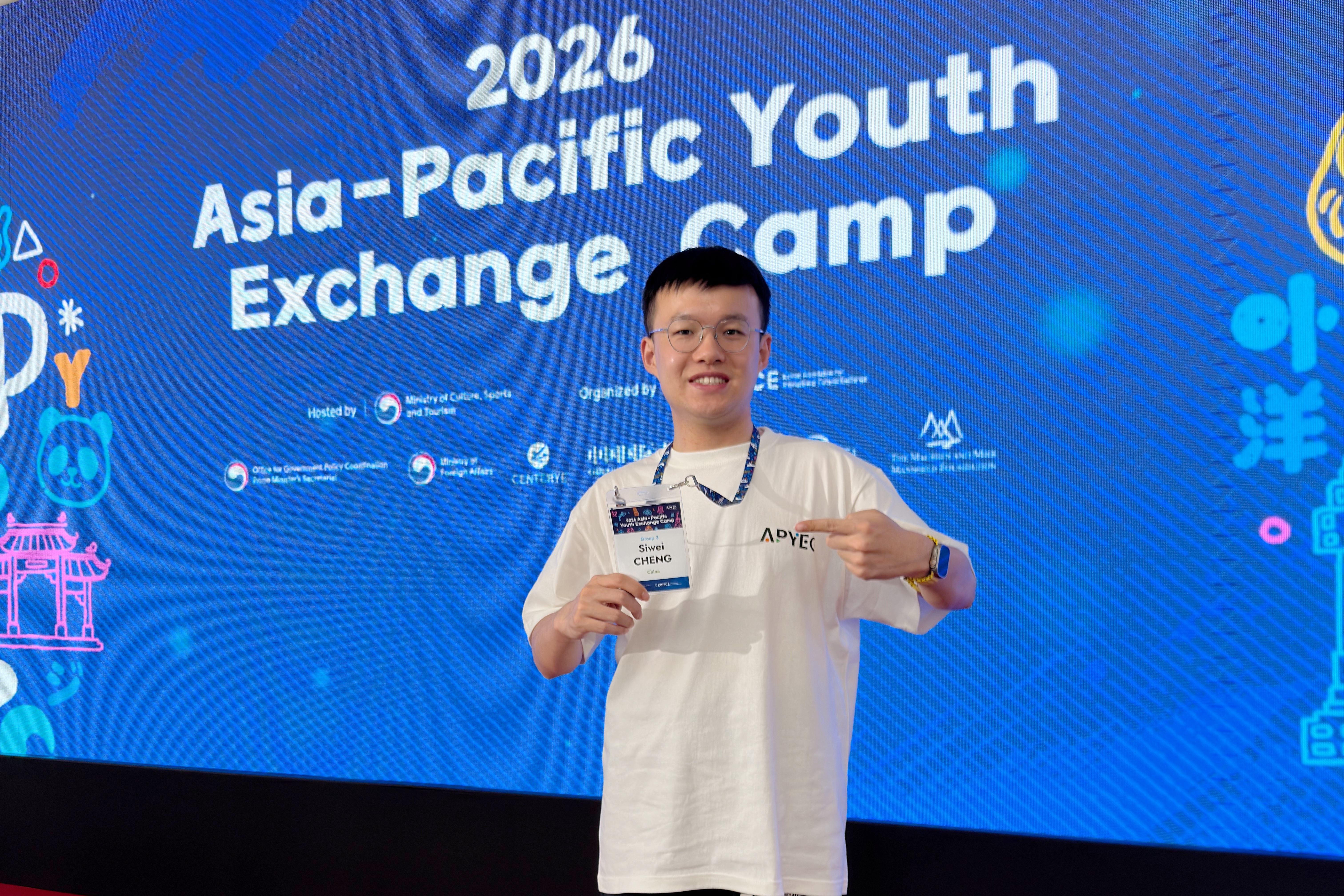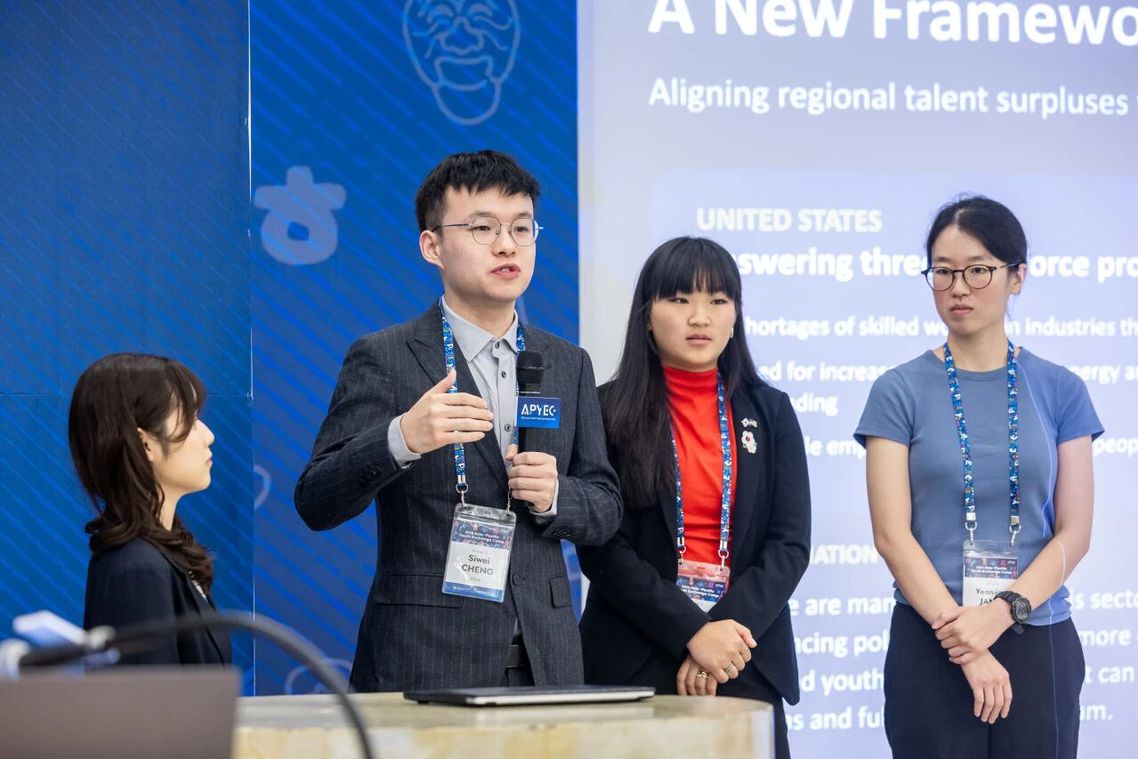
Siwei Chen (second from left) gives a presentation at the exchange camp
Siwei Cheng barely hesitated when signing up for the 2026 Asia-Pacific Youth Exchange Camp.
In 2016, Lee Sedol, one of South Korea's top Go players and a 9-dan, faced off against Google’s AI program AlphaGo in a match that captivated the world. At the time, Cheng was still a high school student. Glued to his computer, he watched with close attention. A longtime Go fan, he began to develop an interest in artificial intelligence from then on.
Today, Cheng is a PhD student in the 2025 cohort collaboratively trained by the Eastern Institute of Technology, Ningbo (EIT) and the University of Science and Technology of China. This summer, the 2026 Asia-Pacific Youth Exchange Camp was held in South Korea. When he learned he might have the change to meet Lee Sedol on the trip, he signed up without hesitation.
In just ten days, he had several memorable firsts—traveling to Gyeongju with three peers from other countries and getting a taste of impromptu socializing with Americans. And that was only part of what made the trip memorable.
Meeting Lee Sedol
What Cheng looked forward to most on the trip was meeting Lee Sedol in person.
A decade on, apart from his shorter hair, Lee appeared much as he did back then: calm, direct, and unafraid to court controversy. Onstage, Lee's speaking style echoed the temperament he showed on the Go board.
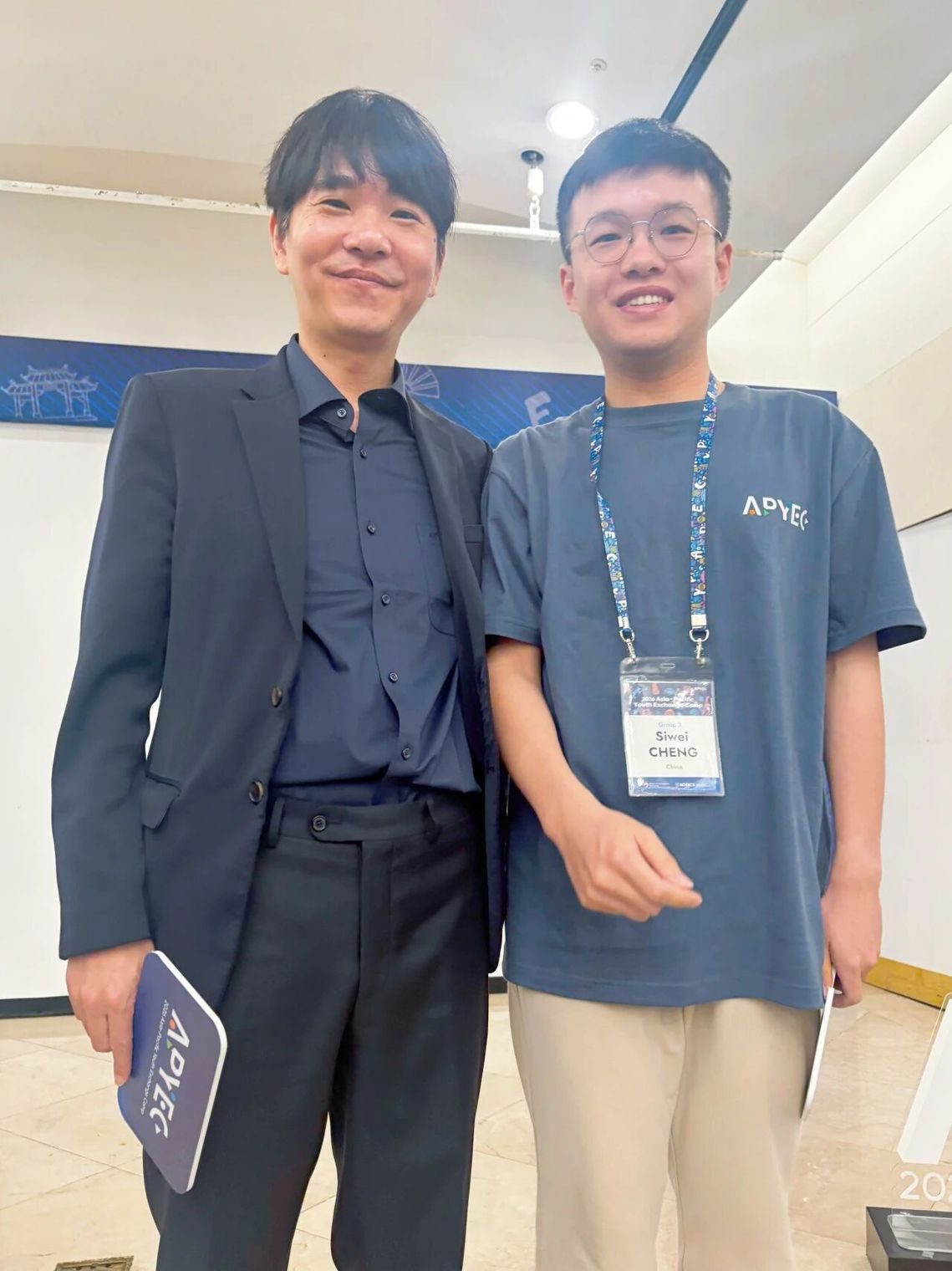
Siwei Cheng (right) with Lee Sedol (left)
Beginning March 9, 2016, Lee played a man-versus-machine Go match against AlphaGo, ultimately losing the five-game series 4–1. But his only win has been hailed as the first human victory over an AI in history.
A decade after the match, Lee set out a distinctive "AI philosophy": "AI may once have been humanity's rival, but in the future it will inevitably become a tool that empowers people and meets real-world needs."
Cheng found the remarks deeply illuminating: "In algorithm research, we tend to focus primarily on metrics such as computational speed and accuracy. But once a technology is deployed in the real world, it reaches real users. How they understand and use it, and whether it actually solves their problems, may matter just as much as the model's raw power."
He began to reflect that the purpose of research should not be merely to chase leaderboard rankings, and that technology cannot remain forever confined to datasets and laboratory code.
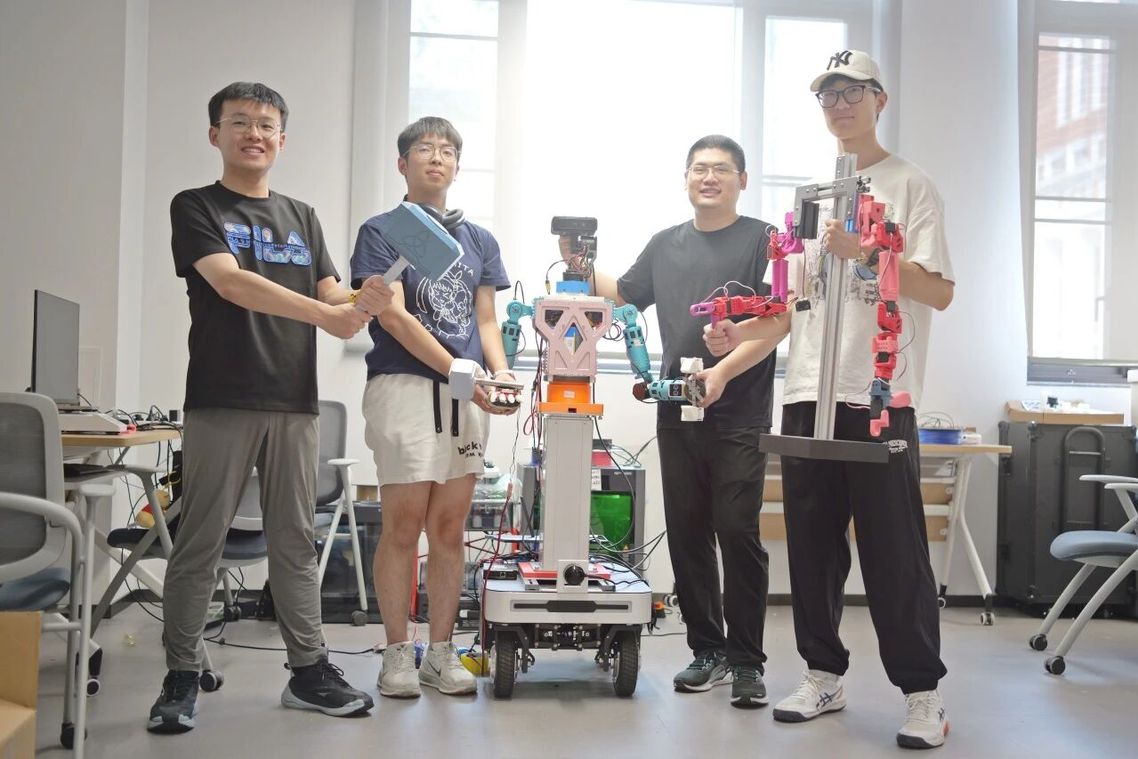
Siwei Cheng (first from left) with classmates from his research group in the lab
This line of thinking also aligns closely with the research he is pursuing. Cheng is advised by Wei Zhang, an assistant professor in the College of Information Science and Technology at EIT, and focuses on lightweight approaches to embodied AI.
His research is conducted in close collaboration with the large-model research team led by Xiaoyu Shen, an assistant professor in the College of Information Science and Technology at EIT. The goal is to deploy intelligent algorithms on physical robots, moving cutting-edge technology out of virtual environments and into real-world applications, bringing it closer to people and enabling it to serve them.
The Asia-Pacific Youth Exchange Camp
The 2026 Asia-Pacific Youth Exchange Camp brought together 40 young delegates from China, South Korea, the United States, and Japan. The delegation from China was organized and led by the China International Youth Exchange Center. The young participants engaged in multidimensional cross-border dialogue through three main tracks: discussions on global issues, cultural industry visits, and field research in cities.
During his undergraduate years, Cheng led projects that won several national awards. He also worked with his advisor to commercialize a wireless laser communication terminal and co-founded a company in Wuxi city with students from lower years. Over two years, he led the team in turning a bulky first-generation prototype into an integrated, box-shaped device, which was delivered to the Fifth Institute of Electronics under the Ministry of Industry and Information Technology.
In addition, Cheng has on multiple occasions provided bilingual reception support for international projects and given presentations in both Chinese and English on scientific and technological achievements. This impressive record in innovation and cross-cultural exchange set him apart from a large pool of applicants. On the recommendation of EIT, he was selected for the Chinese delegation as its only delegate specializing in AI.
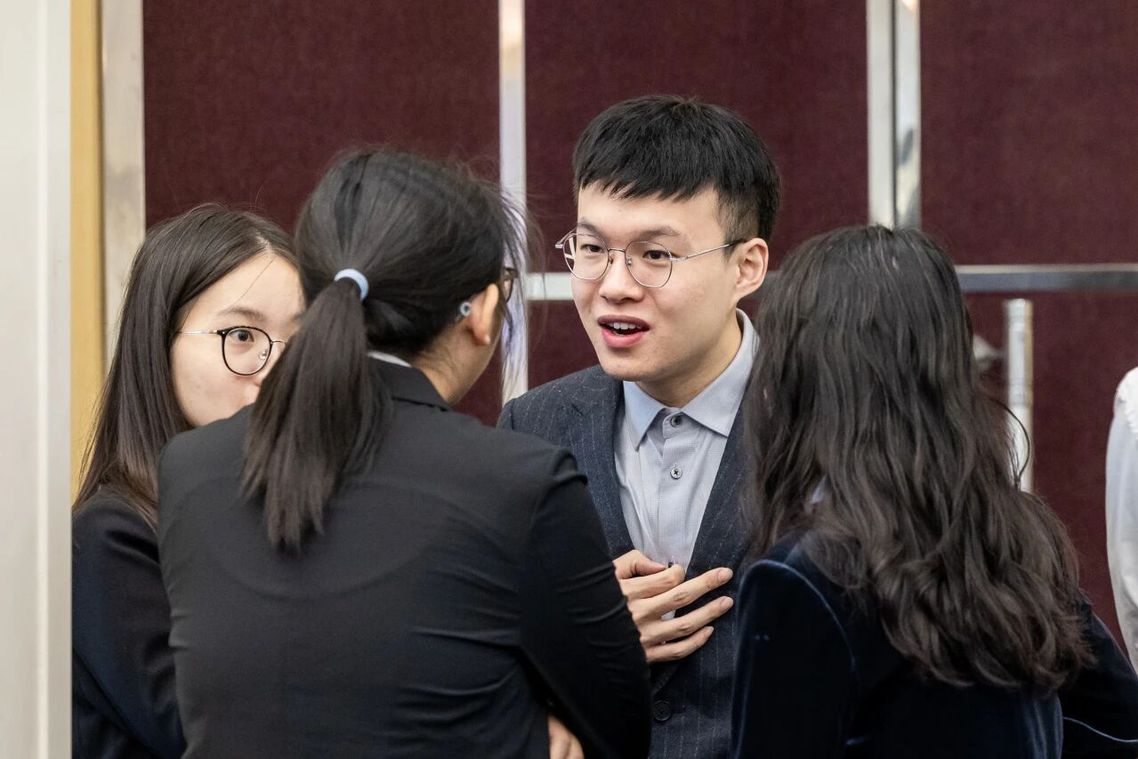
Siwei Cheng (second from right) at the camp
Cheng had expected to take part in discussions on AI-related topics, but the organizers assigned participants to group by random draw. He was placed in the "Youth Housing Security and Employment Support" group, with three teammates from the United States, Japan and South Korea
Both were firsts for him: entering an unfamiliar research field and teaming up with peers from three countries. Cheng took the initiative to systematically gather background on employment and talent mobility in different countries and to organize the research materials—the kind of work he, as a PhD student, was "relatively good at."
"Most Popular Member"
During the camp, Cheng's roommates often hosted gatherings for delegates from other countries. Conversation would begin with the story behind the Korean folk song "Arirang" and then turn to the challenges and concerns facing young people across the four countries. Cheng and his friends never ran out of things to talk about, a testament to his outgoing nature and ability to connect with people.
"Unlike the engineering student we had imagined, Cheng genuinely enjoys talking to people. To him, every place is a chance to strike up a conversation," a fellow delegate said.

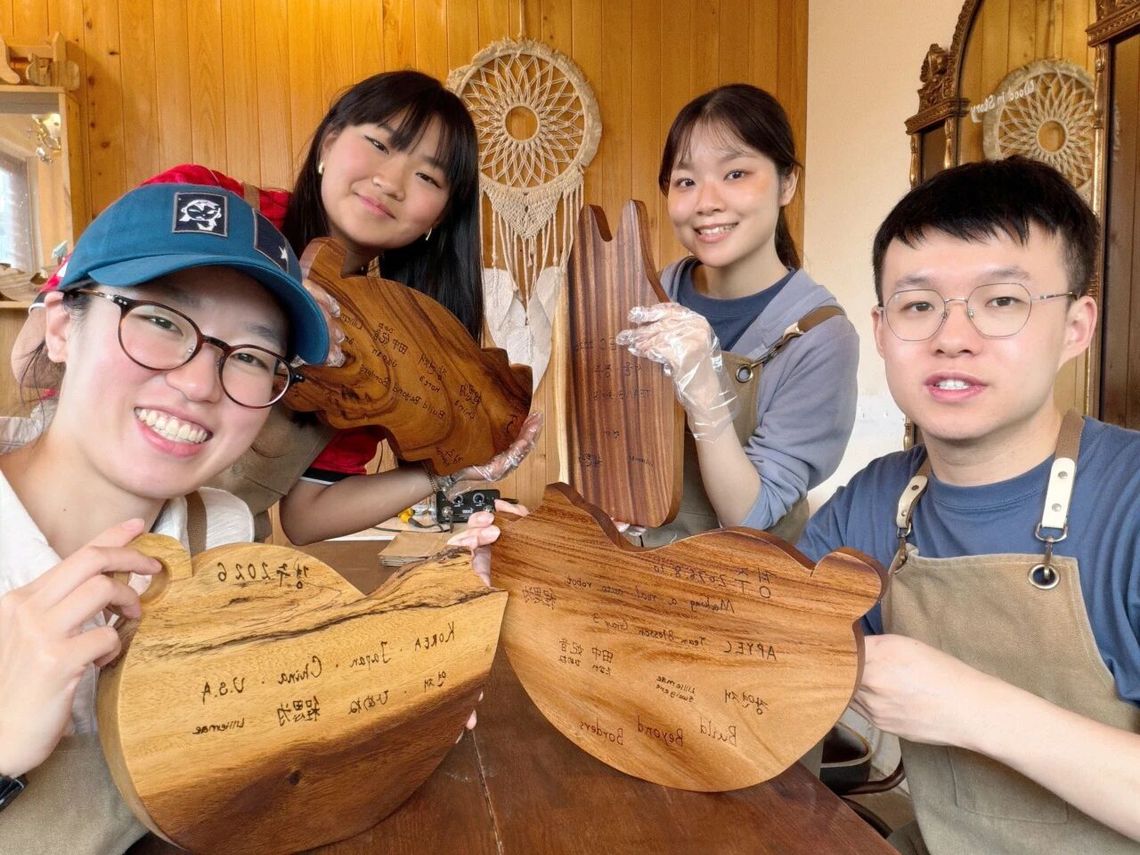
He also had several memorable firsts:
His first trip abroad with peers from other countries. The group set off for the coast near Gyeongju. As they strolled and chatted in the salty sea breeze, the cultural divides between them seemed to fade with each wave.
In the dance practice room on the fourth floor of SM Entertainment's headquarters, Cheng, a complete beginner, joined delegates from other countries in taking on a segment of a dance routine set to the girl group song "Lemonade." After an hour of practice, everyone joked that they were "trying to get their unruly limbs under control."
He also tried local woodcraft for the first time. Everyone carved each other's names by hand onto cat-shaped wooden plaques. "They say it's a form of emotional healing," he said excitedly, pointing to the names on the plaque.
He also tried local woodcraft for the first time. Everyone hand-carved one another's names into cat-shaped wooden plaques. "They say it's a form of emotional healing," he said, pointing excitedly to the names on his plaque.
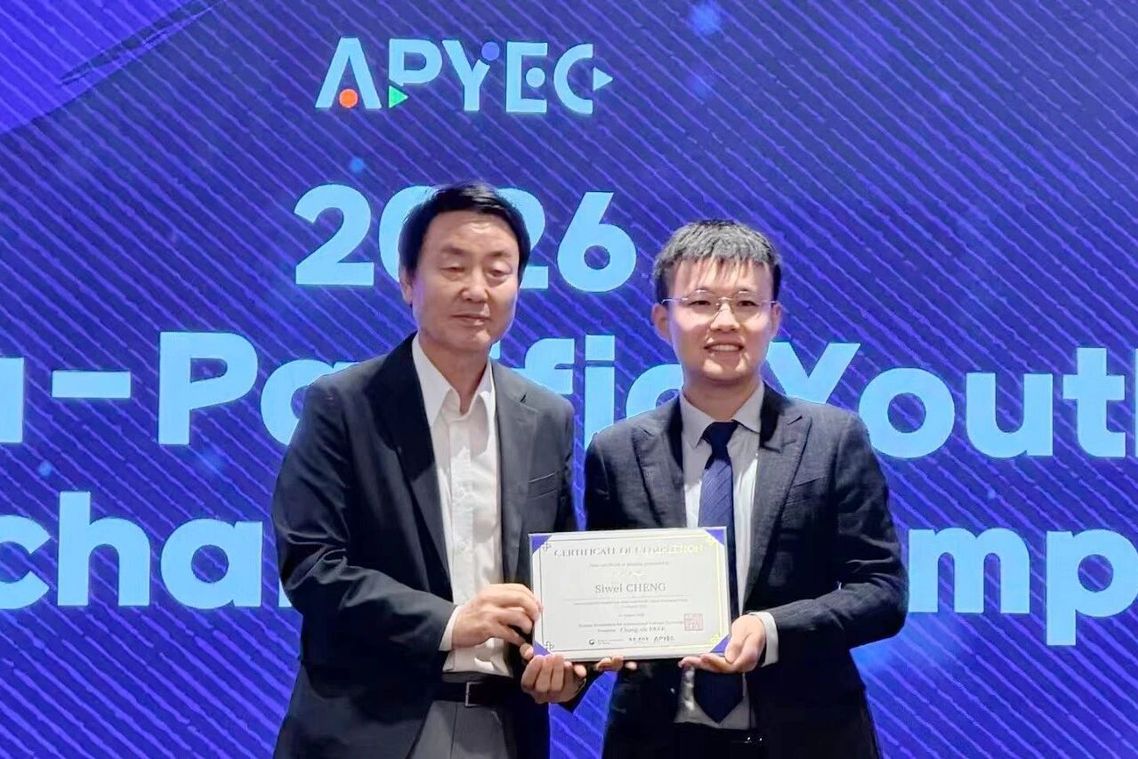
The "Most Popular Member" award ceremony
In just ten days, Cheng formed genuine friendships with nearly all the other participants. In the final vote, he was voted "Most Popular Member" by a landslide.
"Looking back, the most interesting part wasn't that I ‘went to many places,’ but that I got to live a different life, if only for ten days," he recalled.
Benefiting from EIT's internationalized academic environment, Cheng drew constant inspiration from conversations with peers from around the world and gained a stronger sense of purpose in his research.
The exchange camp has ended, but cross-border communication continues. With this experience behind him, Cheng will keep his passion for dialogue alive and, with a broadened perspective, set his sights on even broader horizons.