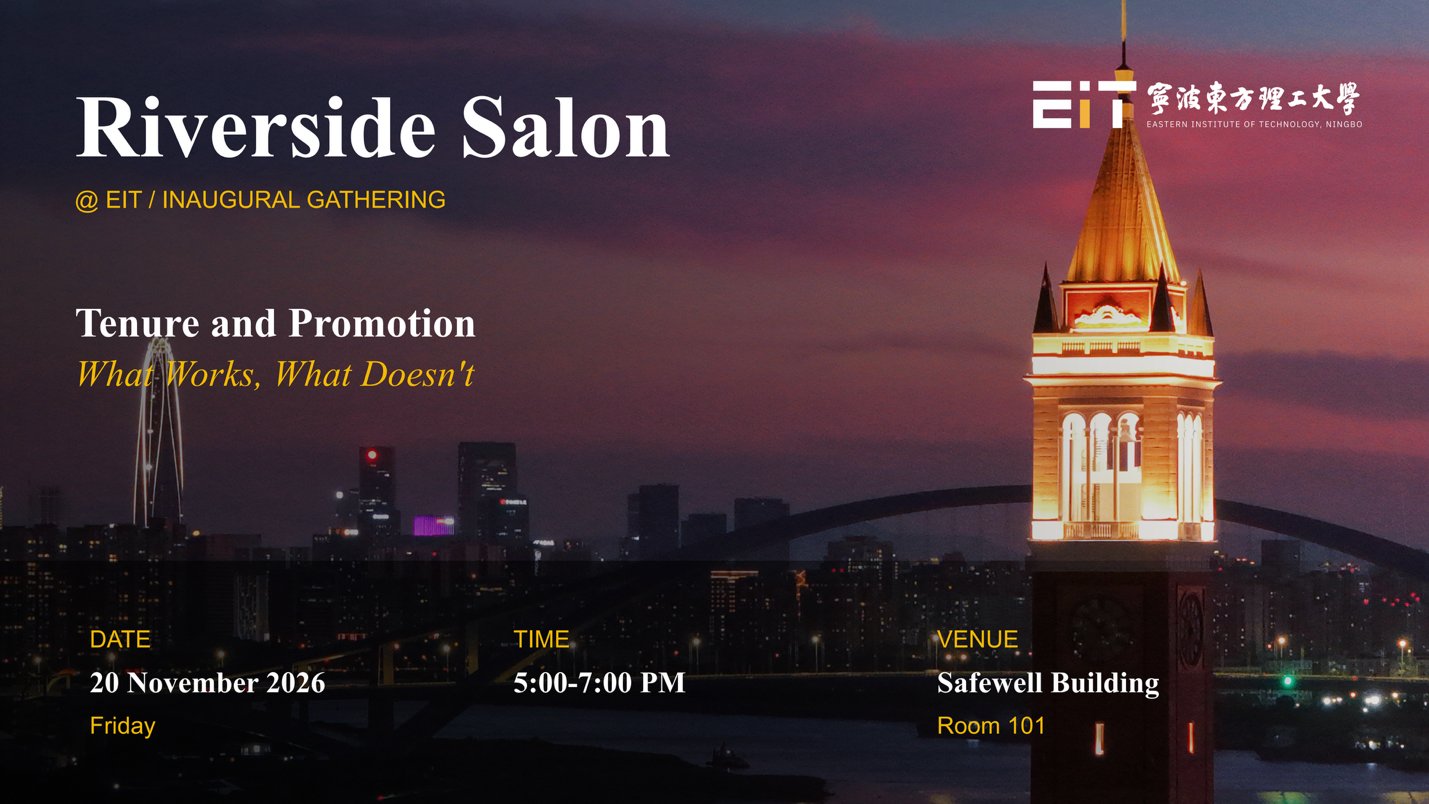
As late-autumn dusk settled over the Yong River and the waterfront lights flickered on, the inaugural Riverside Salon of the Eastern Institute of Technology, Ningbo (EIT), opened at Safewell Building on November 20. The session was devoted to the theme "Tenure and Promotion: What Works, What Doesn't."
Prof. Shiyi Chen, President of EIT and Member of the Chinese Academy, and Prof. Dongxiao Zhang, Executive Vice President and Provost of EIT, attended and addressed the gathering. Prof. Chunmiao Zheng, Vice President of EIT, served as event convener and moderator. A large number of faculty joined the evening, sharing their reflections and experiences in a relaxed, candid atmosphere.
The salon is built on a straightforward conviction: institutions should not exist only on paper. For its first session, the organizers chose "tenure and promotion"—an issue that bears directly on every faculty member. With no fixed agenda, the emphasis was squarely on genuine, open exchange.
President Chen welcomed the Riverside Salon as a valuable format for dialogue. EIT's tenure system, he noted, is designed to give faculty the security to devote themselves to scholarship and pursue academic excellence. Such a culture rests not only on institutional safeguards, but also on frank conversation among colleagues. He encouraged everyone to speak openly about their own journeys, so that fellow faculty might take away useful insights.
Turning to research, President Chen said universities should cultivate a relaxed academic environment that gives scholars ample time and space to settle into sustained inquiry into major scientific questions. Understanding a truly important problem in depth demands both long-term vision and years of commitment. Measured against that ethos, the rush for quick results seen in some corners of today's academic landscape deserves serious reflection.
Prof. Zhang observed that tenure and promotion policies must be continually refined through practice, and that feedback from faculty is the most important basis for improvement. He hoped the Riverside Salon would become a regular fixture and a bridge between university governance and the faculty voice, noting that future topics would be shaped by concerns identified through faculty surveys.
Prof. Zheng explained the rationale behind the salon and the choice of the inaugural topic. Tenure and promotion are pivotal junctures in every academic career, he said, and the institutional cornerstone of building a world-class faculty. Through informal exchange—over tea and in conversation—he hoped faculty could talk the issues through thoroughly and open up their experiences to one another.
Nan Lyu, Director of Office of the Provost, then gave faculty a systematic briefing on the framework and review procedures of EIT's tenure and promotion system, clearly walking through evaluation criteria, dossier preparation, key timelines, and other questions of close concern, and providing an institutional reference point for the discussion that followed.
The moments that resonated most deeply came from two colleagues' personal stories. Prof. Jie Liang, Deputy Director of the Office of Academic Affairs and Chair Professor, recounted his full trajectory from joining the institute through passing tenure review, describing how he balances teaching, research, and service to the university, and sharing both the approaches that worked and the lessons of detours along the way. Profr. Xiaolong Yin, Deputy Dean of the Collegeof Engineering, offered another vantage point on the pivotal choices and inner journey of an academic career, speaking frankly about the difficulties he encountered, the avenues through which he sought support, and the vital role of building a network of international colleagues.
A lively open discussion followed. Faculty asked questions and offered views on navigating tenure criteria, assessing interdisciplinary output, recognizing achievements in an international context, and career planning for early-career scholars. In an easygoing atmosphere, the conversation deepened as perspectives met and sharpened one another, with senior professors contributing their observations and advice without reserve.
As a new research university, EIT is committed to supporting faculty across the full arc of their careers and to respecting their freedom to choose their own paths. The university continues to refine its U-shaped evaluation framework, defined by two tracks that form the poles of the U: the academic track and the technology track. The academic track emphasizes original achievements and scholarly impact, while the technology track centers on technological breakthroughs, technology transfer, and industrial contribution—all in service of an open, inclusive environment for growth.
The Riverside Salon is a new interactive platform for faculty across the university, dedicated to honest dialogue on issues of shared concern. It will be held regularly under a faculty-centered philosophy, bringing the real questions surfaced in surveys into the spotlight—and making these riverside gatherings a cherished space in which the EIT academic community grows together.