Recently, the team led by Chair Professor Xueliang Sun, Foreign Member of the Chinese Academy of Engineering and Assistant Professor Changhong Wang at the Eastern Institute of Technology, Ningbo (EIT), published their findings in the Journal of the American Chemical Society (JACS). For the first time, the team systematically explored the electrochemical performance and sustainable recycling strategy of all-solid-state lithium–tellurium (Li–Te) batteries under low external pressure, opening a new pathway for next-generation solid-state batteries with high energy density, high safety, and recyclability.
Chalcogen cathode systems are attracting increasing attention owing to their high energy density. Among them, tellurium (Te) combines near-metallic high electronic conductivity, high ionic conductivity after lithiation, and excellent volumetric capacity. Nevertheless, all-solid-state Li–Te batteries, especially under low external pressure, have remained relatively unexplored. Therefore, realizing high-performance all-solid-state Li–Te batteries while addressing the high cost of tellurium is the key challenge.
Core Innovations
Breakthrough in Material Design: Composite Cathode with Ultrahigh Active-Material Content
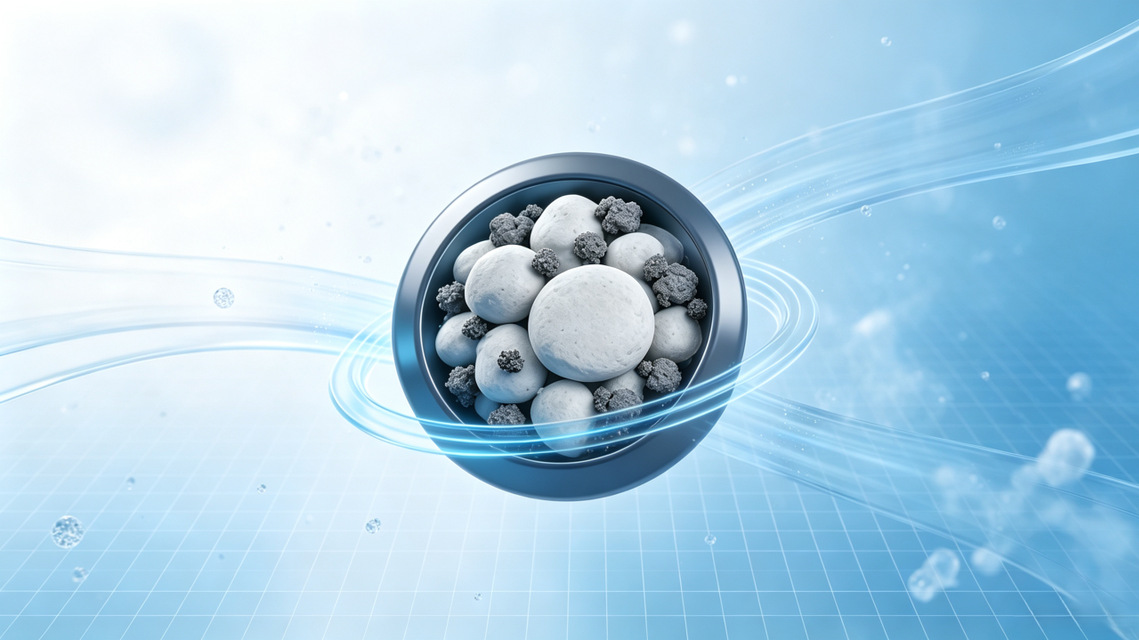
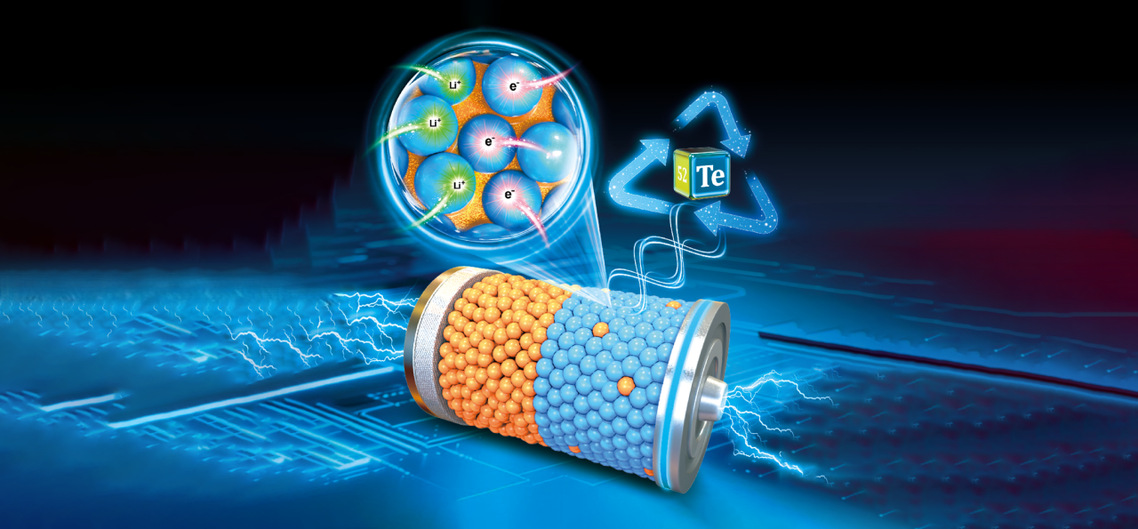
Through a high-energy ball milling process, the team successfully constructed a nanocomposite cathode material, designated Te91@LPSC-350, with a Te content as high as 91 wt%. In this material, ~10 nm Te nanocrystallites are uniformly embedded in an amorphous LPSC (Li₅.₅PS₄.₅Cl₁.₅) matrix, establishing an excellent mixed ionic–electronic conducting network that substantially enhances the reaction kinetics at the solid–solid interface.
Exceptional Electrochemical Performance: 13,000 Cycles and 1100 Wh L⁻¹ Energy Density at 2.5 MPa
Full utilization of theoretical capacity: Delivers the theoretical specific capacity of 420 mAh g⁻¹ at 0.25 mA cm⁻²;
Ultralong cycle life: Stable cycling for 13,000 cycles at a high current density of 12.5 mA cm⁻² with 86% capacity retention;
Ultrahigh areal capacity: Achieves an areal capacity of 21 mAh cm⁻² at an ultrahigh mass loading of 55 mg cm⁻²;
Low-pressure operation: The pouch cell delivers a volumetric energy density of 1100 Wh L⁻¹ under a low stack pressure of only 2.5 MPa, retaining 81% capacity after 200 cycles;
Excellent low-temperature tolerance: Delivers a high areal capacity of 4.6 mAh cm⁻² at –10 °C.
Green and Sustainable: 100% Selective Gasification Recovery of Tellurium
The team proposed and validated for the first time a gasification–condensation recovery process based on the low-temperature sublimation characteristic of tellurium. At mild temperatures (455–680 °C), tellurium is efficiently recovered with a recovery rate of up to 98 wt% and a purity exceeding 99.8 wt%. When the recovered tellurium was reassembled into batteries, the electrochemical performance showed virtually no degradation, demonstrating excellent sustainability and economic viability.
This study not only fills the research gap of all-solid-state Li–Te batteries in the solid-state realm, but also effectively addresses the resource scarcity and cost issues of tellurium through a green recycling technology, while demonstrating their practicality under extreme conditions such as low external pressure and low temperature. This technological route is expected to be widely applied in high-safety electric transportation, portable electronics, extreme‑environment energy storage, and other fields, driving solid-state batteries from the laboratory toward industrialization.
The Eastern Institute of Technology, Ningbo (EIT) is the first affiliation of the paper. Professor Xueliang Sun and Assistant Professor Changhong Wang are the corresponding authors. Postdoctoral researcher Junwu Sang, Associate researcher Borui Liu, and research assistant Shanshan Jiang from EIT are the co‑first authors.