From constantly shattered sports records to geographically divergent human lifespans; from erratic geological hazards to volatile financial risks—the real world is replete with messy, heterogeneous data. Since the birth of modern extreme value theory nearly a century ago, the classical theory has been shackled by the strict assumption of identically distributed data, making it exceedingly difficult to estimate extreme bounds accurately from vast, heterogeneous datasets. Solving the statistical challenge posed by heterogeneous data has therefore become a core pursuit pursued relentlessly by the global statistics community.
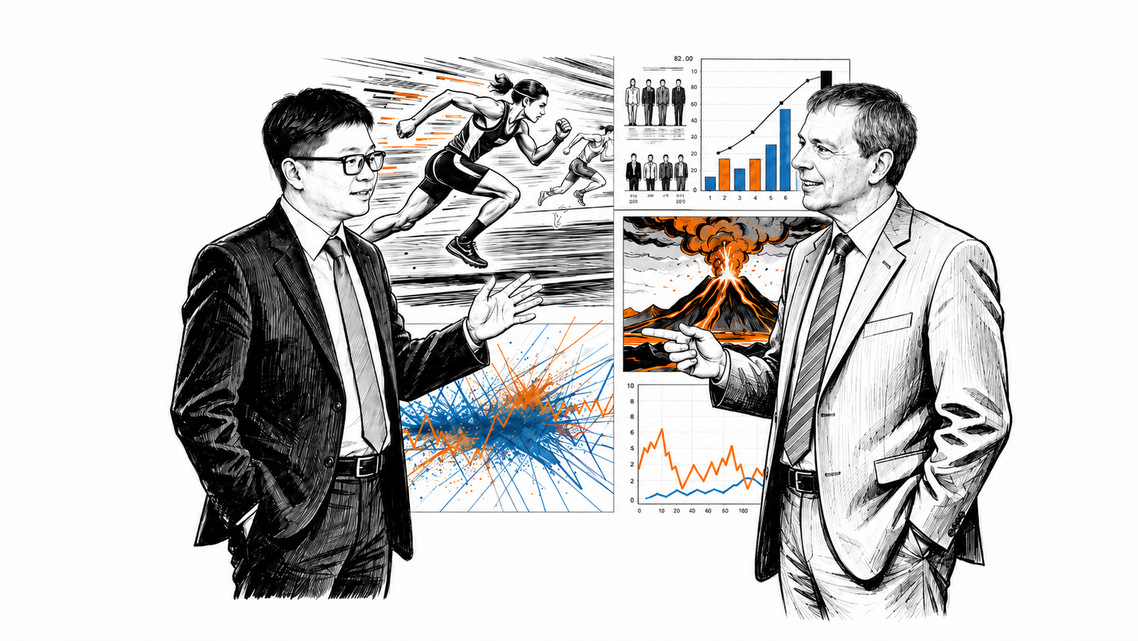
Professor Yi He from the College of Science at the Eastern Institute of Technology, Ningbo (EIT), in collaboration with Professor John H.J. Einmahl of Tilburg University in the Netherlands, has developed a universal extreme value statistical framework for heterogeneous data that adapts to all scenarios, achieving a paradigm shift in the century-old extreme value theory. The research was recently published in the Journal of the American Statistical Association (JASA).
The century‑long "shackle of identical distribution"
The extreme value theory is built upon two cornerstone theorems.
In 1928, R.A. Fisher, the father of modern statistics, and his student L.H.C. Tippett first revealed the limiting distribution of sample maxima; in 1943, the Soviet scholar Boris Gnedenko provided a rigorous mathematical proof, and this core theory became known as the Fisher–Tippett–Gnedenko theorem.
Half a century later, August A. Balkema and Laurens de Haan, representatives of the Dutch extreme value school, together with James Pickands III, a statistician at the Wharton School, proved that the tail distribution of exceedances over a threshold converges to the generalized Pareto distribution—the Pickands–Balkema–de Haan theorem.
Yet the classical extreme value theory of the past hundred years has always been constrained by the strong assumption of identically distributed data. Real‑world data are inherently heterogeneous; forcibly applying identically distributed models fails to capture the true boundaries of extreme events accurately.
Three years ago, Professor Yi He and Professor John H.J. Einmahl, working within the peaks‑over‑threshold framework, broke through traditional restrictions for the first time and clarified the impact of general heterogeneity on extreme value inference. However, limited by technical bottlenecks, that work only covered a single extreme value case, leaving the theoretical system incomplete.
In the present study, they have joined forces again and successfully unified all three core types of extreme value theory, achieving a staged leap for the discipline. They rigorously derived and quantified the complex laws through which heterogeneity influences extreme value statistical inference.
Highlights of the research
Highlight 1: A unified analytical framework for heterogeneous data
The most central contribution of the paper is the construction of a unified analytical framework based on a peaks‑over‑threshold (POT) design that can handle general heterogeneous data. It proves that extreme value statistical analysis must revolve around the core concept of the “mean tail,” ensuring that classical extreme value estimates retain asymptotic validity under heterogeneous data and covering all extreme value domains.
Highlight 2: A breakthrough in mathematical proof and novel explicit formulas
Since the “homogeneous quantile transformation” technique on which previous proofs relied completely breaks down under heterogeneous data, Professor Yi He rebuilt the entire proof system from the ground up using the core tools of the new framework. During this reconstruction, through rigorous mathematical derivation, he unearthed for the first time an explicit expression for the asymptotic variance that was previously entirely unknown, thereby making it possible to characterize the impact of heterogeneity on statistical inference.
Highlight 3: Heterogeneity is exploitable information
Heterogeneity was traditionally regarded as a factor that renders inference more difficult, but this paper demonstrates that at various levels heterogeneity can directly reduce the asymptotic variance. This finding changes the way we view “heterogeneity”: data differences that were previously neglected can be converted into more precise extreme value inference.
Highlight 4: Three real‑world applications demonstrating the theoretical advantage
Relying on real‑data analyses, the new theory substantially improves inferential accuracy at the 95% confidence level:
Human lifespan limit: Analysis of 1,772 Danish monozygotic twin pairs yields an upper limit of 124.5 years, with the interval narrowed by 0.6 years compared to traditional models.
Ultimate 200‑meter sprint times: The limit for men is 17.96 seconds and for women 20.16 seconds, with dramatically reduced estimation errors.
Extreme earthquake magnitudes: The magnitude interval for a once‑in‑a‑century earthquake is 9.1–9.4, and the confidence interval is markedly narrowed.
Expanding the boundaries of a discipline
Since the birth of the Fisher–Tippett theory, extreme value theory has developed for nearly a century. This study breaks the traditional identically distributed assumption and refines the asymptotic theory under a full domain‑of‑attraction framework, making it far more suitable for real data. In the future, this statistical methodology can be widely applied to extreme value inference in fields such as extreme climate events, catastrophe insurance, financial risk, infrastructure disaster prevention, and biological and physical performance limits, thereby further extending the application scope of extreme value statistics.
The Eastern Institute of Technology, Ningbo, is the first affiliation of the paper. Professor Yi He of EIT is the first author, and Professor John H.J. Einmahl of Tilburg University, the Netherlands, is the co‑author.