As electronic devices continue to evolve toward thinner, more efficient, and miniaturized form factors, multiferroic materials that simultaneously possess magnetism and ferroelectricity have become a focal point of research. By harnessing the interplay between these two distinctive properties, they hold the promise of enabling more sensitive sensors and memory devices with faster read–write speeds.
Suhuai Wei, Chair Professor and Dean of the School of Physics in the College of Science at the Eastern Institute of Technology, Ningbo (EIT), together with Professor Yunhao Lu of Zhejiang University, Researcher Lan Chen of the Institute of Physics, Chinese Academy of Sciences, and Professor Shengyuan Yang of The Hong Kong Polytechnic University, has achieved a major advance in two-dimensional room-temperature multiferroicity. They proposed a new strategy for realizing multiferroicity through interlayer self-doping. The findings were recently published in the top-tier physics journal Physical Review Letters.

Research Background
Existing multiferroic materials generally fall into two categories. In type‑I multiferroics, ferroelectricity and magnetism arise from distinct and independent origins. The two orders are not directly induced by each other, and their magnetoelectric coupling is typically linear but weak. In type‑II multiferroics, ferroelectricity is a secondary order driven by a primary magnetic ordering. This usually occurs in noncollinear magnetic structures, where the formation of magnetic ordering breaks symmetry and generates electric polarization. The magnetoelectric coupling mechanism in type‑II multiferroics relies on spin–orbit coupling (SOC), and the coupling strength is generally stronger than in type‑I cases, making them more suitable for applications.
However, type‑II multiferroics also suffer from significant disadvantages. First, because ferroelectricity is induced from magnetism via spin–orbit coupling (SOC) (an energy scale that is typically small), the ferroelectric order is usually weak and the transition temperature is low, often in the range of 10–50 K, far below room temperature. Second, robust type‑II multiferroics remain very limited, and the ordering present in bulk multiferroics often cannot be sustained in ultrathin layers. These issues pose major challenges for materials design and practical applications.
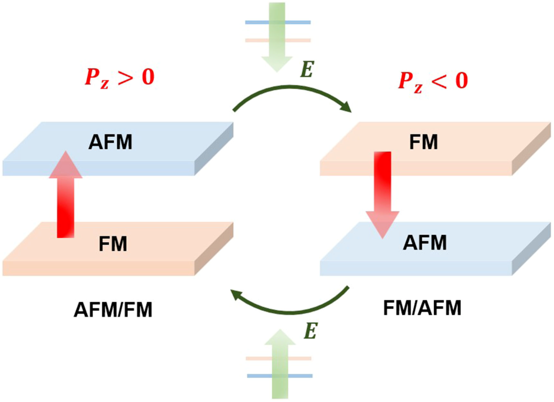
Schematic illustration of electrical switching in interlayer self-doping multiferroics. Image provided by the research group
Research Highlights
In this work, the authors propose a design strategy for a new class of multiferroic materials: interlayer self-doping multiferroics. The study demonstrates that, owing to the preference of antiferromagnetic and ferromagnetic orders for different band fillings, a homobilayer system with intermediate band filling exhibits an intrinsic instability toward interlayer self-doping. This leads to one layer adopting antiferromagnetic order while the other adopts ferromagnetic order, accompanied by out-of-plane ferroelectricity.
Unlike conventional type‑I and type‑II multiferroics, the ferroelectric and magnetic orders in interlayer self-doping multiferroics are intrinsically coupled and do not rely on spin–orbit coupling, thus possessing the potential to persist at elevated temperatures. Using first-principles calculations, this mechanism was verified in two specific systems: bilayer CrTe₂ and bilayer FeTe. Remarkably, the multiferroicity in bilayer CrTe₂ is predicted to be stable at room temperature.
This study reveals a novel class of multiferroic materials and opens a new path for designing two-dimensional ultrathin multiferroics with high transition temperatures and strong magnetoelectric responses.
Shulin Zhong, a doctoral student at Zhejiang University, is the first author of the paper, and Professor Shengyuan Yang, Researcher Lan Chen, Professor Suhuai Wei, and Professor Yunhao Lu are the corresponding authors.