All-solid-state sodium-ion batteries hold broad promises for applications such as electric vehicles and large-scale grid storage, owing to the abundant sodium resources, the absence of flammable liquid electrolytes, and their pronounced cost advantages. The solid electrolyte is the core material that determines the practical performance and industrial viability of these batteries, yet the prevailing mechanochemical ball-milling synthesis route faces a critical manufacturing pain point: preparing conventional pure halide materials often requires dozens of hours of milling, leading to high energy consumption and severely limited production throughput.
A team led by Chair Professor Xueliang Sun, Foreign Member of the Chinese Academy of Engineering and Assistant Professor Wei Xia at the Eastern Institute of Technology, Ningbo (EIT) has discovered that introducing a small amount of oxygen into the halide anion framework can drive ultrafast amorphization synthesis of halide electrolytes. By leveraging advanced characterization techniques including synchrotron radiation, they systematically unraveled the microstructural evolution of halide solid electrolytes and clarified the intrinsic mechanism by which oxygen doping governs the amorphization process. The findings were recently published in the top-tier chemistry journal Angewandte Chemie International Edition.

Selecting the oxyhalide NaTaOCl₄ as a model material, the researchers achieved complete amorphization after merely 5 minutes of ball milling—a leap in synthesis efficiency compared with the days-long protocols required for conventional NaTaCl₆. Through multi-dimensional characterization using Raman spectroscopy, X-ray photoelectron spectroscopy, synchrotron-based pair distribution function analysis, and X-ray absorption spectroscopy, combined with ab initio molecular dynamics simulations, they elucidated the microscopic mechanism of bridging-oxygen-driven ultrafast amorphization: low-coordinate Ta−O−Cl bridging oxygen units in the structure induce pronounced lattice distortion that dramatically lowers the energy barrier for the amorphization reaction. At the same time, these units effectively expand the free volume of the system, optimize the Na-ion coordination environment, and reduce the ion migration barrier by nearly half, thereby constructing continuous and efficient sodium-ion transport pathways.
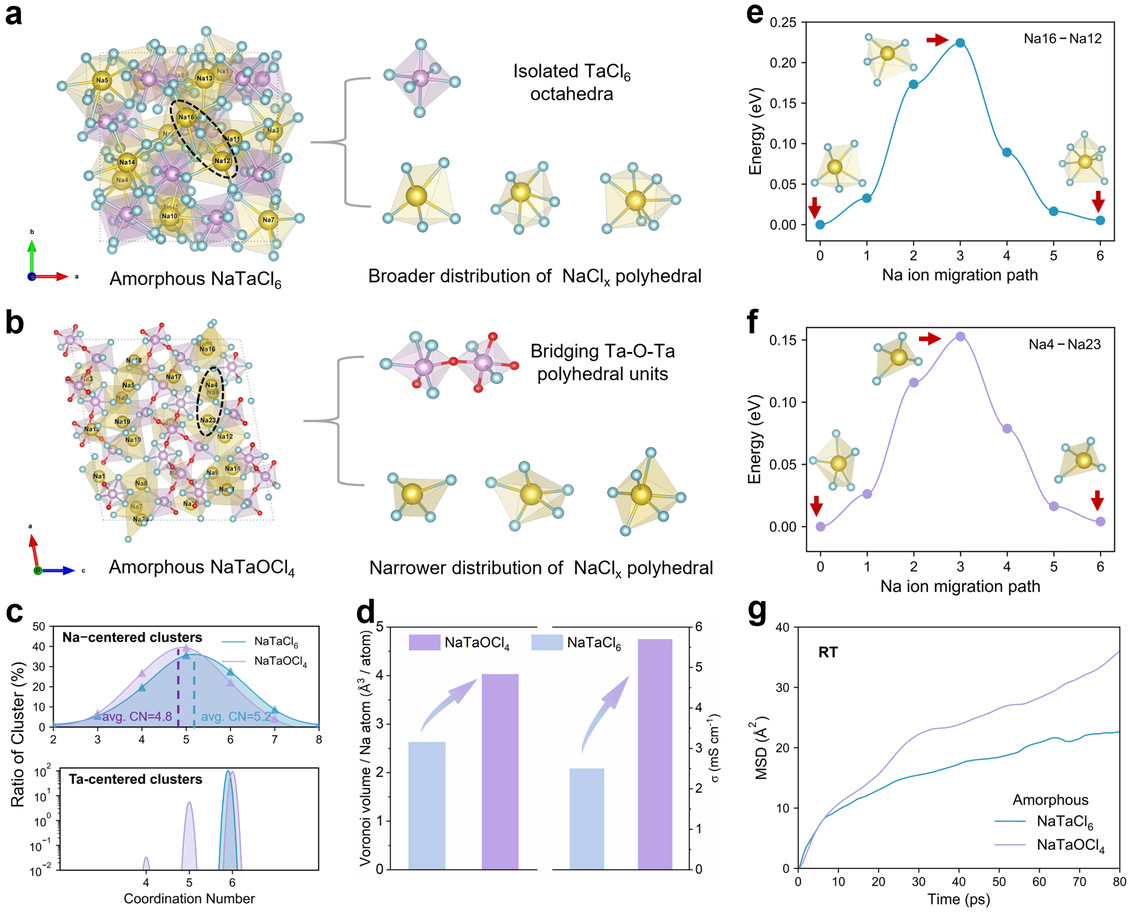
Amorphization structure and dynamic properties derived from ab initio molecular dynamics simulations. Image provided by the research group
Harnessing the real-time dynamic tracking capability of an in situ synchrotron X-ray scattering setup coupled with ball milling, the team captured, for the first time, the complete and strikingly different mechanochemical reaction pathways of the two electrolytes. The conventional chloride follows a pathway in which crystalline products precipitate first, followed by a prolonged amorphization transition; a crystalline phase preferentially forms in the early stages of milling, and its stable lattice is difficult to disrupt, making the amorphization conversion sluggish. In contrast, with the involvement of bridging oxygen the crystalline intermediate step is completely bypassed. In situ scattering experiments confirmed a three-step ultrafast evolution: rapid fragmentation of the precursors → generation of a metastable intermediate → bridging-oxygen-driven instantaneous amorphization. A disordered amorphous network is constructed within minutes.
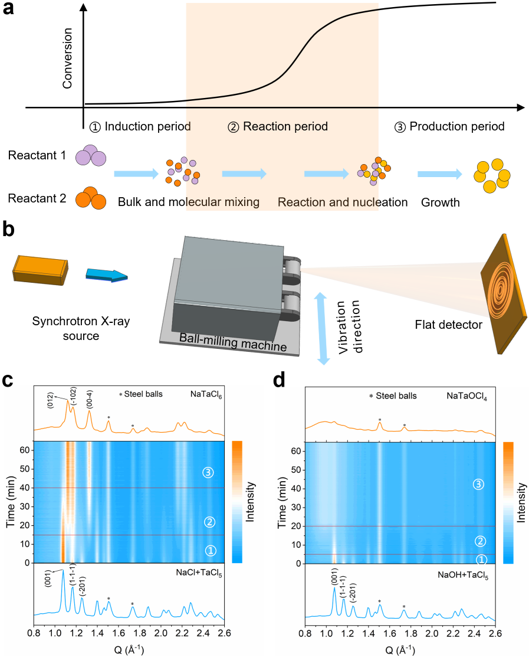
Time-resolved in situ structural evolution. Image provided by the research group
Building on the central principle of bridging-oxygen-driven amorphization, the team established a general strategy based on multidentate oxygen-containing anion modification, extending the concept to diverse oxygen-bridged halide electrolyte systems that incorporate carbonate, phosphate, silicate, and other oxyanions. Among them, the optimized NaTaO₀.₅Cl₅ electrolyte can be prepared with just 30 minutes of ball milling and delivers a room-temperature ionic conductivity as high as 3.39 mS cm⁻¹, a performance far exceeding that of the vast majority of reported solid electrolytes of this class. Moreover, the electrolyte possesses an electrochemical stability window of over 4 V, enabling compatibility with high-voltage cathode materials. All-solid-state batteries assembled with this electrolyte demonstrate excellent cycling performance.
This work deciphers, from both thermodynamic and kinetic perspectives, the chemical origin of how bridging oxygen accelerates lattice disordering, and establishes universal design criteria for solid electrolytes that employ oxygen as a bridging building unit. It pioneers an entirely new preparation route for amorphous halide electrolytes that is fast, low-cost, and achieves high ionic conductivity. The coupled in situ ball-milling/synchrotron radiation characterization scheme also provides a critical tool for investigating mechanochemical mechanisms, giving a strong push to all-solid-state sodium-ion battery technology as it moves from laboratory research toward industrial mass production.
Wen Tang and Kaixin Zhang, doctoral students at EIT are the first authors of the paper. Professor Xueliang Sun, Assistant Professor Wei Xia, and Dr. Jo-chi Tseng, a beamline scientist at the SPring-8 synchrotron radiation facility in Japan, are the co-corresponding authors.