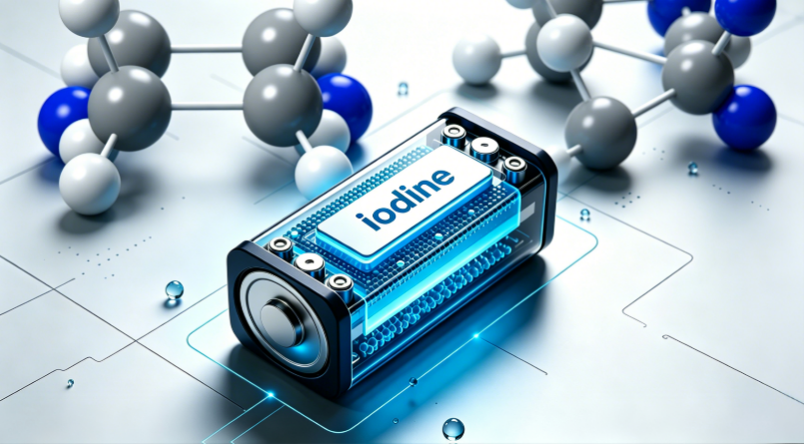
High-energy-density battery systems such as lithium–iodine (Li–I₂) batteries have drawn considerable attention in recent years owing to their low cost, high theoretical energy density, and excellent fast-charging capability. However, the iodine cathode readily generates soluble polyiodides during cycling, and the resulting shuttle effect causes active-material loss and rapid capacity fade. Conventional physical adsorption offers only limited confinement of polyiodides, whereas a chemical anchoring strategy can provide far stronger binding. If a quantifiable chemical parameter could be established to precisely describe this interaction strength, it would be possible to move beyond trial-and-error material screening and realize the rational design of electrode hosts and electrolyte components at the molecular level.
A team led by Chair Professor Yusheng Zhao and Assistant Professor Wei Xia at the Eastern Institute of Technology, Ningbo (EIT), has proposed using the iodine–iodine (I–I) bond length in ligand–iodine complexes as a unified descriptor to guide the molecular design of electrode materials and electrolytes for lithium–iodine batteries. The findings were recently published in the top chemistry journal Angewandte Chemie International Edition.
Research Highlights
The research team adopted the I–I bond length, a fundamental structural parameter, as a quantitative metric. They found that when the ligand–iodine interaction is weak, the I–I bond remains short; as the interaction strengthens, charge transfer leads to the elongation of the I–I bond, and the bond length exhibits a good linear correlation with the interaction strength. More importantly, this I–I bond length directly correlates with the shift of characteristic Raman peaks, enabling rapid and straightforward experimental determination. This provides a convenient, quantifiable, and practical guide for real-world material screening.
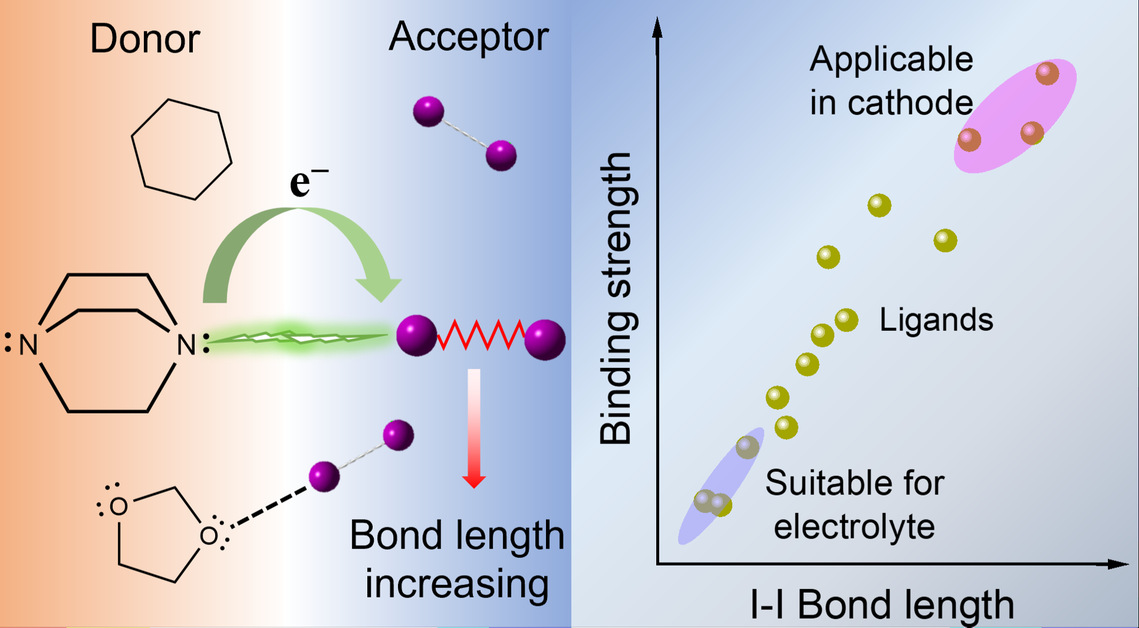
Design concept of using the I–I bond length as a quantitative descriptor. Image provided by the research group
Based on this descriptor, the team established clear design principles:
Strong ligands (those that markedly elongate the I–I bond) are suitable as cathode host materials to achieve robust chemical anchoring of iodine species;
Weak ligands are suitable as electrolyte components to mitigate competitive coordination with iodine species, thereby suppressing their dissolution and shuttle.
To validate the strategy, the team selected 1,4-diazabicyclo[2.2.2]octane as the electrode host material and 1,1,2,2-tetrafluoroethyl 2,2,3,3-tetrafluoropropyl ether as an electrolyte co‑solvent to construct a new Li–I₂ battery system. Compared with conventional electrolytes or typical electrode configurations, this battery delivered a higher discharge capacity, a lower self‑discharge rate, and an ultralong stable cycling of up to 4,000 hours at a low rate.
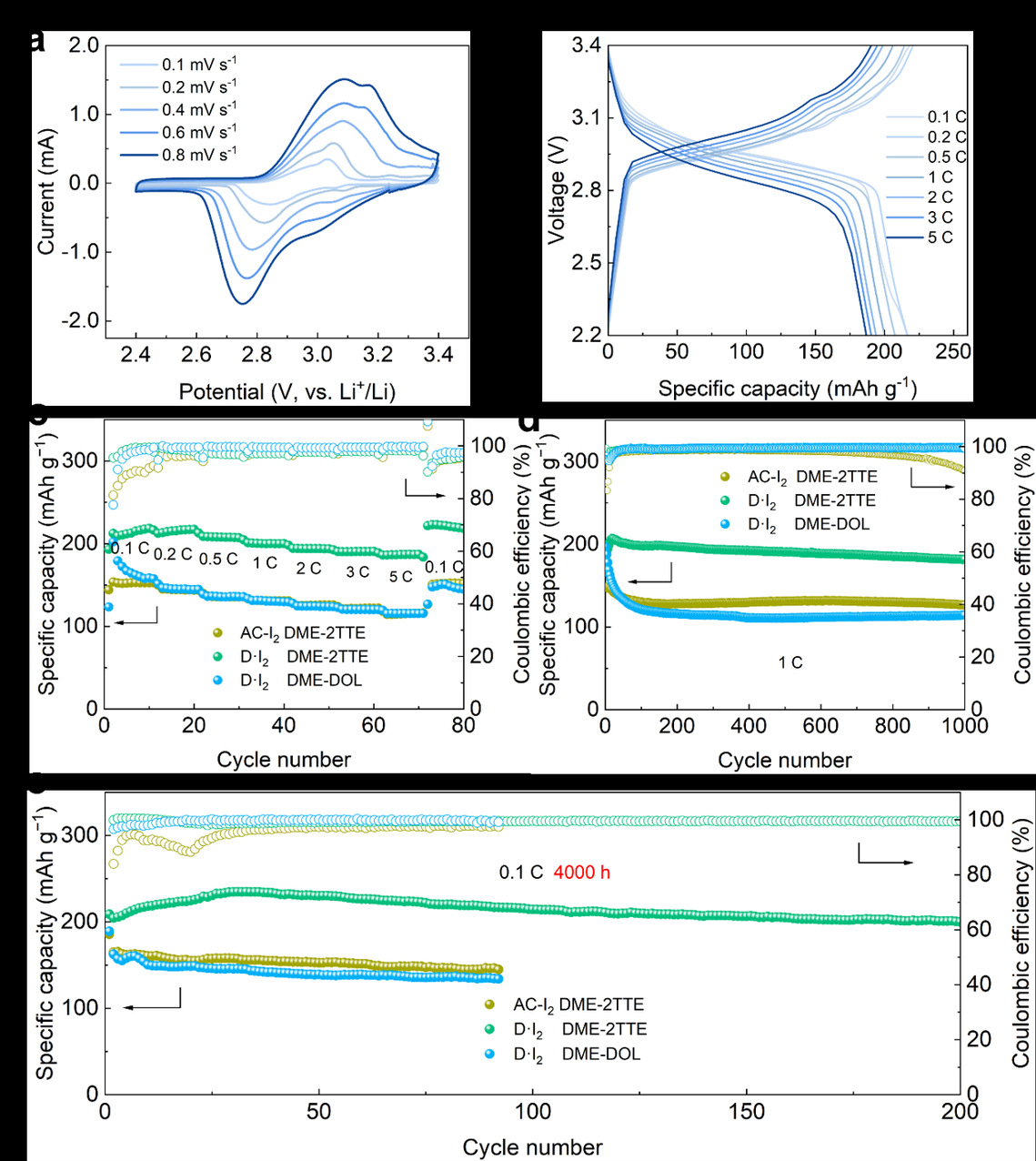
Electrochemical performance. Image provided by the research group
Furthermore, to demonstrate the generality of this descriptor and design strategy, the team extended the system to other electrode materials and carbonate‑based electrolytes, and proposed a general method to precisely tune ligand strength through molecular fluorination. All extended systems exhibited markedly enhanced electrochemical performance, fully validating the significant guiding value of this I–I bond‑length metric in the rational design of electrodes and electrolytes for lithium–iodine batteries.
This work transforms a classic chemical bond‑length parameter into a quantitative tool for battery materials design, providing a clear molecular‑design route for the development of high‑performance lithium–iodine batteries and potentially advancing low‑cost, high‑energy‑density energy storage technologies.
Mengzi Geng, a collaboratively‑training Ph.D. student at the Eastern Institute of Technology, Ningbo and The Hong Kong Polytechnic University, is the first author of the paper. Professor Yusheng Zhao, Assistant Professor Wei Xia, Professor Biao Zhang at The Hong Kong Polytechnic University, and Professor Songbai Han at the Southern University of Science and Technology are the corresponding authors.