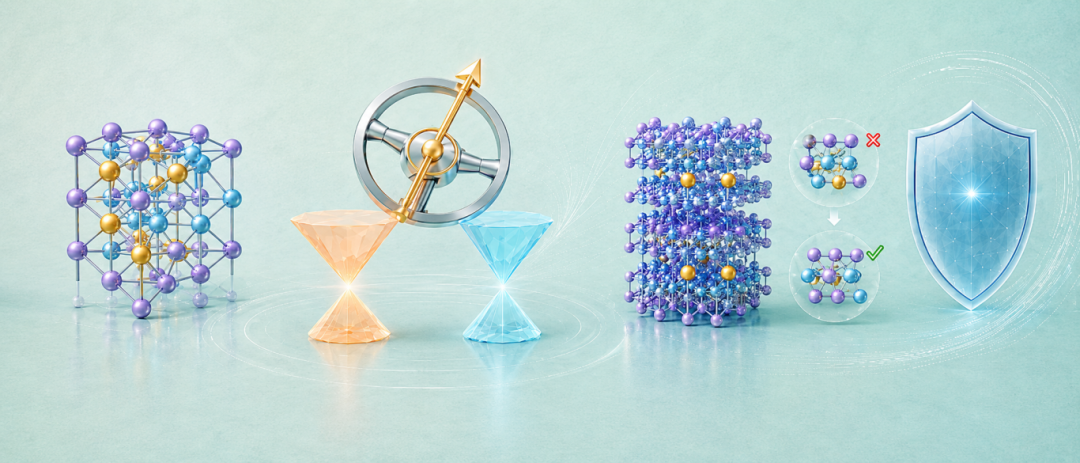
The team led by Associate Professor Tong Zhou at the Eastern Institute of Technology, Ningbo (EIT), together with teams from Fudan University, East China Normal University, Southeast University, and other institutions, has made two important advances in the control and stabilization of magnetic topological quantum materials. One study reveals a giant exchange-coupling-driven magnetic topological phase transition in the new topological magnet Eu₃In₂As₄ (EIAS), realizing vectorial control of the minimal Weyl state. The other clarifies the microscopic mechanism by which antisite defects affect the magnetic and topological properties of Mn(Bi₁₋ₓSbₓ)₂Te₄ (MBST) and, through optimized crystal growth, provides a materials basis for stabilizing its topological state. Together, the two studies respectively equip magnetic topological materials with a "magnetic-field steering wheel" and a "stabilizer" against defect-induced perturbations.
The corresponding results were published in Advanced Materials and Nature Communications, respectively.
The combination of magnetism and topology provides an important platform for discovering and manipulating novel quantum states of matter. Magnetic order can not only break time-reversal symmetry and reshape electronic band structures, but also drive transitions among different topological quantum states, such as topological insulators and Weyl semimetals. For real materials, however, obtaining a topological state is only the first step: how to actively and continuously tune topological bands through the magnetic degree of freedom, and how to suppress the detrimental effects of crystal defects on magnetic and topological properties, are two key issues that must be addressed to advance magnetic topological materials toward controllable quantum systems.
Giant exchange coupling: installing a "magnetic-field steering wheel" for topological states
Exchange coupling is the bridge connecting localized magnetic moments and itinerant electrons, and its strength directly determines the ability of magnetic order to modify electronic bands. In most magnetic topological materials, the exchange-induced band shift is typically only a few to tens of millielectronvolts, making it difficult to drive significant topological phase transitions at relatively low magnetic fields. At the same time, complex band structures can easily obscure the intrinsic response of topological electronic states.
In the new Zintl-phase topological magnet Eu₃In₂As₄, the team found that the exchange coupling between localized magnetic moments and itinerant electrons acts as an “amplifier,” converting changes in magnetic moments into pronounced band reconstruction. A magnetization-dependent band shift of up to about 300 meV was observed experimentally, far exceeding the energy scale of the ordinary Zeeman effect. In addition, the material exhibits soft magnetic properties, so that a relatively small magnetic field can change the orientation of the magnetic moments.
This unique combination of giant exchange coupling and soft magnetic response means that the magnetic field no longer merely magnetizes the material, but can directly tune its topological electronic structure. First-principles calculations further revealed a clear correspondence between magnetic configurations and topological bands: when the magnetic moments align along the crystal a-axis or b-axis, Eu₃In₂As₄ can form a minimal Weyl semimetal state containing only one pair of Weyl nodes; when the moments rotate to the c-axis, it evolves into a nodal-ring semimetal.
More importantly, as the magnetic moments rotate continuously, the pair of Weyl nodes also moves continuously in momentum space. In other words, the magnetic field direction acts like a "steering wheel," determining not only which topological phase the system is in, but also where the Weyl nodes are located and how far apart they are. Magneto-infrared spectroscopy, quantum oscillations, anisotropic magneto-transport, and the anomalous Hall effect collectively support the exchange-coupling-driven band reconstruction from different perspectives. This work connects magnetic configurations, topological bands, and experimental responses, establishing Eu₃In₂As₄ as an ideal material platform for studying the minimal Weyl model and its vectorial control.
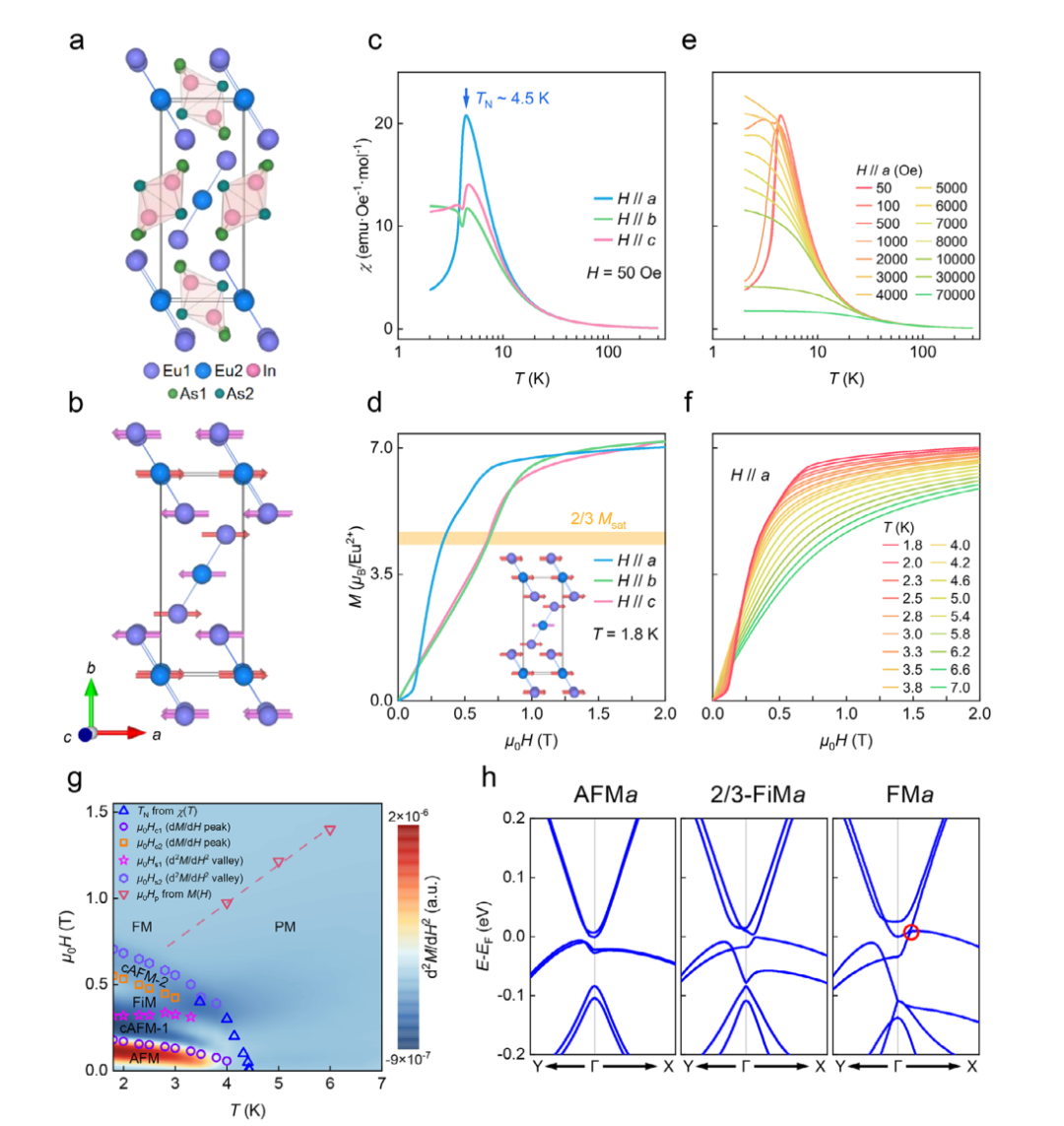
Crystal structure, magnetism, and magnetic-field-controlled topological properties of Eu₃In₂As₄. Image provided by the research group
Defect control: installing a "stabilizer" for topological states
If the first work addresses how to make topological states respond to the magnetic field, the second focuses on how to keep them stable in real crystals.
The team studied the Mn(Bi₁₋ₓSbₓ)₂Te₄ system as an example. MnBi₂Te₄ and its Sb-substituted derivatives can host a variety of topological quantum states, including antiferromagnetic topological insulators and field-forced ferromagnetic Weyl semimetals. Sb substitution can tune the Fermi level toward the charge neutrality point, but it also tends to aggravate antisite defects between Mn and Bi/Sb atoms. These atomic-scale “misplacements” cause magnetic moment compensation and magnetic dilution on the one hand, and disrupt the ideal magnetic order and band structure required for Weyl states on the other. Therefore, Fermi level tuning and defect suppression must be achieved simultaneously.
To address this issue, the team constructed supercell models containing different types and concentrations of antisite defects and systematically investigated their effects on magnetic coupling, magnetic configurations, and band topology. The results show that antisite defects cause the misplaced Mn moments to form intralayer antiparallel alignment with the magnetic moments of the main Mn layer, weakening the ability of the material to achieve full ferromagnetic polarization under conventional magnetic fields. As the defect concentration increases, the Weyl band crossings in the ideal system are gradually gapped out, eventually degrading the Weyl semimetal into a trivial magnetic insulator. The theoretical calculations thus reveal at the microscopic level that only by effectively suppressing antisite defects while tuning the Fermi level can the intrinsic magnetic and topological properties of the material be better preserved.
Based on this understanding, the team developed an optimized chemical vapor transport method. By adjusting the growth temperature profiles, precursor ratios, and growth environment for different Sb contents, they obtained high-quality Mn(Bi₁₋ₓSbₓ)₂Te₄ single crystals with compositions closer to stoichiometry and significantly reduced antisite defects. At approximately x = 0.20, the Fermi level is tuned to near the charge neutrality point, with a carrier density as low as about 7×10¹⁷ cm⁻³ and a mobility reaching 2519 cm²·V⁻¹·s⁻¹. Strong quantum oscillations in the field-induced ferromagnetic state, together with opposite signs of the anomalous Hall conductivity in n-type and p-type samples, provide strong evidence for a type-II Weyl semimetal state.
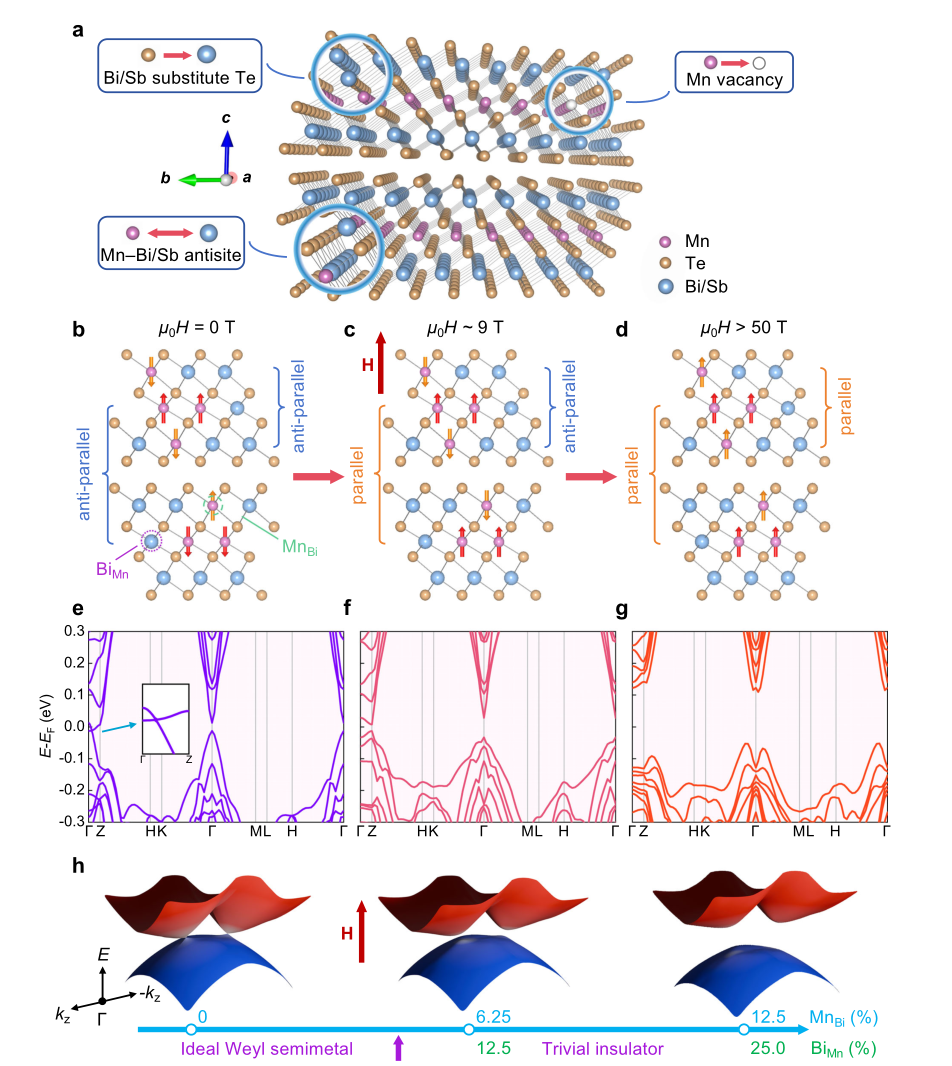
Defect types, magnetic configurations, and topological properties in Mn(Bi₁₋ₓSbₓ)₂Te₄. Image provided by the research group
Although the two studies focus on different material systems, they jointly address a central question: how to develop magnetic topological states into a designable and controllable quantum resource. One makes topological states tunable, and the other makes them stable, demonstrating from the complementary perspectives of external-field control and material optimization a research pathway in which theoretical calculations and experimental investigations work together to advance quantum materials.
In the two studies, Associate Professor Tong Zhou's team mainly carried out theoretical calculations and physical mechanism analysis. Xunkai Duan, a Ph.D student at EIT is the co-first author of both papers, and Associate Professor Tong Zhou is a co-corresponding author. Collaborators also include Researcher Zhang Cheng and Ph.D students Haonan Chen and Jiayu Wang from Fudan University, Professor Xiang Yuan and Ph.D student Guangyi Wang from East China Normal University, and Professor Lin Miao and Ph.D student Huayao Li from Southeast University. This research was supported by the National Natural Science Foundation of China, the Zhejiang Provincial Natural Science Foundation of China, the Yongjiang Talent Programme, and other projects.
Link: