Water freezes at 0°C and boils at 100°C. The critical points of such phase transitions are a key to understanding the physical world. Topological states of matter, a concept recognized by the 2016 Nobel Prize in Physics, reveal a class of matter that is insulating in the interior but conducting on the surface.
For a long time, these two fields were regarded as "two isolated islands": critical points are where the energy gap closes, whereas topological states require an energy gap for stability.
The research group led by Prof. Xue-Jia Yu at the School of Physics, Eastern Institute of Technology, Ningbo (EIT), in collaboration with Hunan University and Zhejiang University, has achieved a significant theoretical breakthrough. Their latest study shows that between these two isolated islands there is not only a bridge, but on the bridge there also runs an unruly "edge legion." They reveal, for the first time, an anomalous dynamical behavior dominated by topological edge states at a critical point, challenging the conventional Kibble‑Zurek (KZ) mechanism in quantum critical dynamics.
Recently, their work has been published in Physical Review Letters, and selected as an "Editors' Suggestion" and prominently featured on the journal's homepage.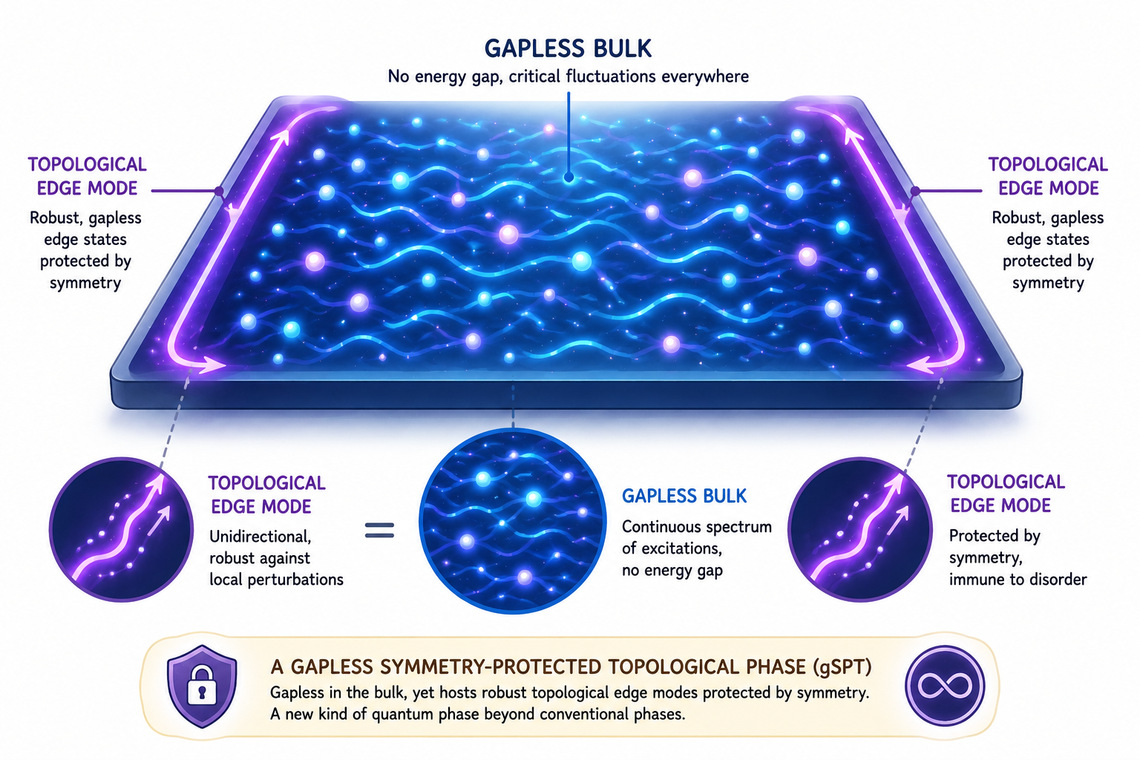
Coexistence of topology and criticality: Schematic of a gapless symmetry-protected topological phase (critical topological state). Image provided by the research group
A Paradigm Shift: Critical Topology Makes the "Incompatible" Compatible
Since 2021, several international theory groups, including that of Prof. Xue-Jia Yu's group, have gradually uncovered that even gapless quantum critical points can harbor rich topological phenomena. This demonstrates that topology and quantum criticality are not irreconcilable; on the contrary, their combination can give rise to new physics beyond gapped systems. Prof. Yu, in collaboration with Prof. Limei Xu of Peking University and Prof. Hai-Qing Lin of Zhejiang University, was invited to publish the first comprehensive review article in this emerging direction in Physics Reports [1], systematically outlining the nascent field of "critical topology."
The discovery of critical topology has challenged the traditional classification paradigm for phase transition: two critical points may share the same critical exponents yet belong to different categories owing to distinct topological properties. This novel quantum critical point transcends the description of Landau symmetry-breaking paradigm [2]. Currently, critical topology has been identified at quantum critical points and non‑equilibrium quantum critical points [3],exhibiting novel properties beyond conventional topological physics[4], and has recently been observed in large‑scale superconducting quantum circuit experiments [5].
Critical Topology Drives Anomalous Dynamics, Challenging the Conventional KZ Mechanism
Although the equilibrium properties of critical topology have attracted considerable attention, its non equilibrium dynamics remain largely unexplored.Prof. Yu's team investigated the dynamical scaling behavior of topologically distinct quantum critical points under driving [6], and discovered for the first time that non trivial topological edge states at quantum critical points can induce anomalous scaling behavior beyond the conventional KZ paradigm.
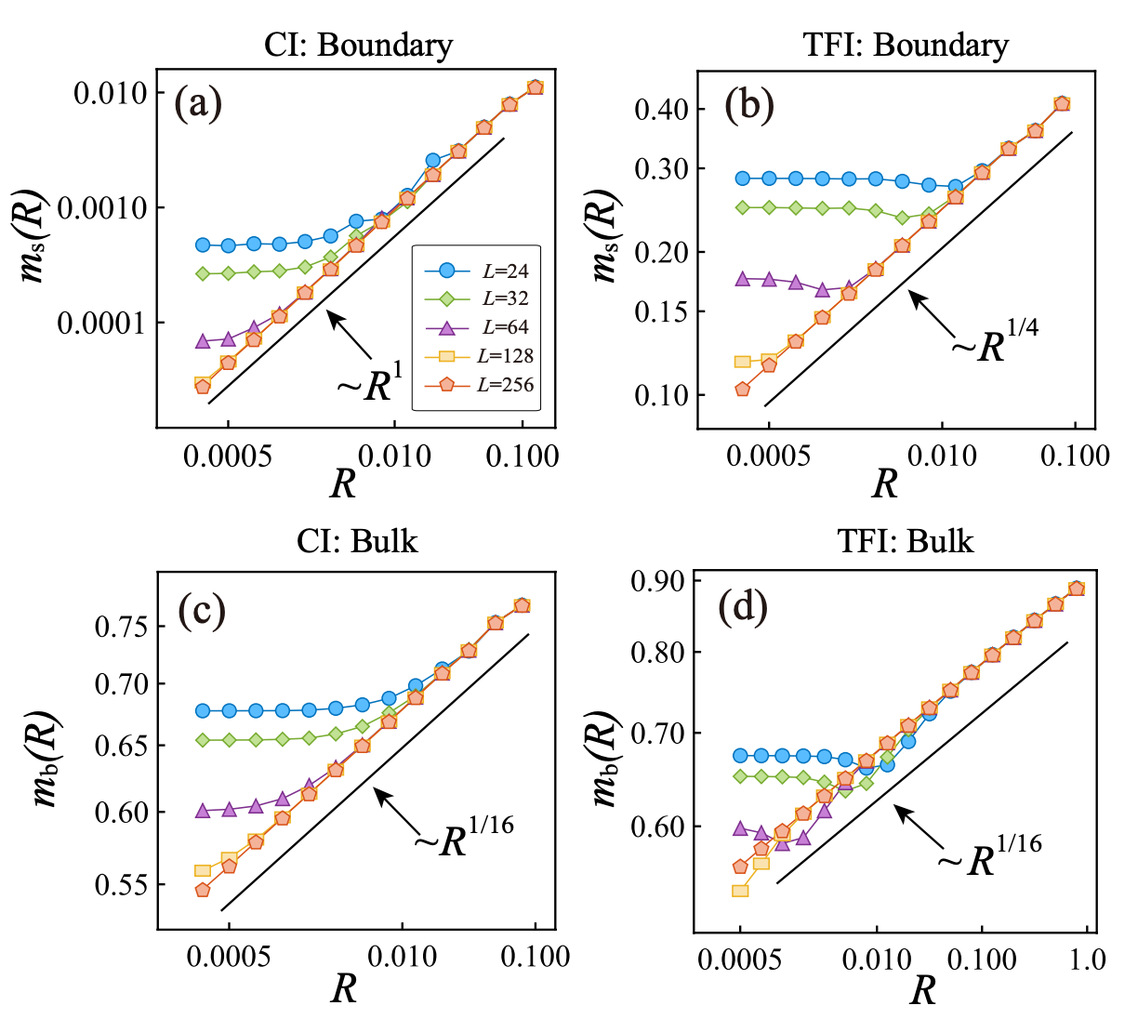
Bulk and boundary critical driven dynamical scaling in the one-dimensional transverse-field Ising model and the cluster-Ising model. Image provided by the research group
The KZ mechanism is the law of quantum critical dynamics: when a system is ramped across a phase transition too rapidly, it fails to keep up with the change, becomes "frozen," and leaves behind defects whose density follows a universal power law. By comparing the transverse-field Ising model (topologically trivial) and the cluster-Ising model (topologically non-trivial), the team found thatwhile the bulk dynamics of both models obey the standard KZ scaling, the boundary dynamics are radically different: the trivial case exhibits conventional KZ behavior, while the non-trivial case shows a modified power-law scaling that deviates from traditional theoretical predictions—as if the main body marches to a uniform rhythm while the edge detachment steps to its own beat.
This anomalous scaling was further corroborated by tensor network numerical simulations in a non exactly solvable quantum Potts chain. The team also examined driven dynamics at topologically distinct critical points in a free fermion model. These results unequivocally demonstrate that stable topological edge states at the critical point are the key ingredient driving anomalous universal dynamical behavior, thereby establishing a new mechanism for observing dynamical phenomena beyond the KZ framework.
The anomalous dynamical scalingcan serve as a natural and practical "probe" for detecting topological signatures at critical points. On current quantum simulation platforms, preparing a true critical ground state remains a formidable challenge. This dynamical probe, however, does not require precise ground state preparation; instead, topological information can be extracted from the evolution process, lending it significant experimental feasibility.
The first author of the paper is Dr. Menghua Deng (Hunan University), and the corresponding authors are Prof. Xue‑Jia Yu (Eastern Institute of Technology, Ningbo) and Prof. Fuxiang Li (Hunan University). Co‑authors include Dr. Sheng Yang (Zhejiang University) and Prof. Chen Sun (Hunan University). This work was supported by the National Natural Science Foundation of China and the China Postdoctoral Science Foundation.
Links to Related Works:
https://doi.org/10.1103/mqr4-wnny
[1] Xue-Jia Yu#, Limei Xu# , and Hai-Qing Lin# , Topological Physics at Quantum Critical Systems, Physics Reports 1160, 1 (2026)
https://www.sciencedirect.com/science/article/abs/pii/S0370157325002881
[2] Sheng Yang, Fu Xu, Da-Chuan Lu, Yi-Zhuang You# , Hai-Qing Lin# , and Xue-Jia Yu# , Deconfined criticality as intrinsically gapless topological state in one dimension, Phys. Rev. B 113, L201105 (2026)
https://journals.aps.org/prb/abstract/10.1103/nj3d-8g9s
[3] Xue-Jia Yu*, Sheng Yang*, Shuo Liu# , Hai-Qing Lin, and Shao-Kai Jian# , Gapless Symmetry-Protected Topological States in Measurement-Only Circuits, Phys. Rev. B. 113. 134302 (2026)
https://journals.aps.org/prb/abstract/10.1103/b95c-th5t
[4] Yuxuan Guo*, Sheng Yang*, and Xue-Jia Yu# , Generalized Li-Haldane Correspondence in Critical Dirac Fermion Systems, Phys. Rev. Research, 8, 023203 (2026)
https://journals.aps.org/prresearch/abstract/10.1103/96gp-fq3j
[5] Ziqi Tan*, ... , Xue-Jia Yu# (corresponding author),..., Exploring nontrivial topology at quantum criticality on a superconducting processor, Communications Physics 9, 136 (2026)
https://www.nature.com/articles/s42005-026-02569-9
[6] Menghua Deng, Sheng Yang, Chen Sun, Fuxiang Li# , and Xue-Jia Yu# , Anomalous Dynamical Scaling at Topological Quantum Criticality, Phys. Rev. Lett,137, 096605 (2026) (Editors's Suggestion)
https://journals.aps.org/prl/abstract/10.1103/mqr4-wnny

Prof. Xue-Jia Yu is an Assistant Professor at the Eastern Institute of Technology, Ningbo. He received his Ph.D. degree in 2023 from the International Center for Quantum Materials, School of Physics,Peking University.
The research group led by Prof. Xue-Jia Yu primarily focuses on theoretical and computational studies of quantum phase transitions and critical phenomena in strongly correlated many body systems, within the broader contexts of statistical physics and condensed matter physics. Their work integrates analytical approaches with large scale numerical simulations, employing a diverse toolkit that includes quantum (conformal) field theory, tensor networks, and quantum Monte Carlo algorithms. Over the years, they have produced a series of innovative achievements in quantum phase transition and critical theory, non equilibrium quantum criticality, and quantum simulation. In particular, the group has been at the forefront of the emerging field of topological physics at quantum critical points. As one of the early contributors to this direction, they have, over the past five years, consistently generated highly influential research results as primary corresponding authors, including two papers in Nature. Their expertise has been recognized by an invitation to write the first comprehensive review article in this area. Representative works include the systematic construction of a theoretical framework for topological invariants at quantum critical points and the elucidation of the corresponding topological bulk–edge correspondence.
Currently, the group is recruiting postdoctoral researchers and Ph.D. students. They warmly welcome young talents to join.
Contact: xuejiayu@eitech.edu.cn
Group website: https://www.x-mol.com/groups/xuejiayu_eit_qpt?lang=zh