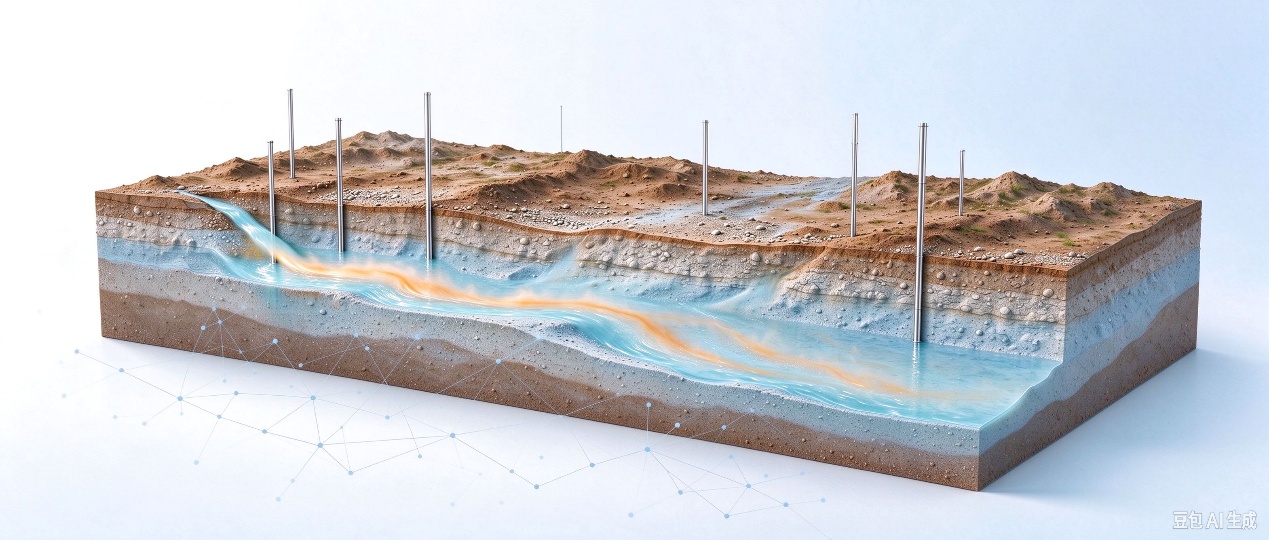
Where contaminants migrate after entering groundwater, and how long they remain in the subsurface, are among the most critical yet challenging questions in groundwater contamination prevention and remediation. Contaminants may rapidly reach downstream water supplies through highly permeable pathways, or they may become trapped within low-permeability domains, where they are slowly released over extended periods.
Recently, a team of researchers led by Chair Professor Chunmiao Zheng from the Eastern Institute of Technology, Ningbo (EIT), in collaboration with Associate Professor Zhilin Guo from the Southern University of Science and Technology (SUSTech) and other researchers worldwide, published a review article in Reviews of Geophysics, a prestigious international review journal. Centered on the Macrodispersion Experiment (MADE) site in the United States, the paper systematically reviews four decades of advances in field experiments and modeling studies on contaminant transport in groundwater, analyzes the key mechanisms governing contaminant migration in complex subsurface environments, and discusses next-generation transport prediction approaches and modeling tools for groundwater contamination prevention and remediation
Reviews of Geophysics is an invitation-only review journal published by the American Geophysical Union (AGU), with an impact factor of 38.5 in 2025.
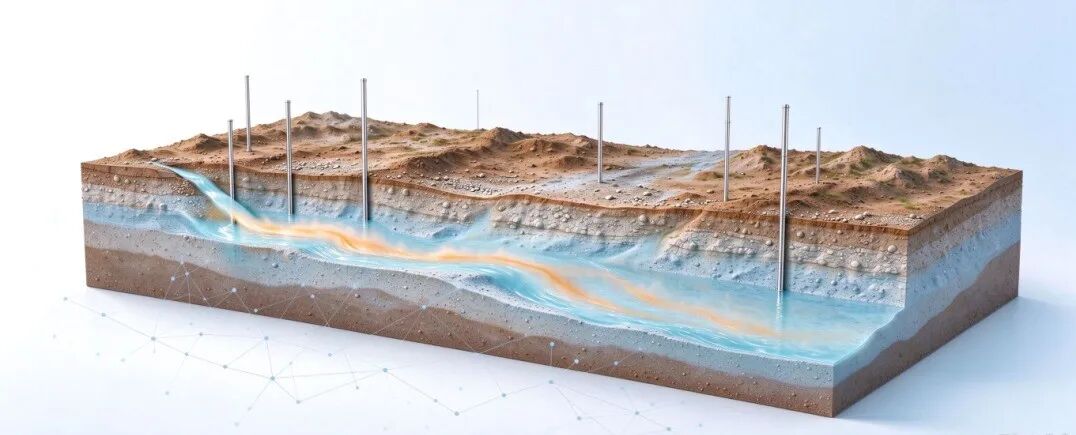
"CT Scanning" Contaminants in Groundwater
Groundwater is one of the world's most important sources of drinking water. Once contaminated, pollutants cannot be rapidly diluted or intercepted as they may be in surface water systems. Instead, they migrate slowly through pores and fractures within rocks and sediments, sometimes remaining undetected until they reach wells several kilometers away years later. Accurately predicting contaminant migration pathways in groundwater is therefore essential for timely risk identification and the protection of water resources.
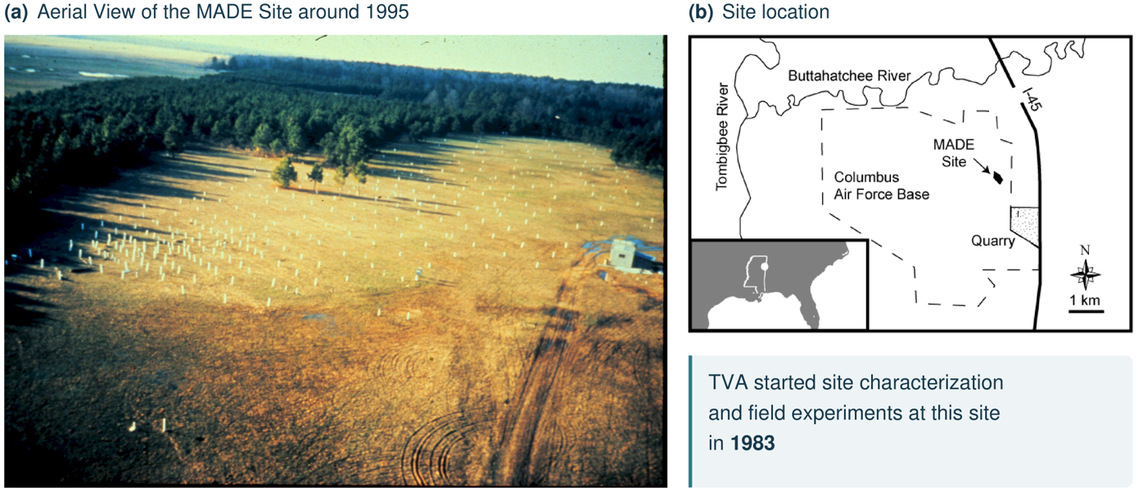
Schematic illustration of the U.S. Macrodispersion Experiment (MADE) site. (a) An aerial photograph taken around 1995; (b) geographical location. The site is located in Columbus, Mississippi, USA. Initial site investigations and experiments began in 1983.
Located in Columbus, Mississippi, USA, the MADE site provides an ideal field platform for investigating contaminant transport processes in heterogeneous aquifers. The aquifer at the site consists of interbedded sand, gravel, silt, and clay layers, with substantial spatial variability in hydraulic conductivity. Some regions exhibit high permeability and facilitate rapid flow, whereas others are relatively impermeable and restrict transport, forming a highly heterogeneous aquifer system representative of many natural subsurface environments.
Since 1986, researchers have conducted five major tracer experiments at the site, injecting tracers such as tritium and bromide into the subsurface. A dense monitoring network consisting of approximately 250 monitoring wells, with up to 30 sampling depths per well, has enabled high-resolution three-dimensional characterization of contaminant plumes. Over the past four decades, the MADE site has become one of the world's most important field experimental sites and model-testing platforms for studying contaminant transport in groundwater. This review also incorporates research from other classic field sites, including the Borden site in Canada, Twin Lake, Cape Cod, and Hanford in the United States, comparing similarities and differences in transport processes under different geological conditions.
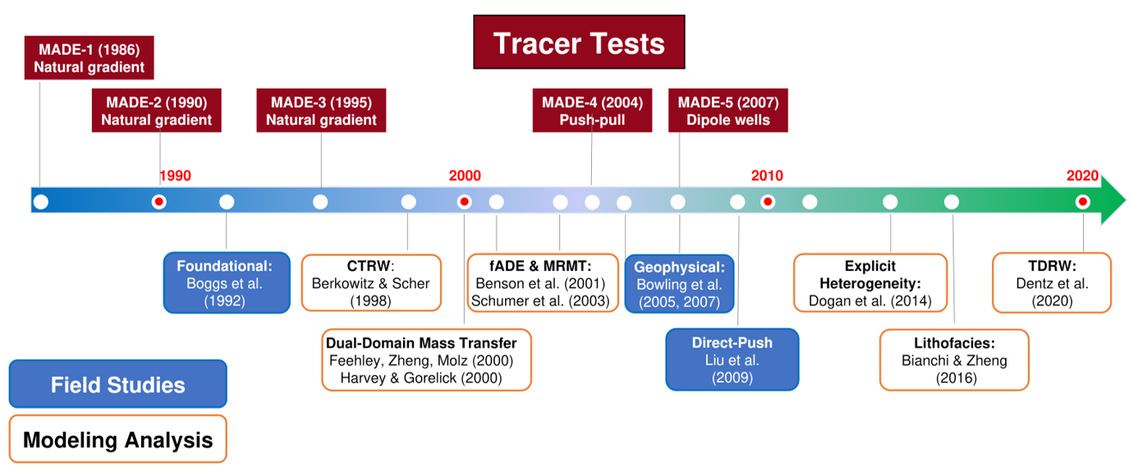
Timeline of research advances at the U.S. MADE site, showing major tracer experiments, site characterization technologies, and the development of transport models.
Decades of field observations have demonstrated that contaminant transport in groundwater often differs substantially from predictions based on classical theories. Some tracers migrate rapidly along highly permeable pathways, arriving at downstream locations earlier than predicted by conventional models. Others become trapped within low-permeability domains and are released slowly over long periods, producing pronounced tailing effects. Observed contaminant plume distributions are asymmetric, with slower concentration attenuation, exhibiting characteristic non-Fickian transport behaviors, including early arrival and long-term tailing.
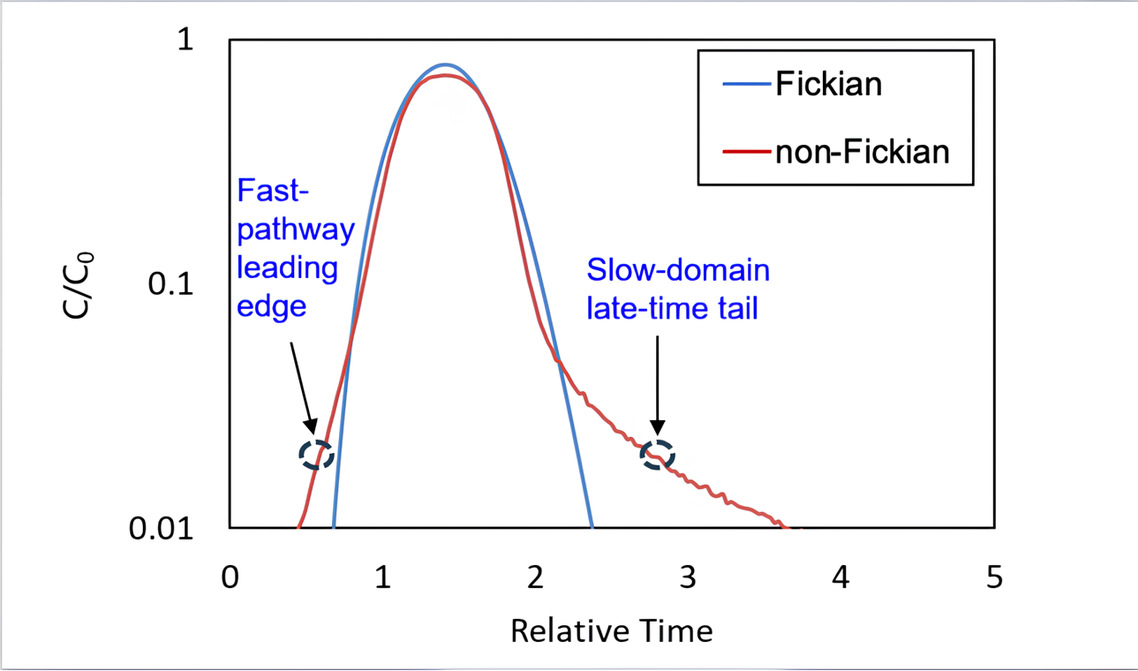
Schematic comparison of Fickian (blue line) and non-Fickian (red line) transport. Non-Fickian transport may exhibit early arrival and long-term tailing. The horizontal axis represents relative time, and the vertical axis represents normalized concentration (logarithmic scale). The curves are conceptual illustrations rather than measured data. Adapted from Figure 2 of the paper.
Why Classical Models "Fail"
The fundamental reason lies in the fact that natural aquifers are not homogeneous media. Instead, they consist of complex three-dimensional networks formed by the spatial arrangement of geological materials with different hydraulic properties. Contaminant migration pathways are controlled not only by variations in permeability, but also by the spatial distribution and connectivity of highly permeable pathways. If models fail to adequately represent rapid transport pathways and stagnant storage regions, simplified velocity fields cannot accurately reproduce observed transport behavior.
To address these challenges, the paper systematically reviews classical advection–dispersion equations and their applications in field settings, hydrofacies-based models, dual-domain and multi-rate mass transfer models, continuous-time random walk (CTRW) approaches, and fractional derivative models. The authors emphasize that model selection should be guided by available data, prediction objectives, and parameter acquisition conditions. A model's ability to reproduce the overall distribution of a contaminant plume does not necessarily mean that it can accurately predict contaminant concentrations at individual locations.
Professor Chunmiao Zheng's research group has been deeply involved in studies of the MADE site for many years and has made a series of contributions in areas including dual-domain mass transfer modeling, analysis of preferential flow pathways and three-dimensional connectivity structures, and hydrofacies-based transport simulation. For example, in 2000, the group applied a dual-domain mass transfer approach to simulate solute transport at the MADE site, successfully reproducing the observed non-Fickian transport behavior and providing important insights into contaminant migration processes in highly heterogeneous aquifers. This review integrates the group's research with advances from international researchers, systematically summarizing the mutually reinforcing development of field experiments, conceptual understanding, and transport modeling approaches.
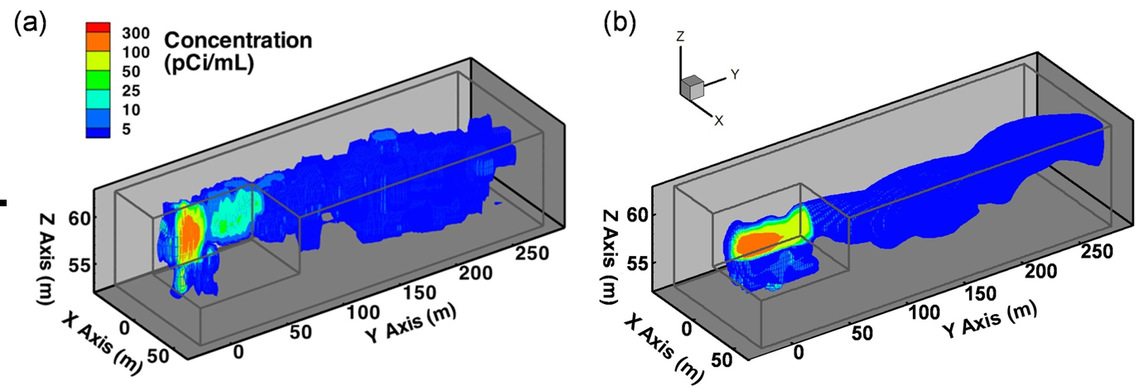
Tritium tracer plume 328 days after injection during the MADE-2 experiment. (a) Field observations; (b) dual-domain model simulation. The high-concentration region remained near the injection location, while low-concentration tracer mass extended downstream, demonstrating the heterogeneous nature of transport. Adapted from Figure 10 of the paper; original study: Feehley, Zheng* and Molz(2000).
From Field Experiments to Future Predictions
The paper highlights that future research needs to more accurately characterize the connectivity structures and discontinuities of subsurface media. It is essential not only to identify interconnected high-permeability pathways, but also to recognize geological interfaces that impede or modify these pathways. Integrating multiple sources of information, including borehole data, hydraulic testing, geophysical surveys, and tracer observations, will help reduce uncertainties associated with the characterization of critical subsurface structures.
Whether insights gained at the field-experiment scale can be extended to entire aquifers or watersheds requires further investigation. This will require the development of upscaling approaches that preserve key geological features and transport mechanisms, incorporate dynamic boundary conditions such as pumping and recharge, and systematically evaluate predictive uncertainties. Meanwhile, model evaluation should place greater emphasis on indicators directly related to contamination risks, including local concentrations, peak concentrations, and dilution levels, so that simulation results can better support monitoring network design, remediation strategy selection, and groundwater quality management.
The paper also discusses the potential applications of artificial intelligence-based approaches, particularly machine learning methods, in aquifer structure characterization, parameter inference, surrogate modeling, and observational data integration. Such approaches should satisfy fundamental physical constraints, including mass conservation and appropriate boundary conditions, reasonably reflect geological structures and their connectivity, and be validated against independent field observations. How to balance computational efficiency with physical consistency, while adapting to diverse data availability across different sites, remains an important area for future research.
The concept of deeply integrating artificial intelligence with physical processes was also systematically discussed by Professor Chunmiao Zheng in his keynote presentation at the recently concluded 53rd World Groundwater Congress of the International Association of Hydrogeologists. In his presentation, Professor Zheng highlighted the increasingly important role of AI in diagnosing contaminant transport processes, parameter inference, and contaminant source identification. He emphasized the necessity of incorporating mass balance and physical process constraints, as well as conducting independent validation, to ensure the reliability of AI-based approaches.
Prof. Zhilin Guo is the first author of the paper, and Prof. Chunmiao Zheng is the corresponding author. The study was jointly conducted by researchers from the Eastern Institute of Technology, Ningbo; Southern University of Science and Technology; the University of Alabama; the University of California, Davis; the Weizmann Institute of Science in Israel; the Institute of Environmental Assessment and Water Research in Spain; and other institutions worldwide. The research was supported by the National Natural Science Foundation of China and related research programs from Guangdong, Zhejiang, Ningbo, and other funding agencies.