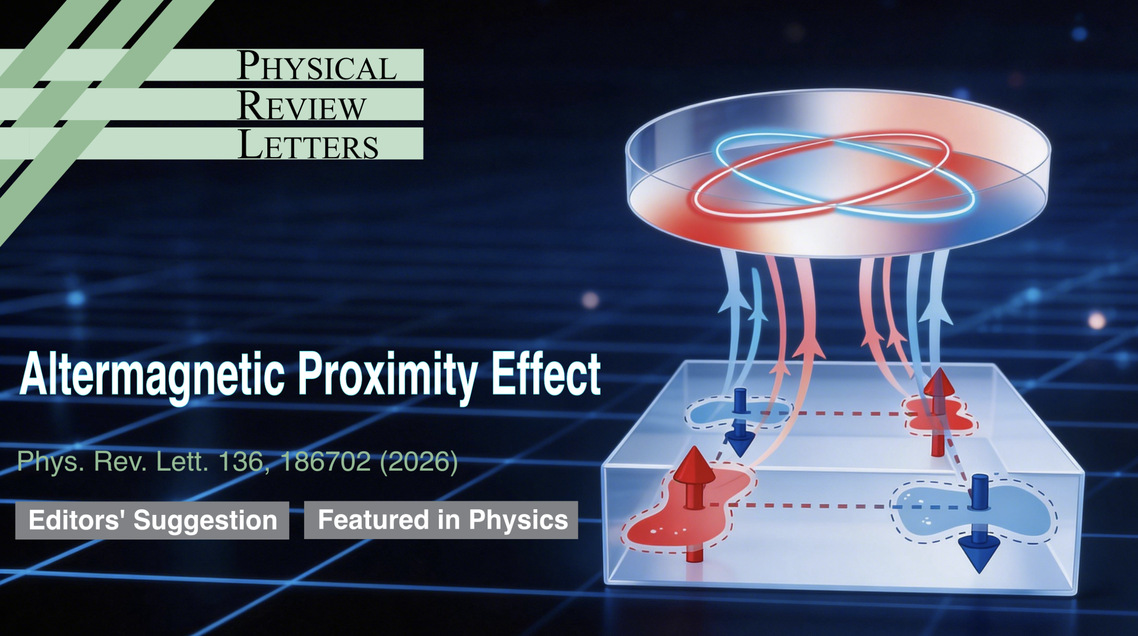
Recently, the team led by Associate Professor Tong Zhou at the Eastern Institute of Technology, Ningbo (EIT), has made significant advances in the field of magnetism and spintronics. For the first time, the research team has revealed an entirely new interfacial physical mechanism—the altermagnetic proximity effect. The findings were published in Physical Review Letters, a top-tier international physics journal, under the title "Altermagnetic Proximity Effect." The paper was selected as an Editors' Suggestion and featured as a highlight on the journal's homepage. Concurrently, Physics, the science reporting journal of the American Physical Society, featured the research in a dedicated story titled "Spreading the Altermagnetic Love" (Featured in Physics). This work systematically elucidates how altermagnetism can be transferred to nonmagnetic materials via an interfacial proximity effect, forging a new pathway for the interfacial engineering and functional application of altermagnetism.
The Physics of "One Takes on the Behavior of One's Company"
An ancient proverb states, "One takes the behavior of one's company", a metaphor for how an environment influences an individual. In the microscopic world, an analogous phenomenon is widespread. In physics, this is known as the proximity effect: when two materials come into contact, their physical properties can influence each other and even transfer across the interface. For instance, a superconductor can induce superconducting properties in an ordinary material at the interface, and a ferromagnet can make an adjacent non-magnetic material exhibit magnetism. Such interfacial effects have become a crucial physical foundation for the development of superconducting quantum devices and spintronics.
Does the Proximity Effect Exist for Altermagnetism?
In recent years, a new class of collinear magnetism—altermagnetism—has attracted widespread attention. Like an antiferromagnet, it possesses zero net magnetization, yet like a ferromagnet, it exhibits spin splitting, combining the advantages of both and presenting rich physical implications and application potential. However, the properties of a single altermagnetic material remain relatively limited, and the number of experimentally confirmed materials is small, restricting its application development to a certain degree. The proximity effect offers a vital route for integrating distinct physical properties, but it was unclear whether altermagnetism could sustain a proximity effect. Unlike the spatially uniform spin polarization characteristic of ferromagnetism, altermagnetism originates from the specific crystalline symmetry relationships between spin sublattices, placing stringent requirements on the overall lattice symmetry.
A critical question thus arises: Given that altermagnetism depends on the overall lattice symmetry, while the proximity effect is typically confined to the interfacial vicinity, can this magnetism, dictated by global symmetry, be transferred across a finite interface to an adjacent non-magnetic material? Furthermore, what physical behavior emerges if the target material itself lacks the corresponding symmetry?
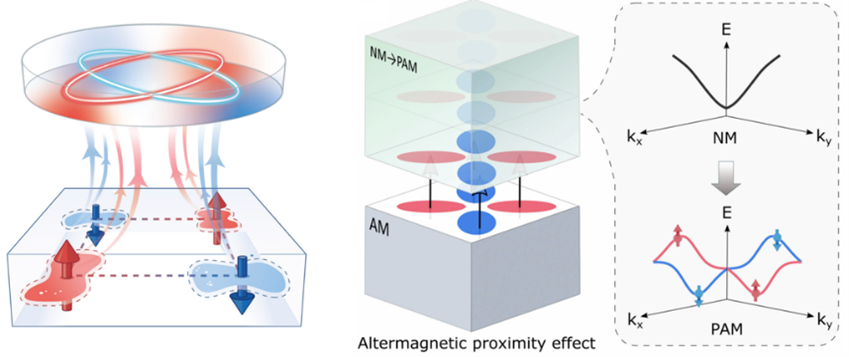
Schematic illustration of the altermagnetic proximity effect. Image provided by the research group
The Universality of the Altermagnetic Proximity Effect: Cross-Interface "Adaptive Reconstruction" of Spin-Electronic Structure
To address this question, the research team conducted a systematic investigation using symmetry analysis, model analysis, and first-principles calculations. Using the typical layered altermagnetic material V₂Se₂O as an example, the team constructed a heterostructure with the non-magnetic material PbO. They demonstrated, through multiple lines of evidence, that the originally non-magnetic PbO acquires the altermagnetic properties of V₂Se₂O via interfacial coupling—that is, it becomes altermagnetized. The team termed this novel interfacial mechanism, capable of transferring altermagnetism across an interface, the altermagnetic proximity effect. In this process, the electronic wave functions extend and hybridize at the interface, causing the characteristic momentum-dependent spin splitting of altermagnetism to be transferred into the originally spin-degenerate non-magnetic material.
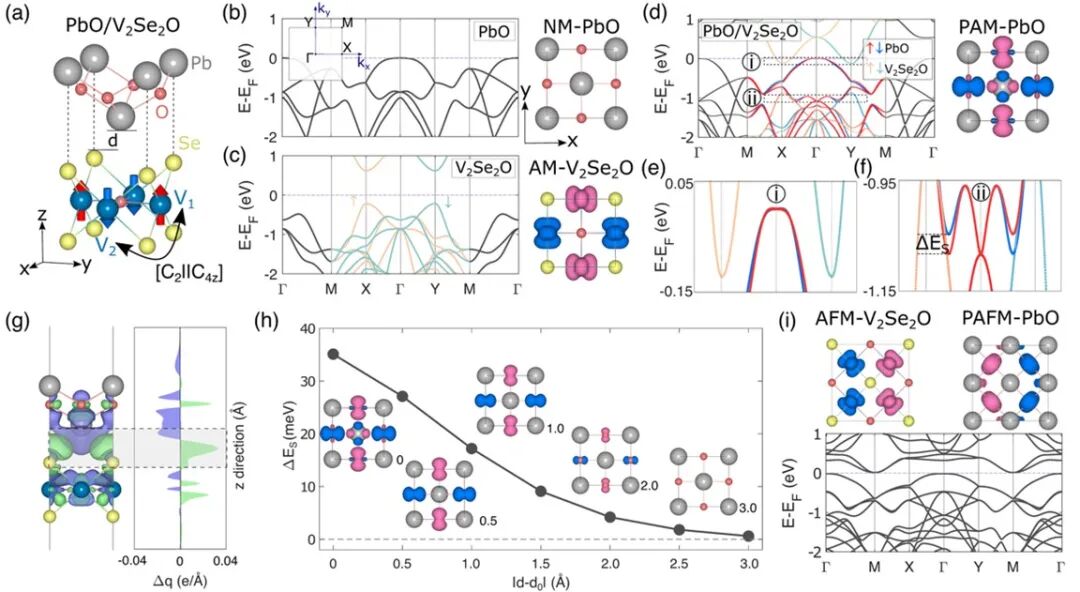
Verification of the altermagnetic proximity effect in the V₂Se₂O/PbO heterostructure, based on first-principles calculations. Image provided by the research group
Furthermore, the team verified the universality of the altermagnetic proximity effect across a variety of typical altermagnetic systems, covering material platforms ranging from two-dimensional to three-dimensional structures, and from insulators to metals. A representative result is that even graphene, the most common two-dimensional material, can acquire altermagnetic properties by forming a heterostructure with the experimentally established altermagnetic material CrSb, even when their lattices are mismatched. This indicates that altermagnetism can be widely introduced through interfacial engineering, no longer restricted to a few specific materials. More importantly, this process demonstrates a capacity for "spin-electronic structure adaptation": even when lattice symmetry is mismatched, the system can achieve effective coupling through the reconstruction of electronic states, thereby greatly expanding the freedom in material design.
"Having the Best of Both Worlds" in Quantum Material Design
The potential value of the altermagnetic proximity effect lies in providing an entirely new pathway for the synergistic integration of multiple physical properties. For example, using V₂Se₂O as a platform, the team constructed a heterostructure with the valleytronic material PbS, achieving tunable spin and valley splitting. Combining it with the s-wave superconductor NbSe₂ induces spin splitting without introducing net magnetization, causing NbSe₂ to exhibit a topological superconducting state. This offers new opportunities for realizing Majorana zero modes and their geometric control. A more profound implication is that this mechanism makes it possible, through heterostructure design, to integrate various physical properties into a unified platform that would otherwise be difficult to coexist within a single material system, truly achieving the goal of "having the best of both worlds."
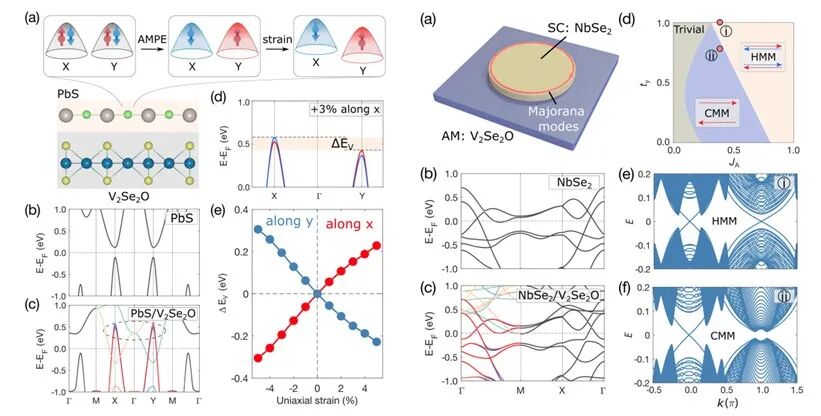
Application of the altermagnetic proximity effect in valleytronics and topological superconductivity. Image provided by the research group
This work transforms altermagnetism from an intrinsic property of a material into a functional resource that can be transferred, reconstructed, and exploited through engineering. Just as the superconducting and ferromagnetic proximity effects once propelled the development of superconducting quantum devices and spintronics, the altermagnetic proximity effect holds promise to play a pivotal role in the future design of quantum materials and devices.
The Eastern Institute of Technology, Ningbo, is the first affiliation of the paper. Postdoctoral researchers Ziye Zhu and Richang Huang from Associate Professor Tong Zhou's team are the co-first authors, and Associate Professor Tong Zhou is the sole corresponding author. Collaborators also include postdoctoral researchers Xianzhang Chen, Zhou Cui, and Jiayong Zhang, Ph.D. student Xunkai Duan from Associate Professor Tong Zhou's team, and Professor Igor Žutić from the University at Buffalo, The State University of New York. This work was supported by the National Natural Science Foundation of China, the Zhejiang Provincial Natural Science Foundation of China, and other funding sources.