The fast charging and long-range capability of new energy vehicles rely heavily on high-performance battery materials. For next-generation all-solid-state lithium batteries, how to achieve both rapid charge-discharge capability and long-term cycling stability while ensuring safety constitutes one of the key challenges hindering their practical application.
The team led by Chair Professor Xueliang Sun, Foreign Member of the Chinese Academy of Engineering and Associate Professor Xiaona Li at the Eastern Institute of Technology, Ningbo (EIT) addressed the transport bottleneck within the composite cathode of all-solid-state batteries by proposing an innovative material design strategy. They introduced a lithium tungsten oxychloride (LWOC) functional additive to simultaneously construct both ionic and electronic conduction pathways inside the cathode, thereby transforming the originally discrete and inefficient reaction regions into a continuous and synergistic transport network. This strategy significantly enhances the electrochemical performance of all-solid-state NCM cathodes under high-rate and long-term cycling conditions.
Recently, these findings were published in the Journal of the American Chemical Society.
The "Transport Bottleneck" in Solid-State Battery Cathodes
While all-solid-state lithium batteries promise high safety and high energy density, their composite cathodes still suffer from complex transport issues. A conventional composite cathode typically consists of a cathode active material (CAM), solid electrolyte, and carbon conductive additive. The solid electrolyte primarily conducts lithium ions, while the carbon additive handles electronic conduction. However, this design is not always efficient under practical operating conditions. Because the ionic and electronic pathways are separate, the composite cathode can develop "electron-rich/ion-deficient" or "ion-rich/electron-deficient" regions, leading to underutilization of the active material. This transport mismatch is exacerbated during high-rate charge–discharge processes, causing rapid capacity decay.
Furthermore, conventional carbon additives tend to be rigid. During long-term cycling, they struggle to accommodate the volume changes of cathode particles, often resulting in localized contact loss and increased interfacial impedance. Therefore, constructing a stable, efficient, and evolution-adaptive ionic/electronic synergistic transport network within the composite cathode is critical for enhancing all-solid-state battery performance.
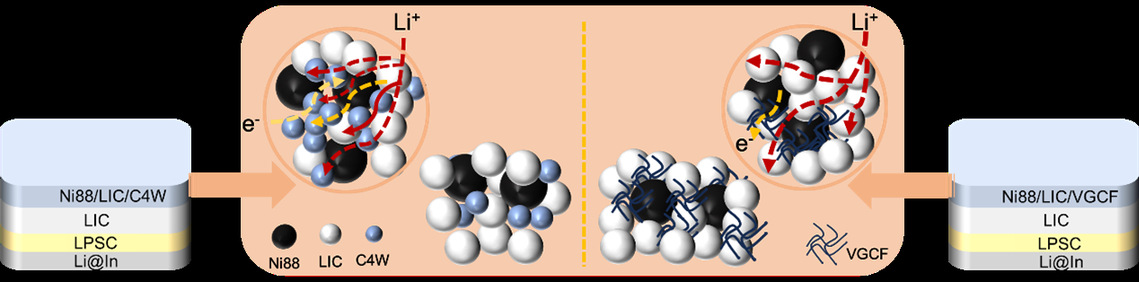
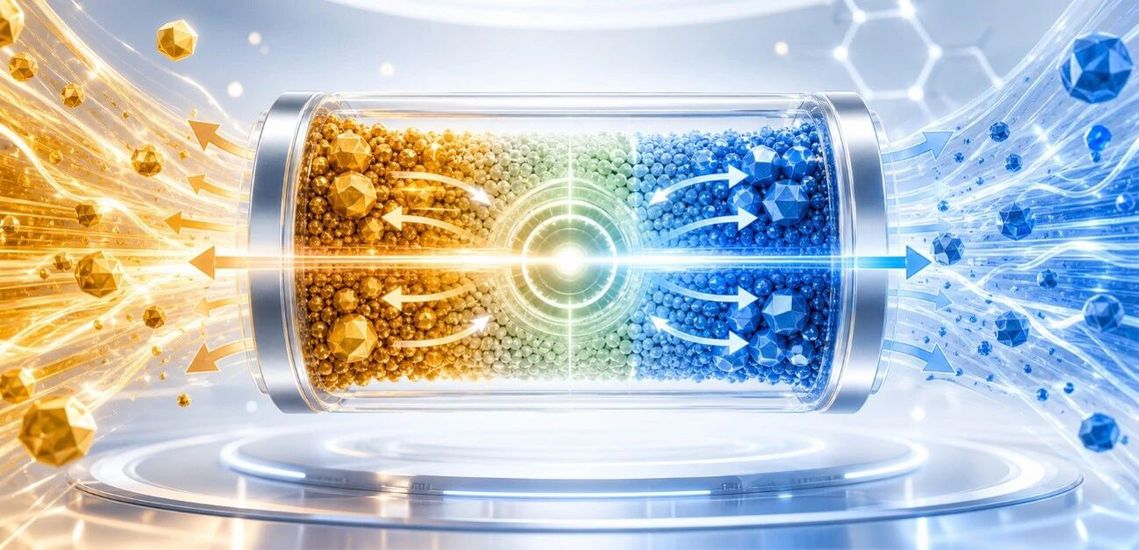
Schematic illustration of electron and ion transport inside the composite cathode. Image provided by the research group
Enabling Additives to Conduct More Than Just Electrons
To tackle this issue, the team stepped outside the conventional design philosophy for carbon conductive additives: since the composite cathode needs both lithium-ion and electron conduction, why not develop an additive that fulfills both roles simultaneously?
Following this rationale, the team designed the LWOC system as a novel functional additive. Unlike traditional carbon additives (e.g., VGCF), LWOC not only possesses electronic transport capability but also exhibits a certain level of lithium-ion conductivity. The abundant W–O/Cl local coordination environments within its structure facilitate Li⁺ migration, while the electronic structure associated with the high-valence state of W promotes electron transport. In other words, LWOC is no longer merely a simple "electron wire"; it functions as a mixed conductor that simultaneously connects ionic and electronic transport pathways inside the composite cathode.
Experimental results demonstrate that a representative LWOC additive exhibits a lithium-ion conductivity of approximately 0.73 mS cm⁻¹, while its electronic conductivity reaches levels comparable to, or even better than, commonly used carbon additives. This dual-transport property provides the material foundation for constructing a continuous reaction network inside the composite cathode.
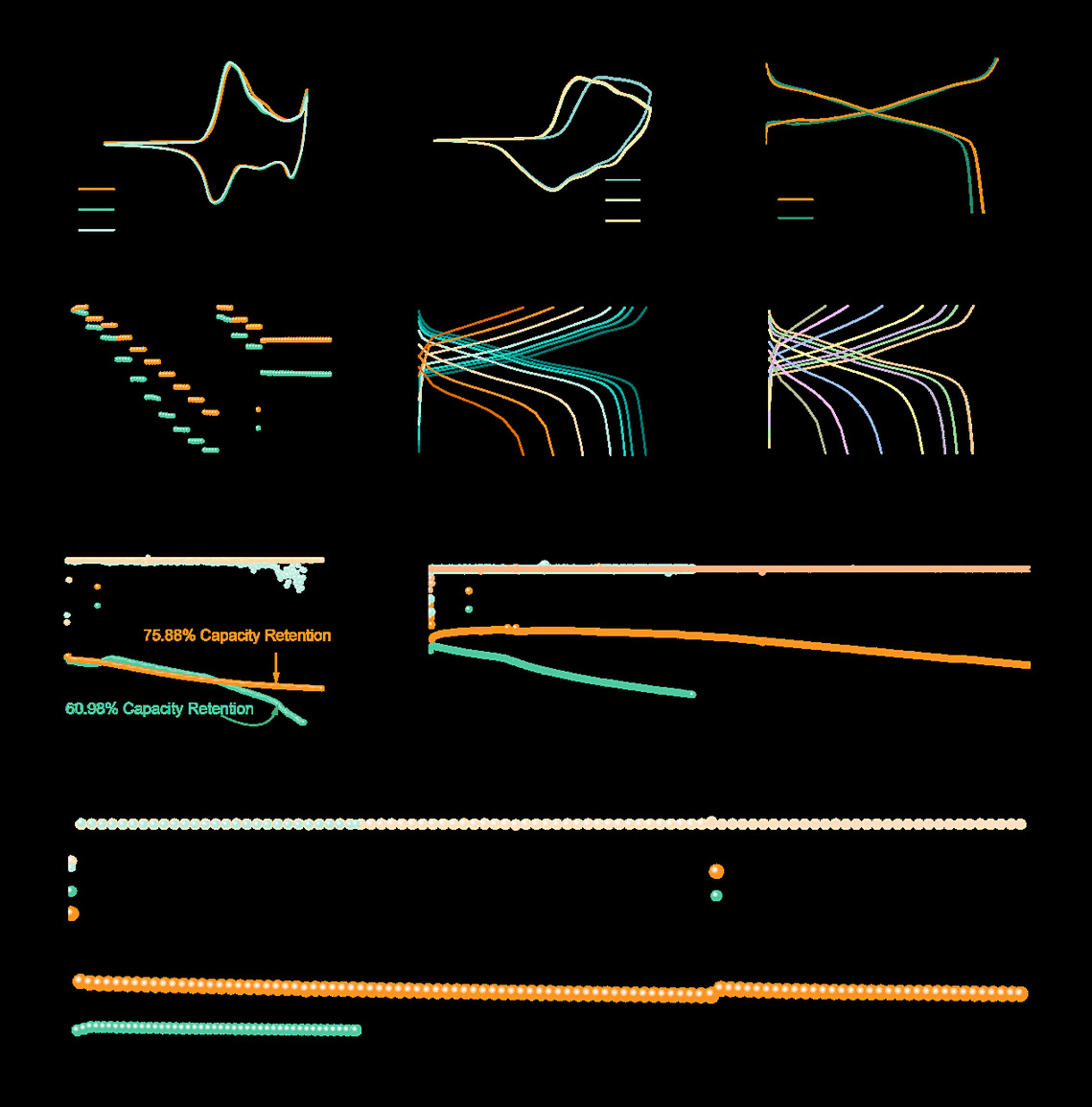
Electrochemical performance of LWOC. Image provided by the research group
From "Ion‑Isolated Zones" to a "Synergistic Transport Network"
The introduction of LWOC markedly transforms the transport regime within the composite cathode. While conventional carbon additives primarily establish electronic pathways without effectively ameliorating the ionic transport deficiency, LWOC participates in both ionic and electronic transport, making the originally separate channels more continuous. This synergistic transport network plays multiple roles: it reduces transport dead zones within the composite cathode, thereby enhancing the utilization of the NCM active material; it exhibits favorable structural and chemical compatibility with halide solid electrolytes, helping to lower local interfacial impedance; and its relatively compliant mechanical characteristics better accommodate microstructural changes during cathode cycling, preserving stable interparticle contact.
Consequently, all-solid-state NCM batteries constructed with LWOC deliver outstanding performance: they retain 81.18% of their initial capacity after approximately 1,800 cycles at 1C, and achieve a capacity retention of 81.31% after 10,000 cycles at a much higher rate of 5C. This system also demonstrates superior cycling stability under high cathode loading conditions.
It is worth emphasizing that this strategy does not simply substitute a novel material for the traditional carbon additive; rather, it redefines the functional role of the additive in composite cathodes—from a single-function electronic conductor to a multifunctional mixed conductor that integrates ion transport, electron transport, and interfacial stabilization. This design provides a new paradigm for constructing high-rate, long-life composite cathodes for all-solid-state batteries.
Mingying Zhang, a Ph.D. student jointly supervised by EIT and Shanghai Jiao Tong University and Dr. Xingyu Wang, a postdoctoral researcher at EIT are the co-first authors of the paper. Dr. Jianwen Liang, Director of the GRINM (Guangdong) Institute for Advanced Materials and Technology & China Automotive Battery Research Institute , Professor Xueliang Sun, and Associate Professor Xiaona Li are the co-corresponding authors.
This research was supported by the Beijing Natural Science Foundation, the Ningbo Yong Jiang Talent Introduction Program, the National Natural Science Foundation of China, Beijing Nova Program
Link: https://doi.org/10.1021/jacs.5c22628