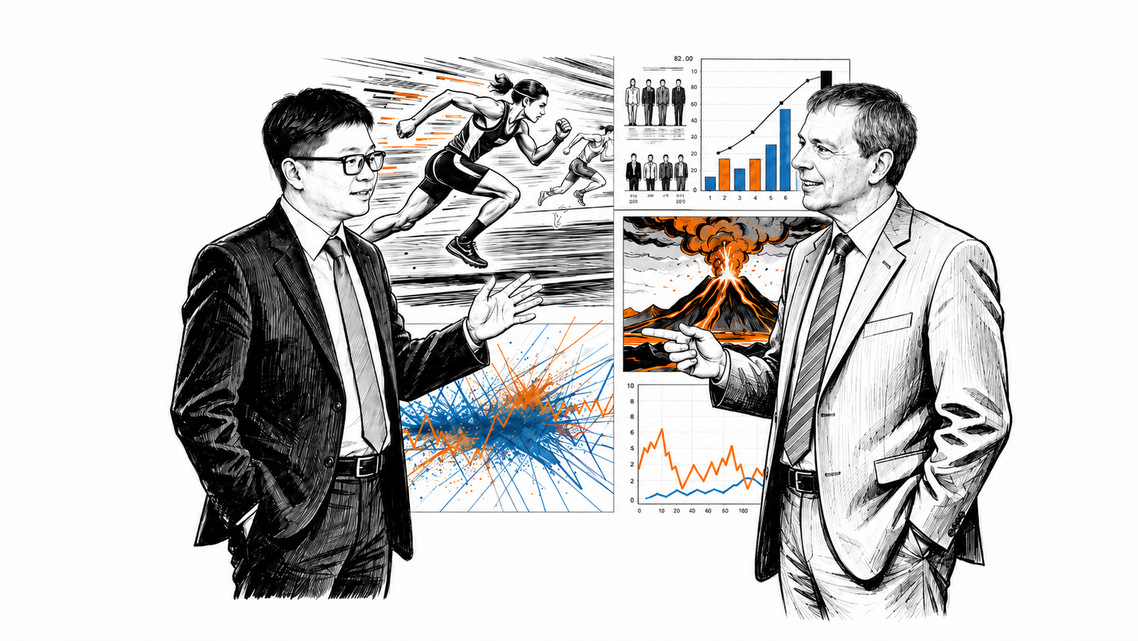
How fast can humans possibly run the 100-meter dash? This question has captivated the world since Usain Bolt set the current world record of 9.58 seconds. On the 100-meter track, each 0.01-second improvement represents a new breakthrough, making the "limit of human speed" a classic topic in sports science.
Recently, Professor Yi He of the College of Science at the Eastern Institute of Technology, Ningbo (EIT), in collaboration with John H.J. Einmahl, a leading authority on extreme value statistics from Tilburg University in the Netherlands, re-estimated the ultimate human limit in the 100-meter dash using more rigorous extreme value theory. Their findings suggest that, in a statistical sense, the ultimate 100-meter record for humans is approximately 9.49 seconds for men and 10.20 seconds for women. The research has been published in the paper titled "Accurate Estimates of Ultimate 100-Meter Records in Extremes", a leading international journal in the field of extreme value theory.
Why were previous estimates inaccurate? This approach upgrades the methodology
The 100-meter dash is a quintessential "extreme value problem." Researchers are not focused on the average of the general population, but rather on the limits of the world’s elite sprinters.
In the past, traditional research methods faced two major challenges. First, sparse data: inferences were typically drawn from a limited set of historical world records or a few top-tier performances, resulting in a small sample size. Second, overly idealistic assumptions: these methods often assumed that all elite athletes share the same upper bound of attainable performance In reality, between-individual differences (i.e., heterogeneity) exist, and each athlete may have a different personal "upper limit." These factors contributed to considerable uncertainty in previous predictions.
Characterizing the boundary of 100-meter limits with a large sample
To enhance the reliability of their estimation, the researchers compiled an extensive dataset of 100-meter performance data from 1991 to 2023, covering the world’s top sprinters.
The men's dataset included 25,244 performance records involving 5,618 athletes; the women's dataset comprised 11,654 records involving 2,528 athletes. Rather than using only each athlete's single best performance, the study incorporated up to five seasonal bests per athlete. Including multiple performances per athlete is essential to statistically capture individual heterogeneity and obtain reliable standard errors of the estimates.
Based on these data, the study derived a 95% lower confidence bound for the ultimate human 100-meter time.
The ultimate 100-meter record for men is 9.49 seconds.
This means that scientists are 95% statistically confident that a human will almost certainly not run faster than 9.49 seconds. This limit is a mere 0.09 seconds beyond Bolt’s world record of 9.58 seconds.
The ultimate 100-meter record for women is 10.20 seconds.
Similarly, it is statistically highly improbable for the women’s 100-meter time to drop below 10.20 seconds. This leaves a theoretical room for improvement of 0.29 seconds from Florence Griffith-Joyner’s world record of 10.49 seconds.
A key advantage of this study is its markedly improved precision compared to previous research. By using multiple performances per athlete, the team achieved a more accurate characterization of how athlete heterogeneity affects the statistical estimation, yielding an approximately 35% reduction in the asymptotic variance of the estimates. This implies that the new results are not only more precise but also better reflect the complexities inherent in real-world competitions.
A new statistical tool for studying athletic limits
This research does not claim that world records will never be broken. Rather, it provides a statistically meaningful boundary for "how much faster" humans can go. It transforms popular discussions about speed, talent, and limits into questions that can be tested by data and scientific theory, offering a new perspective for sports science and related fields.
The Eastern Institute of Technology, Ningbo is the primary affiliation of the paper. Professors John H.J. Einmahl of Tilburg University and Professor Yi He of EIT are co-first authors, with Professor Yi He He serving as the sole corresponding author.