In the realm of chemical synthesis, asymmetric catalysis has consistently remained one of the most challenging research frontiers. It governs our ability to efficiently and precisely construct molecules bearing specific chiral architectures—molecules that are ubiquitous in pharmaceuticals, agrochemicals, and functional materials. Meanwhile, electrosynthesis, a green methodology driven by electrical energy, has garnered considerable attention in recent years.
However, the convergence of these two powerful technologies has often resulted in significant incompatibility. Specifically, in nickel-catalyzed asymmetric reductive cross-coupling reactions, traditional direct current (DC) electrolysis faces two persistent obstacles: cathodic over-reduction and anodic metal salt deposition. These issues critically impede the development of related research.
Recently, the research team led by Associate Professor Chen Zhu at the Eastern Institute of Technology, Ningbo (EIT), achieved a new breakthrough in asymmetric cross-coupling reactions. The team has introduced, for the first time, asymmetric-waveform alternating current (asym. AC) into nickel-catalyzed asymmetric reductive cross-coupling.
The related findings were published in the international journal Nature Communications.
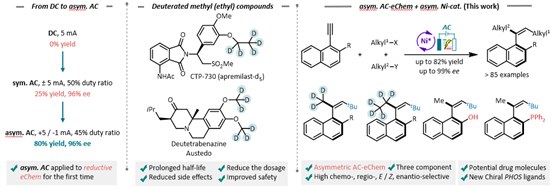
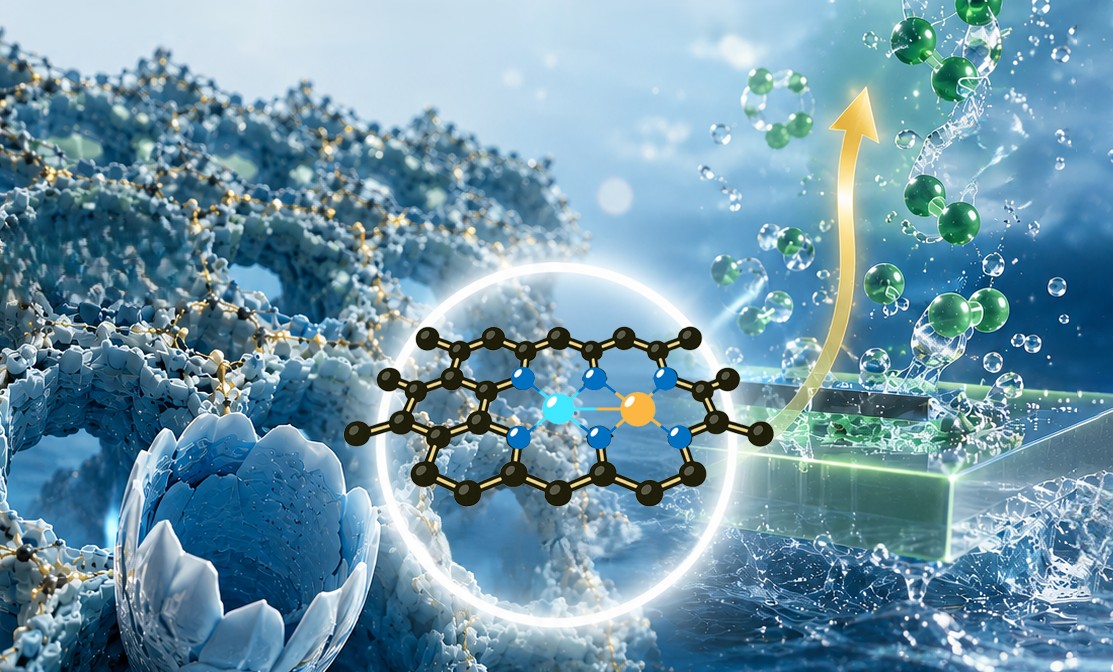
Asymmetric coupling reaction synergistically catalyzed by alternating current (AC) and nickel | Image provided by the research group
This study has developed an asymmetric reductive dialkylation of alkynes, leveraging a synergistic asymmetric waveform alternating current/nickel catalysis system. This strategy successfully overcomes the challenges of cathodic over-reduction and anodic metal salt deposition inherent to DC electrolysis. By periodically reversing the electrode polarity, the approach achieves dynamic regulation of the electrochemical interface, thereby enabling the efficient construction of axially chiral aryl alkenes. Moreover, it exhibits excellent substrate scope, robust functional group compatibility, and promising potential for flow electrochemical system scale-up.
Furthermore, this method is applicable to the synthesis of deuterated compounds and the development of novel chiral phosphine ligands. The resulting chiral phosphine ligands demonstrate exceptional chiral induction ability in palladium-catalyzed asymmetric allylation reactions.
Integrated with experimental studies and Density Functional Theory (DFT) calculations, the authors systematically elucidated the reaction pathways and the origins of chemo-, regio-, E/Z-, and enantio-selectivities. This work establishes a critical foundation for extending asymmetric alternating current (AC) strategies to a broader range of transition-metal-catalyzed reductive reactions in the future.
Dr. Zhiyang Lin, a postdoctoral researcher at EIT, is the first author of the paper. Mr. Cai Zhai, a Ph.D. student at EIT, participated in the DFT calculations and reaction mechanistic studies. Professor Chen Zhu is the sole corresponding author. This research was supported by grants including the National Science and Technology Major Project of the Ministry of Science and Technology and the National Natural Science Foundation of China (NSFC).