Recently, the team led by Chair Professor Xueliang Sun, Foreign Member of the Chinese Academy of Engineering, and Assistant Professor Changhong Wang at the Eastern Institute of Technology, Ningbo (EIT), published a research article in Nature Communications. Using a PrCl₃-based halide solid electrolyte as a model system, they systematically elucidated the structural role of foreign cations and the underlying ion conduction mechanism, and on this basis designed a high-performance electrolyte suitable for low-temperature all-solid-state batteries.
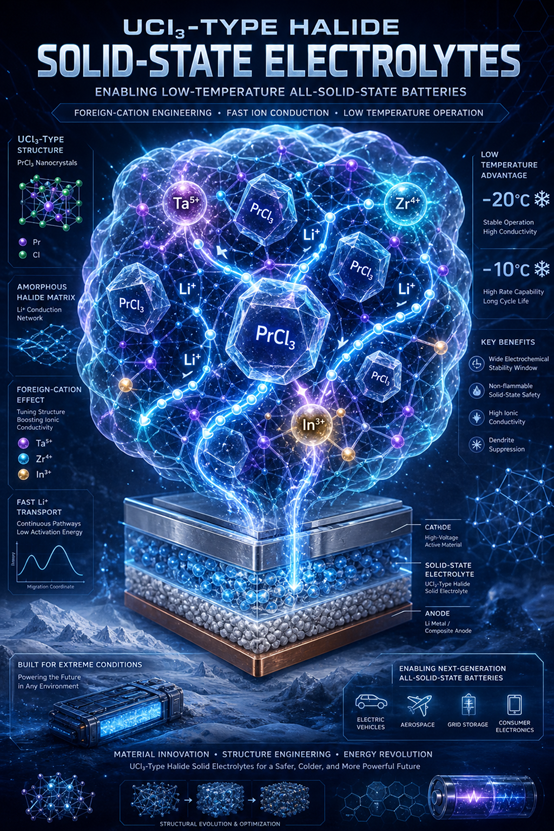
Low temperature is a critical hurdle that all-solid-state batteries must overcome for real-world application. Solid electrolytes that perform well at room temperature often suffer from sluggish ion migration, increased interfacial impedance, and rapid capacity fade in subzero environments. For electric vehicles, low-altitude aircraft, polar equipment, and similar scenarios, batteries must be not only safe but also capable of delivering sufficient power at low temperatures.
Halide solid electrolytes are regarded as a key candidate system for all-solid-state batteries owing to their high ionic conductivity, favorable mechanical compliance, and compatibility with high-voltage positive electrodes. Among them, UCl₃-type rare-earth chloride electrolytes have attracted increasing attention, but a fundamental question has long remained unanswered: when foreign cations such as Ta⁵⁺, Zr⁴⁺, and In³⁺ are introduced, do they enter the crystalline lattice or form a new amorphous phase? And where does the fast Li⁺ conduction truly take place?
Core innovations
Overturning the conventional assumption that small foreign cations enter the UCl₃-type lattice
We found that cations with smaller radii and different coordination preferences—such as Ta⁵⁺, Zr⁴⁺, and In³⁺—do not effectively substitute for Pr³⁺ and enter the PrCl₃ lattice. Instead, they predominantly enrich in the amorphous Li–M′–Cl matrix.
Identifying the dominant pathway for fast ion conduction: not the PrCl₃ nanocrystals, nor the crystal/amorphous interface, but the amorphous phase
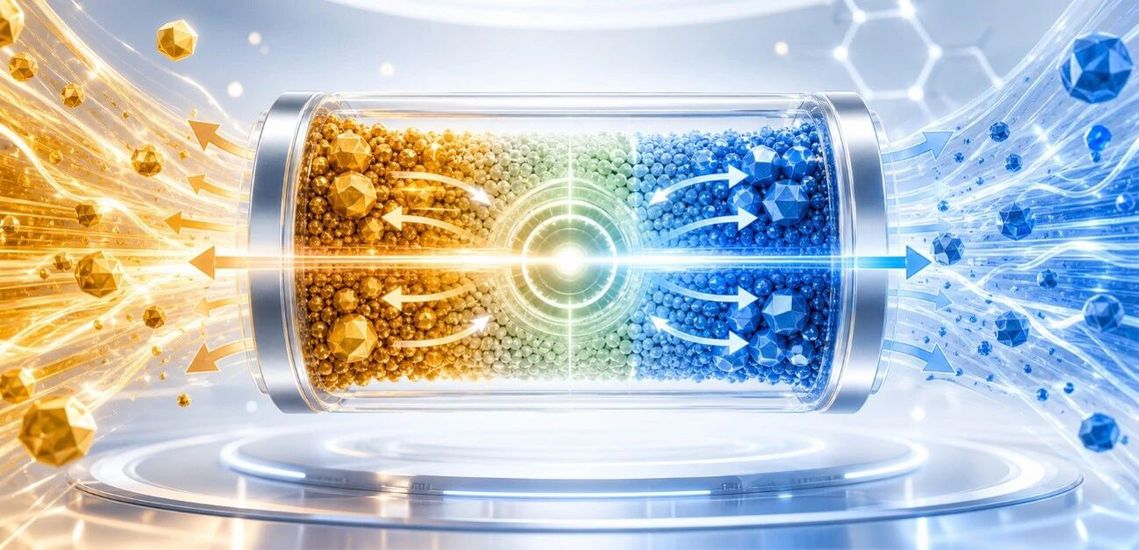
By comparing the structure and conductivity before and after thermal treatment, combined with low-temperature impedance analysis and Ab initio molecular dynamics (AIMD) simulations, we proposed an "amorphous-phase-dominated conduction model": Li⁺ migrates through the dynamic breaking and re-forming of Li–Cl bonds in the amorphous Li–M'–Cl network.
Establishing "amorphous-phase engineering" as a design principle for UCl₃-type halide electrolytes
Previous design strategies largely focused on lattice doping and tuning crystalline pathways, whereas this work shifts the optimization target to the composition, fraction, and formation process of the amorphous phase.
Designing a high-performance low-temperature electrolyte, PTZ-0.25
The optimized composition Li₀.₅Pr₀.₄₅₅Ta₀.₁₇₉Zr₀.₀₆Cl₃ achieves a room-temperature ionic conductivity of 3.10 mS cm⁻¹ with a low activation energy of 0.236 eV.
Demonstrating practical potential in low-temperature all-solid-state batteries
All-solid-state batteries employing PTZ-0.25 deliver a capacity retention of 71.7% at −20 °C and 20 mA g⁻¹, and a cycling life exceeding 1,350 cycles at −10 °C under 100 or 200 mA g⁻¹.
The core significance of this work lies in clarifying the role of foreign cations in UCl₃-type halide solid electrolytes: species such as Ta⁵⁺ and Zr⁴⁺ do not substitute into the PrCl₃ lattice, but rather enrich in the amorphous phase, which dominates fast Li⁺ conduction. This finding provides a new "amorphous-phase engineering" strategy for the rational design of solid electrolytes. The broader implications include enhanced low-temperature ion transport, cycling stability, and safety of all-solid-state batteries. Potential future applications span low-temperature electric vehicles, aviation power sources, high-safety energy storage systems, and high-energy-density solid-state batteries.
The Eastern Institute of Technology, Ningbo is the first affiliation of this work. Chair Professor Xueliang Sun and Assistant Professor Changhong Wang are the corresponding authors. Associate Professor Pushun Lu of Xiamen University, Postdoctoral researcher Shiyue Cao of EIT, and Ph.D. student Zhimin Zhou of EIT are the co-first authors.
Link: https://doi.org/10.1038/s41467-026-70621-x