Have you heard of microplastics? These plastic fragments, invisible to the naked eye and smaller than 5 millimeters in diameter, are found in water, food, and even the air. A collaborative study by multiple research institutions has for the first time systematically analyzed microplastics in human intestinal tumour tissues and found that the detection of microplastics is statistically associated with an increased risk of tumour recurrence and worsening gastrointestinal symptoms.
This work delves deeply into the intrinsic link between microplastic exposure and intestinal health lesions, providing key epidemiological evidence to elucidate the potential impact of microplastics on human health. It also establishes important theoretical and practical support for environmental health risk assessment of microplastics and for in-depth research in environmental medicine.
The study was jointly conducted by the team led by Chair Professor Chunmiao Zheng at the Eastern Institute of Technology, Ningbo (EIT), and the team led by Associate Professor Wenhui Qiu at the Southern University of Science and Technology (SUSTech), in collaboration with Shanghai Jiao Tong University (SJTU), Shenzhen Second People's Hospital, and other institutions. The findings were recently published in Nature Health.
Microplastics detected in over half of 188 intestinal tumor samples
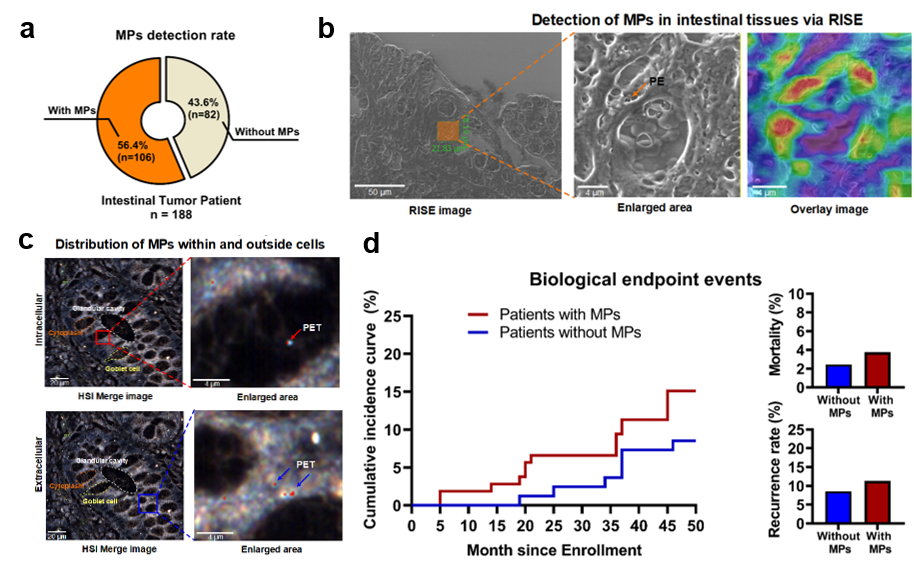
Detection of microplastics in the samples and the association between MPs and endpoint events.Image provided by the research group
The research team collected 188 surgically resected intestinal tumor specimens. Using advanced techniques such as confocal microscopy, Raman spectroscopy, and electron microscopy, they detected and localized microplastics within the tissues. The results showed that microplastics were detected in 56.4% of the samples, with polyethylene terephthalate (PET) — commonly used in beverage bottles and food packaging — being the most prevalent type. Some of these microplastics were found adhering to the periphery of cells, and some even appeared inside the cells.
Subsequently, the researchers divided the patients into a "microplastic-positive group" and a "negative group," and compared them using clinical follow-up data spanning up to 34 months, which included whether the tumor recurred, the severity of the patients' gastrointestinal discomfort, inflammatory markers, and other indicators.
Microplastic-positive patients: higher recurrence risk and more troubled guts
Statistical analysis revealed that patients in the microplastic-positive group had a higher cumulative incidence of tumor recurrence; concurrently, their gastrointestinal symptom scores were worse (e.g., more pronounced abdominal pain, diarrhea, and nausea).
It must be emphasized that the findings currently represent only a statistical association, not a causal relationship. The study does not prove that microplastics directly cause recurrence or symptom exacerbation; other complex factors may be involved. The researchers also noted that this conclusion still requires validation through larger-scale, longer-term prospective studies, as well as animal and cell experiments.
Microplastic pollution is a global environmental problem. Humans primarily ingest microplastics through diet (e.g., bottled water, seafood, salt) and inhalation. As one of the organs with the most frequent contact with the external environment, the intestine is likely a major site of microplastic deposition. Previously, scientists have detected microplastics in human blood, placenta, lungs, and other tissues, but a systematic investigation of the characteristics of microplastics within diseased intestinal tissues and their relationship with clinical indicators has been lacking.
This study is the first to combine high-precision microplastic detection with long-term clinical follow-up data, offering new clinical evidence for understanding how environmental pollutants may potentially affect human health.
The research team stated that future work will advance controlled exposure experiments, animal models, cell studies, and larger prospective cohorts, aiming to reveal whether and how long-term microplastic exposure affects intestinal immunity, inflammatory responses, and the tumor microenvironment, thereby providing a scientific basis for targeted health risk assessment, prevention, and control strategies.
Honghong Chen, a Ph.D. student jointly trained by EIT and SJTU, and Dr. Zhaohui Liu from Shenzhen Second People's Hospital are the co-first authors. Associate Professor Wenhui Qiu is the corresponding author. Professor Chunmiao Zheng is the doctoral supervisor of Honghong Chen and a co-author of the paper. This study was supported by the National Natural Science Foundation of China and key research projects from provincial and municipal programs in the Guangdong–Shenzhen and Zhejiang–Ningbo regions.
Link: https://doi.org/10.1038/s44360-026-00123-z