All‑solid‑state batteries are widely regarded as the ultimate next‑generation power source, and sulfide solid electrolytes (SSEs) have emerged as one of the most industrially promising routes owing to their ultra‑high ionic conductivity and excellent deformability.
Yet a persistent bottleneck has blocked the industrialization of all‑solid‑state batteries — the core raw material of SSEs, lithium sulfide (Li₂S), is prohibitively expensive.
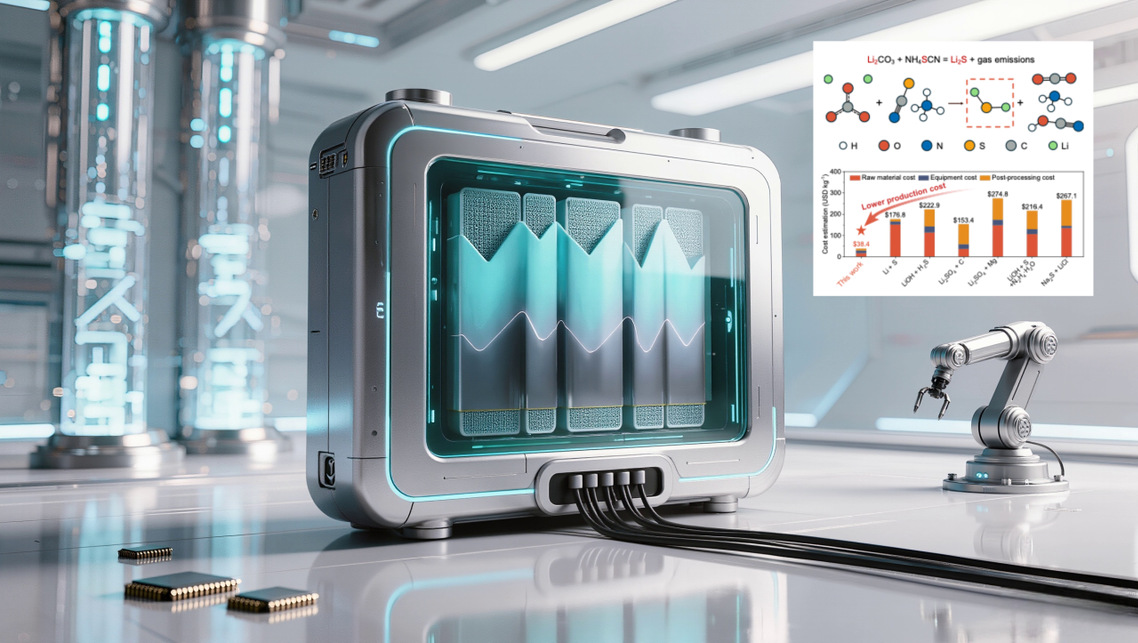
The team led by Chair Professor Xueliang Sun, Foreign Member of the Chinese Academy of Engineering, and Professor Changhong Wang at the Eastern Institute of Technology, Ningbo (EIT) has now cracked this bottleneck. Using industrial‑grade lithium carbonate (Li₂CO₃) as the lithium source and low‑cost ammonium thiocyanate (NH₄SCN) as the sulfur source, they produced low‑cost, high‑quality Li₂S through a multi‑step metathesis reaction.
Cost analysis shows that the total costs of the two resulting SSEs are reduced by 86.6% and 88.5%, respectively, demonstrating a decisive techno‑economic advantage for propelling SSEs toward the commercialization of all‑solid‑state batteries.
This work has recently been published in the top international chemistry journal Angewandte Chemie International Edition.
Li₂S: From "Sky‑High Raw Material" to Affordable, Scalable Production
Conventional Li₂S synthesis methods—whether the lithium–sulfur deflagration method, acid–base neutralization, or carbothermal and magnesiothermic reduction—suffer from high cost, poor safety, cumbersome purification, and considerable pollution risk. None can simultaneously deliver low cost and large‑scale manufacturability. In this study, we selected industrial‑grade Li₂CO₃ (8.56 USD/kg) and the inexpensive sulfur source NH₄SCN (3.56 USD/kg). The reaction generates only gaseous by‑products (CO₂, N₂, etc.), directly affording high‑quality Li₂S without additional purification. Kilogram‑scale production has been demonstrated; the product exhibits uniform particle size, high crystallinity, and excellent compatibility with sulfide SSE synthesis.
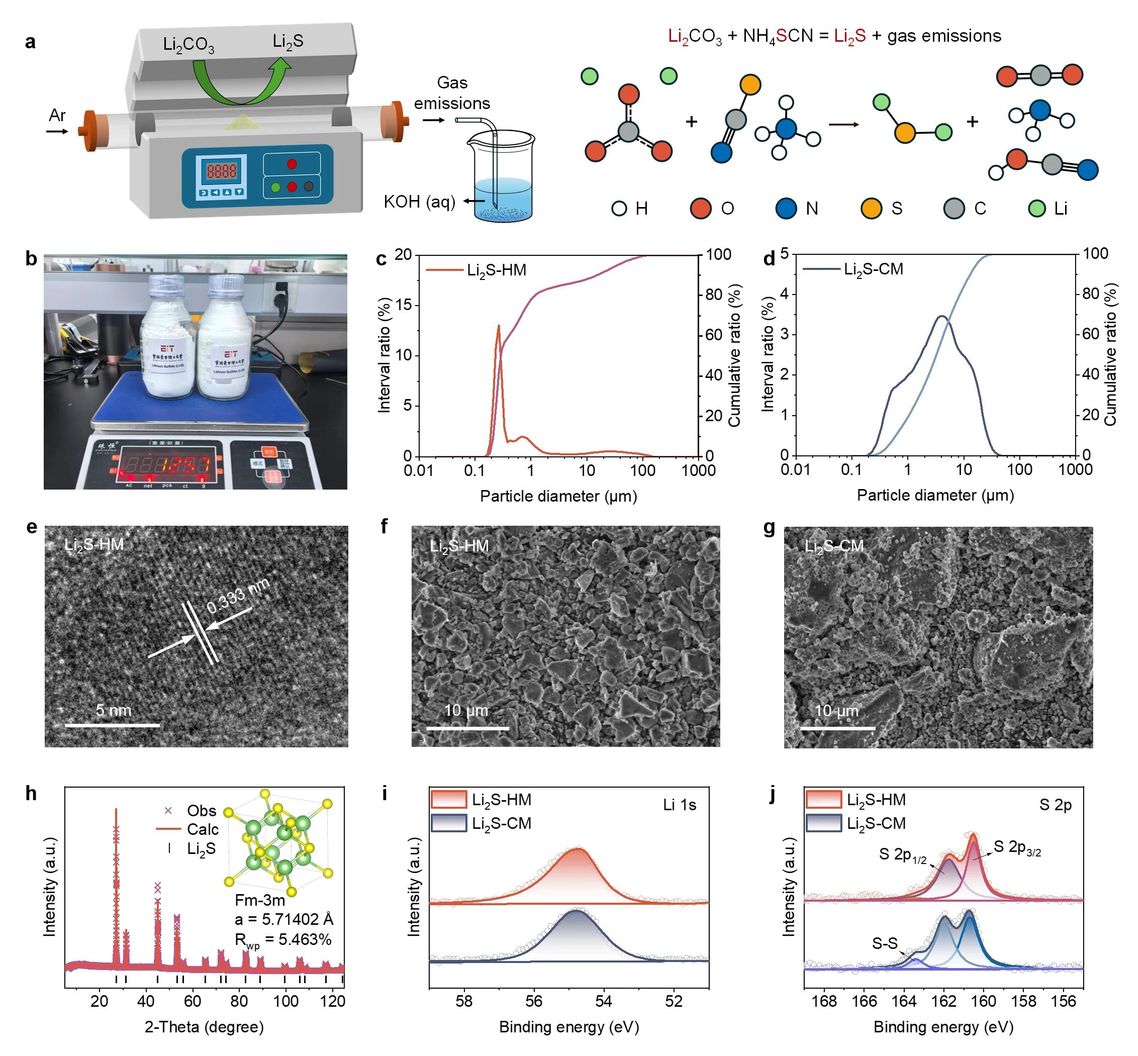
(a) Schematic of the Li₂S synthesis apparatus and reaction pathway. (b) Photograph of kilogram‑scale Li₂S product. (c,d) Comparison of particle size distributions of our in‑house Li₂S and commercial Li₂S. (e) High‑resolution transmission electron microscopy image of the as‑synthesized Li₂S. (f,g) Scanning electron microscopy images of in‑house and commercial Li₂S. (h) Rietveld refinement of the X‑ray diffraction pattern. (i,j) X‑ray photoelectron spectroscopy spectra of Li 1s and S 2p.
Room‑Temperature Ionic Conductivity Comparable to Commercial Liquid Electrolytes
Using this Li₂S, the research team synthesized two archetypal SSEs: Li₅.₄PS₄.₆Cl₀.₈Br₀.₈ (LPSCB) and Li₅.₄PS₄.₆Cl₁.₆ (LPSC). Both show excellent crystallinity with virtually no impurity phases. Their room‑temperature ionic conductivities reach 11.33 and 7.94 mS cm⁻¹, respectively, while their electronic conductivities are as low as 10⁻⁸ S cm⁻¹. We paired LPSCB and LPSC electrolytes with a LiNbO₃‑coated Ni‑rich cathode (Ni90@LNO) and a Li–In alloy anode to assemble all‑solid‑state batteries. At 0.1C, the initial discharge capacities reached 192.2 and 198.8 mAh g⁻¹, with initial Coulombic efficiencies of 81.9% and 85.3%, respectively. Excellent rate capability was achieved from 0.1C to 5C, and the capacity retention approached 95% after 800 cycles at 1C. To verify practical viability, they fabricated pouch cells. The pouch cell stably delivers 55.4 mAh, retains 30.32% of its initial capacity even at the high rate of 3C, and readily lights up an LED bulb.
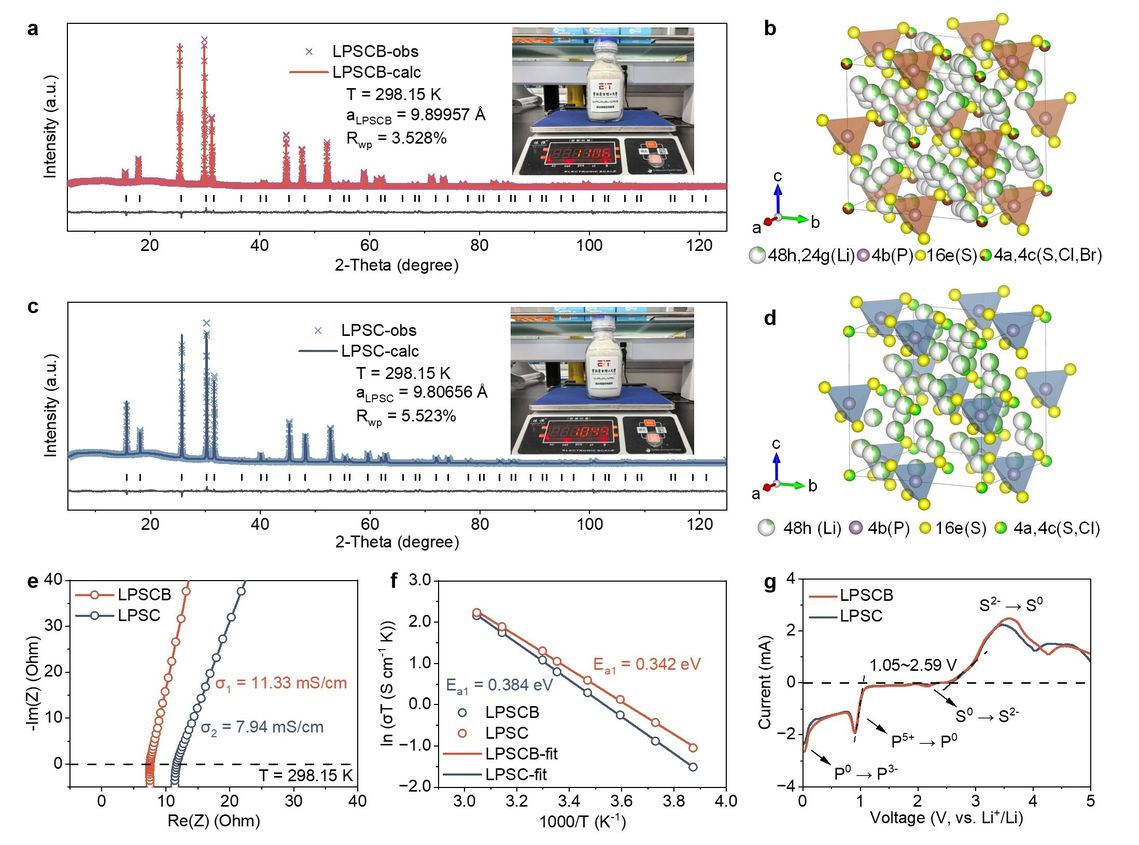
(a–d) Rietveld‑refined X‑ray diffraction patterns and crystal structure models of LPSCB and LPSC sulfide solid electrolytes. (e) Electrochemical impedance spectroscopy Nyquist plots. (f) Arrhenius plots. (g) Linear sweep voltammetry curves.
Dramatic Cost Reduction and Clear Techno‑Economic Advantage
We carried out a comprehensive evaluation of mainstream synthesis routes across six metrics—cost, product purity, production safety, environmental friendliness, energy efficiency, and operability —and conducted a production‑cost accounting for both Li₂S and the resulting electrolyte materials. The new route drastically lowers the cost of the Li₂S precursor. Relative to the route employing commercial Li₂S, the total costs of LPSCB and LPSC are reduced by 86.6% and 88.5%, respectively, and the contribution of Li₂S to the total SSE cost drops to below 50%.
The Eastern Institute of Technology, Ningbo is the first affiliation of this work. Professor Xueliang Sun and Professor Changhong Wang are the corresponding authors. Ph.D students Mengfei Zhu, Shengjie Xia and postdoctoral researcher Chao Wang are the co-first authors.