Recently, the team led by Professor Zhangxing Chen, Chair Professor at the Eastern Institute of Technology, Ningbo (EIT) and Foreign Member of the Chinese Academy of Engineering, published research findings in the international journal Nature Communications. Addressing the demands for efficient geothermal resource development and low-carbon energy transition, the research team proposed a Physics-Constrained Neural Operator framework, termed PCNO. This framework enables rapid, high resolution prediction of long-term development processes in complex geothermal reservoirs, and further constructs an intelligent technical pathway for geothermal resource performance, development scheme optimization, and economic analysis.
This method can be applied to the development of conventional hydrothermal systems, the development of enhanced or advanced geothermal systems, regional geothermal resource evaluation, integrated design for heating and power generation, and rapid decision support for low-carbon energy systems.
Geothermal energy is a vital renewable energy source driving the low-carbon energy transition. Compared to wind and solar energy, geothermal energy offers advantages such as stability, continuity, and low susceptibility to weather conditions, and can be utilized for various scenarios including heating, power generation, and industrial energy use. However, geothermal resources are often buried deep underground, featuring complex reservoir structures and strong coupling among temperature, pressure, permeability, rock thermal properties, and injection-production conditions. Accurately predicting subsurface thermal fluid transport behavior, assessing long-term thermal energy production capacity, and rapidly screening optimal development schemes represent a critical hurdle that must be overcome for the large-scale exploitation of geothermal resources.
While traditional numerical simulation can meticulously characterize complex coupled processes like fluid flow and heat transfer in geothermal reservoirs, it incurs high computational costs and long simulation cycles. When researchers need to simultaneously consider a multitude of geological parameters, engineering parameters, and operational scenarios, traditional simulation often struggles to support large-scale uncertainty analysis and rapid optimization for decision-making. Especially for complex scenarios like the development of deep geothermal resources in enhanced geothermal systems, there is an urgent need to rapidly determine how large the resource potential is, which scheme is optimal, and whether it is economically feasible during the early development stage. This places higher demands on the predictive efficiency and reliability of models.
To tackle this challenge, the research team proposed the PCNO, a Physics-Constrained Neural Operator framework. This framework integrates the efficient learning capabilities of artificial intelligence with the governing equations of geothermal reservoirs, enabling the model not only to learn the mapping relationships between complex inputs and outputs from a wealth of high-fidelity simulation data but also to be constrained by physical laws such as mass conservation, energy conservation, fluid flow, and heat transfer during the training process. In other words, PCNO pursues not only prediction speed but also emphasizes the accuracy, stability, and physical consistency of the prediction results.
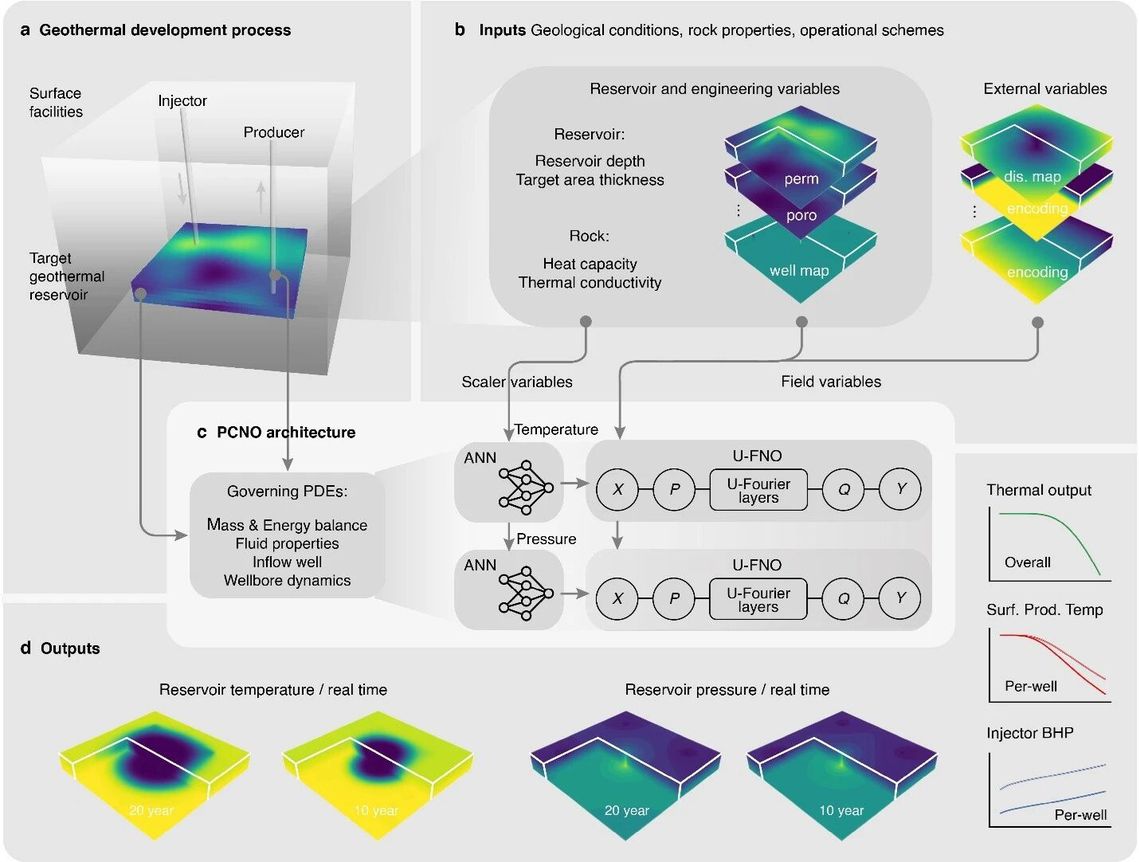
PCNO model framework and workflow. Image provided by the research group
Core Innovations
Overcoming the Application Limitations of Single Reservoirs and Fixed Operating Conditions
The geological conditions and development schemes for geothermal reservoirs often vary significantly. Traditional surrogate models typically rely on training with a specific reservoir or fixed operating conditions, and their predictive capability is often limited when faced with new reservoir parameters, well control conditions, and operational strategies. By employing a neural operator framework to learn the universal mapping relationships between reservoir parameters, engineering conditions, and development responses, PCNO allows the model to be applicable to different geothermal reservoirs and various development conditions. This approach transcends the one model for one scenario limitation of traditional data-driven models, providing a new technical foundation for rapid geothermal resource assessment across reservoirs and schemes.
Building an Efficient Predictive Model for Complex Geothermal Systems
Faced with complex three-dimensional reservoirs, multi-parameter combinations, and long-term development predictions, traditional numerical simulation typically requires significant computational cost. By learning from high-fidelity simulation data, PCNO can rapidly predict reservoir temperature, pressure, and surface thermal energy output responses under different reservoir conditions and development schemes, thus offering an efficient surrogate model for geothermal resource evaluation and scheme screening.
Enhancing the Physical Consistency of AI Predictions
Distinct from AI models relying solely on data fitting, PCNO incorporates governing equations, including mass conservation, energy conservation, fluid flow, and heat transfer, into the training process. This ensures the model’s predictions not only aim to minimize error but also emphasize physical consistency. Such a design helps improve the model's reliability in complex geothermal systems, avoiding predictions that appear accurate but physically inconsistent.
Connecting the Reservoir Response—Engineering Metrics Prediction Chain
PCNO not only characterizes the evolution of subsurface temperature and pressure fields but also further links key development indicators such as production temperature, injector bottomhole pressure, installed thermal capacity, total thermal energy production, and power generation potential. This means the model can answer not only how subsurface temperature and pressure change but also further assess the impact of these changes on the development efficacy and engineering feasibility of a geothermal project.
Supporting Large-Scale Scenario Analysis and Scheme Optimization
Leveraging the efficient predictive capability of PCNO, the model can evaluate a vast number of combinations of geological parameters, well control conditions, and operational scenarios in a relatively short time, thereby identifying the key factors influencing thermal energy production and economic viability. This enables geothermal development scheme design to shift from the traditional trial-and-error simulation to a more systematic rapid screening approach, providing a quantitative basis for early-stage project decision-making, risk assessment, and economic analysis.
The core value of this research lies in the deep integration of traditional numerical simulation of geothermal reservoirs with advanced artificial intelligence models, proposing an intelligent geothermal development method that combines computational efficiency, predictive accuracy, and physical consistency. The significance of PCNO's development is not only to accelerate the assessment of geothermal resource potential but also to offer a generalizable intelligent modeling and optimization approach for complex subsurface energy systems.
The key to geothermal energy development is not only finding subsurface heat sources but also knowing how to convert underground thermal energy into usable energy efficiently, economically, and sustainably. PCNO provides a new technical pathway for this process: it can rapidly predict reservoir response in complex subsurface environments, assisting researchers and engineers in screening for a better solution among numerous candidate schemes, and providing critical support for the efficient development of geothermal energy and the low-carbon energy transition.
The Eastern Institute of Technology, Ningbo, is the first corresponding affiliation of the paper. Professor Zhangxing Chen is the corresponding author, and Zhenqian Xue, a postdoctoral researcher at the University of Calgary, is the first author.