In the world of chemistry and materials science, "order" is often regarded as synonymous with high performance. The more regular the crystal structure, the easier it seems to understand, design, and optimize. Yet, in the field of all-solid-state batteries, some seemingly “less ordered” amorphous materials are showing unexpected promise.
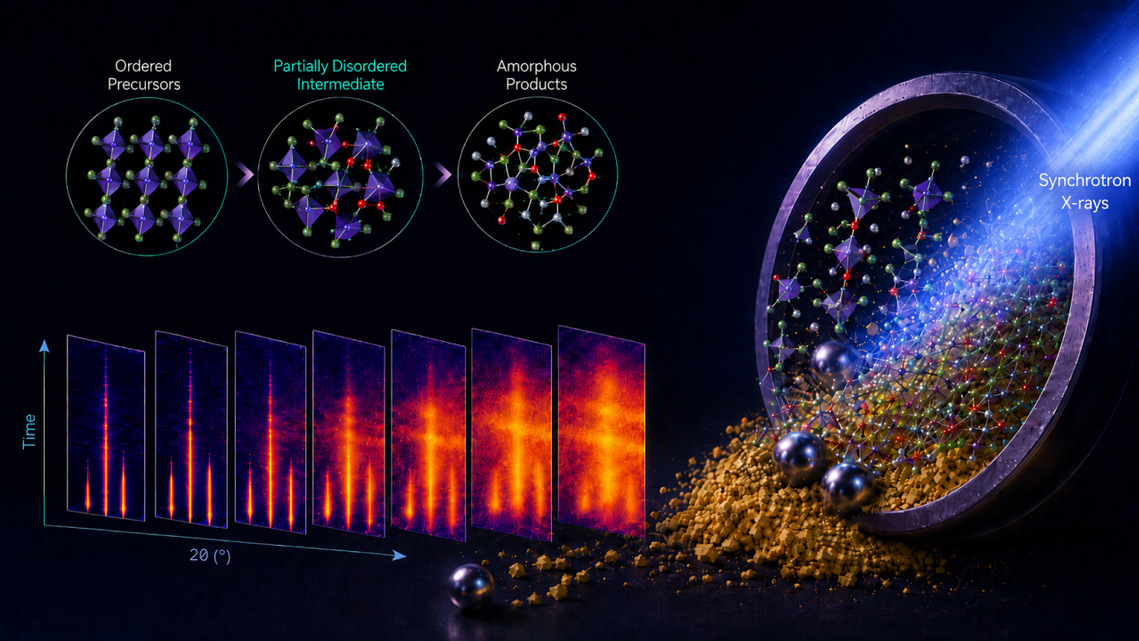
A team led by Assistant Professor Wei Xia of the Eastern Institute of Technology, Ningbo (EIT), in collaboration with the Southern University of Science and Technology (SUSTech), the SPring-8 synchrotron facility in Japan Synchrotron Radiation Research Institute (JASRI), Oak Ridge National Laboratory in the United States, and Queen Mary University of London, has synthesized a class of Li–Zr–N–Cl solid electrolytes. Using in situ synchrotron structural assessment, they tracked the entire transformation pathway from crystalline precursors to the final amorphous solid electrolyte.
The findings were recently published in Nature Communications.
Amorphous Does Not Mean Random; It Could Actually Work Better
In the search for next-generation batteries that offer both high safety and high energy density, all-solid-state batteries are a leading contender. Halide solid electrolytes have been star materials because of their fast ionic conduction and good compatibility with high-voltage positive electrodes. The bottleneck is clear, however: the performance of traditional halide electrolytes strongly depends on structural design. How to make lithium ions move even faster while keeping the material stable and easy to process remains a challenge.
The team took a different approach: what if, instead of striving for a highly ordered crystalline structure, they used mechanical ball milling to drive the material toward an amorphous state?
Through mechanochemical synthesis, they successfully produced a family of amorphous Li–Zr–N–Cl solid electrolytes with the general formula Li3xZrCl4Nx. The representative composition, Li1.44ZrCl4N0.48, delivered an ionic conductivity of 3.21×10⁻³Scm⁻¹ at 30°C—the highest value reported to date for a pure Zr-based halide electrolyte.
Filming the Reaction: In Situ Structural Assessment Reveals the Amorphization Mechanism
Mechanical ball milling resembles a high-speed “collision experiment” taking place among powder particles. The material continually fractures and reassembles under impacts, shear, and localized thermal effects, eventually forming new structures. Because this process is usually too fast and too complex, researchers have traditionally been able to see only the reactants before milling and the products afterward—leaving the intermediate steps largely in the dark.
To visualize how the reactants Li3N and ZrCl4 transform into the amorphous electrolyte product, the team used the SPring-8 synchrotron facility in Japan together with a purpose-built in situ ball-milling setup to carry out time-resolved in situ synchrotron X‑ray diffraction experiments—essentially making a continuous "movie" of the ball-milling reaction.
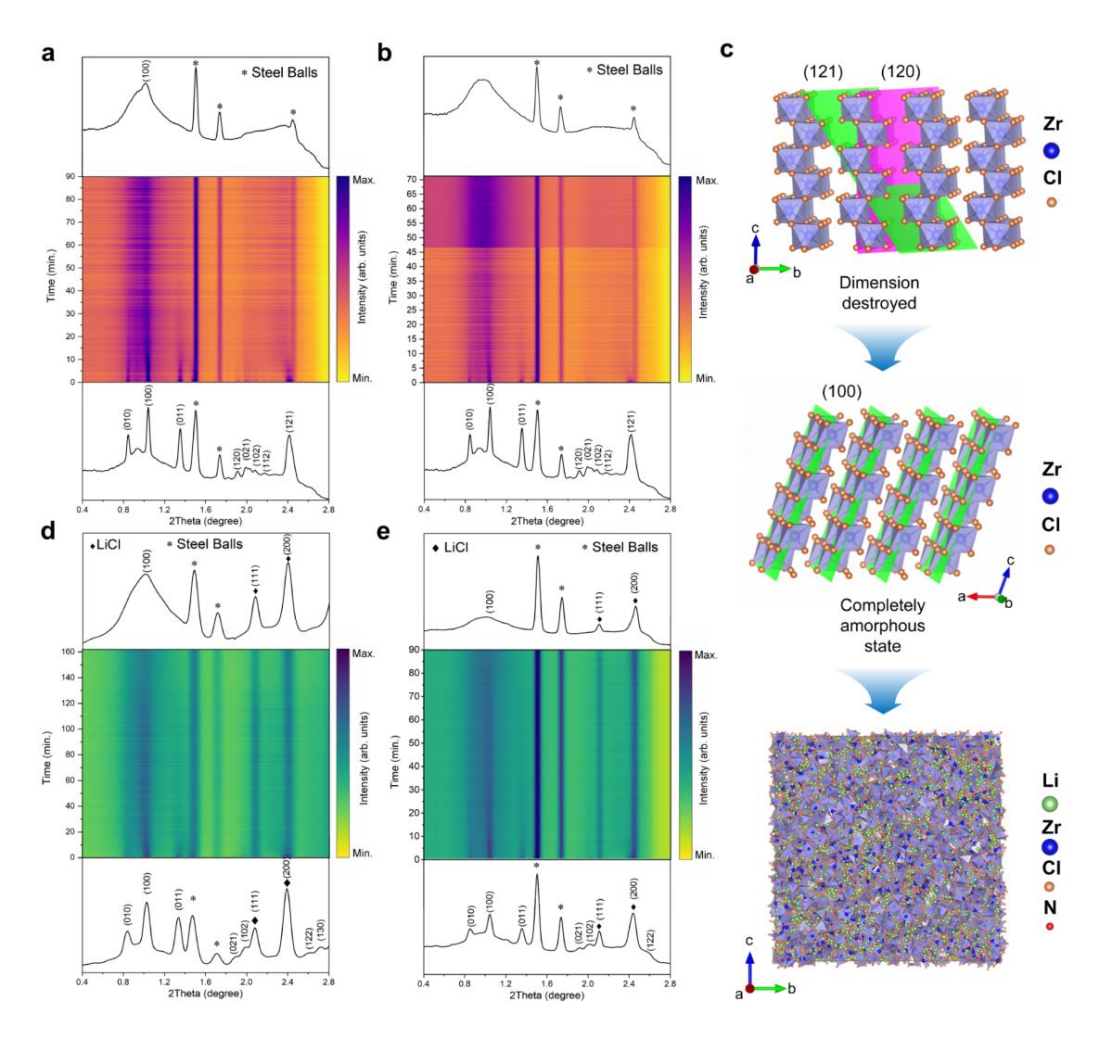
The in situ results show that under 18Hz milling, the structural evolution of ZrCl4 proceeds through several consecutive stages. At the very beginning, a subset of the characteristic diffraction peaks of ZrCl4 rapidly weakened, indicating that mechanical shear first acts on specific crystal planes and that the long-range ordered structure begins to collapse. Subsequently, the remaining diffraction peaks continued to decline in intensity, but signals associated with the smallest Zr-X4 tetrahedral structural units in ZrCl4 were retained. This implies that the connections linking the crystalline framework and the polyhedra had progressively broken while the local tetrahedral units remained largely intact. Such disruption of polyhedral connectivity and loss of crystallinity opened opportunities for nitrogen atoms to enter the structure and take part in bridging. Nitrogen atoms originating from Li3N could occupy or bridge these newly created sites, driving the restructuring of the Zr–Cl local environment into a nitrogen-containing Zr–N–Cl coordination network.
Because the material was not yet fully amorphous at 18Hz, the team further increased the milling frequency to 25Hz. Under this condition, the first two stages of structural disruption occurred more rapidly, and the transformation of the Zr-X4 tetrahedra from an ordered crystalline state to a completely disordered state could be continuously tracked. In the in situ diffraction patterns, the sharp crystalline peaks gradually disappeared while broad diffuse peaks grew in intensity and shifted in position, signaling the progressive loss of long-range order and a steady increase in the amorphous fraction. Ultimately, the Li3N and ZrCl4 precursors were fully amorphized after roughly 47 minutes, yielding the Li1.44ZrCl4N0.48 Li1.44ZrCl4N0.48 solid electrolyte.
A Mixed-Anion Framework Builds New Pathways for Lithium Ions
Why does nitrogen incorporation boost ionic conduction? The team further employed X‑ray absorption spectroscopy, neutron pair distribution function analysis, and reverse Monte Carlo modeling to systematically unravel the local structure of the amorphous material.
The results show that nitrogen is not simply "mixed" into the material; it actively participates in constructing the local structure, forming Zr–N, Li–N, and Zr–N/Cl coordination environments. The introduction of nitrogen breaks the connectivity of the original Zr–Cl polyhedra, creating a more disordered and flexible amorphous framework that supplies more favorable pathways for lithium-ion migration. Interestingly, longer ball-milling time does not always yield better performance. The sample milled for 24 hours exhibited the highest ionic conductivity; extending the milling to 72 hours caused the local polyhedral connectivity to become more ordered and tighter, which can hinder lithium-ion transport. This illustrates that for amorphous electrolytes, more “disorder” is not necessarily better—an appropriate balance between structural disorder and local connectivity must be struck.
Low-Temperature Performance Broadens Application Scenarios for All-Solid-State Batteries
To evaluate the practical potential of this material, the team incorporated Li1.44ZrCl4N0.48 into all-solid-state battery tests. At 30°C, an all-solid-state battery using this electrolyte with a LiCoO2 positive electrode could charge and discharge stably; after 500 cycles at a 2C rate, the capacity retention reached 74.0% with an average Coulombic efficiency of 99.9%. Even more compelling is the low-temperature performance. The electrolyte maintained an ionic conductivity exceeding 10⁻⁴ Scm⁻¹ at –18°C. An all-solid-state battery assembled with this material, cycled at –18°C at a 0.3C rate for 1500 cycles, still delivered a capacity retention of 81.9% and an average Coulombic efficiency of 99.8%. This demonstrates that the nitrogen–chlorine mixed-anion amorphous electrolyte can operate not only at room temperature but is also promising for all-solid-state batteries across a much wider temperature window.
International Collaboration Harnessing Large-Scale Facilities Solves the Challenge of Amorphous Structure Determination
Unlike crystals, amorphous materials lack well-defined, periodic atomic arrangements. Truly understanding the structure–property relationship in such materials typically demands multiple advanced characterization techniques that probe different length scales in a coordinated analysis. To tackle this challenge, Assistant Professor Wei Xia’s team orchestrated a collaborative effort linking research groups from several countries with large-scale scientific facilities, ultimately achieving a multi-scale observation of the entire transformation from crystalline precursors to the amorphous electrolyte. In situ synchrotron X‑ray diffraction experiments were performed at SPring-8 in Japan to track the structural evolution during ball milling in real time. X‑ray absorption spectra were collected at the Synchrotron SOLEIL in France to analyze the local coordination environment around Zr, and neutron scattering data from the China Spallation Neutron Source were combined to further resolve the amorphous structure. This work provides direct evidence for understanding the mechanochemical synthesis process and elucidates the structural origin of how nitrogen incorporation promotes amorphization and enhances lithium-ion transport.
The study pushes the research on key solid-state battery materials from "performance discovery" toward "mechanistic understanding," and offers new ideas for designing high-performance, wide-temperature-range, and scalable all-solid-state battery electrolytes in the future.
Denys Butenko, a postdoctoral researcher in Assistant Professor Wei Xia’s group, currently a visiting scholar at the Southern University of Science and Technology (SUSTech), is the first author of the paper. Assistant Wei Xia; Jinlong Zhu, Associate Professor at SUSTech; Jo-chi Tseng, beamline scientist at SPring-8 of Japan Synchrotron Radiation Research Institut; and Yuanpeng Zhang, beamline scientist at Oak Ridge National Laboratory, USA are the co-corresponding authors.