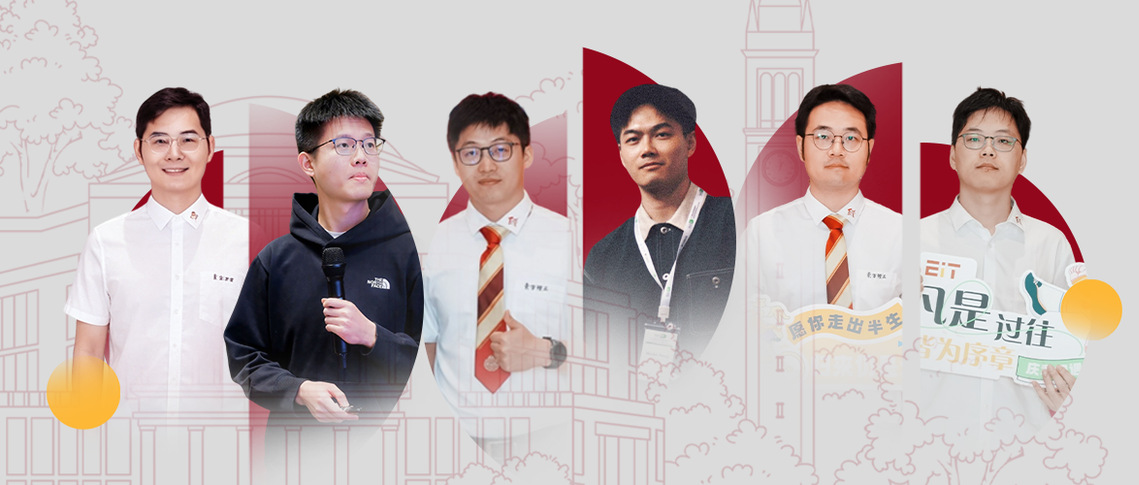
For many doctoral graduates, earning a PhD marks the start of truly independent research. For the first cohort of collaboratively trained doctoral graduates from the Eastern Institute of Technology, Ningbo (EIT), "postdoctoral researcher" has become the shared next step for many.Some are heading to leading institutions around the world—Rice University, the University of Hong Kong, Zhejiang University, and the Chinese Academy of Sciences among them—while others are continuing their academic research at EIT.
Here, we talk with graduates who are continuing their research journeys—what they took away from EIT, and what they're planning next.
Shaoqiang Lu: Exploring a New Path at the Intersection of Hardware and Software
Ph.D Research focus: AI-oriented chip design and system optimization
Next stop: Rice University, Postdoctoral Researche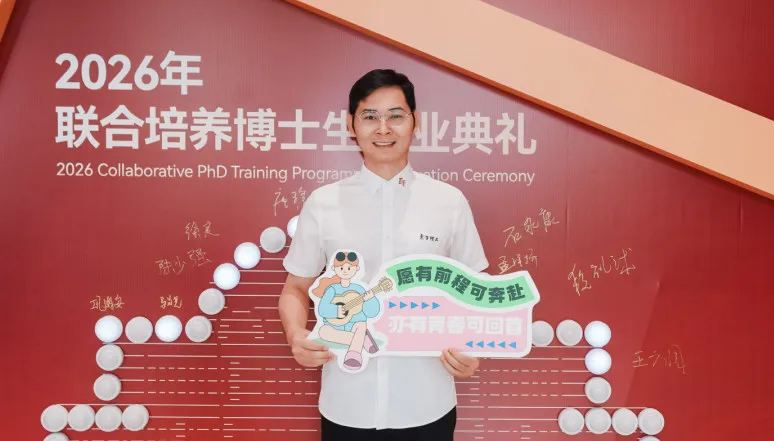
Shaoqiang Lu
Shaoqiang Lu still remembers the first time he submitted a paper. It was during the Spring Festival holiday. Though he was at home, his mind was entirely on his experiments and manuscript. When the paper was accepted, he gained more than confidence—he realized something fundamental:
"The first step in research is to commit and push through that initial zero-to-one breakthrough."
Shaoqiang Lu's work sits at the intersection of two demanding fields: integrated circuits and artificial intelligence. What drew him to EIT were his passion for IC design, the deep expertise of Professor Lei He, Chair Professor in the College of Information Science and Technology, and the open, energetic atmosphere of a new type of research university.
"Eye-opening, broadening, maturing" —those are the three words he uses to describe his doctoral years. After publishing papers at top Electronics Design Automation (EDA) conferences—one at DAC and two at ICCAD—he reached a personal milestone: a paper at ASPLOS, a premier international conference on architectural support for programming languages and operating systems.
"I used to think top conferences were out of reach. But once you do the work, you see that if the direction is right and the research is solid, you can meet those standards," he said.
As AI continues to advance at a fast pace, underlying hardware and software frameworks face new pressures. Shaoqiang Lu's goal for his postdoctoral work at Rice University is clear:"I want to dig deeper into the intersection of AI systems and chip architecture and address the bottlenecks that really affect efficiency."
Mingxing Weng: Living with the Uncertainty of Research
Ph.D Research focus: Computational mathematics and scientific machine learning
Next stop: Academy of Mathematics and Systems Science, Chinese Academy of Sciences
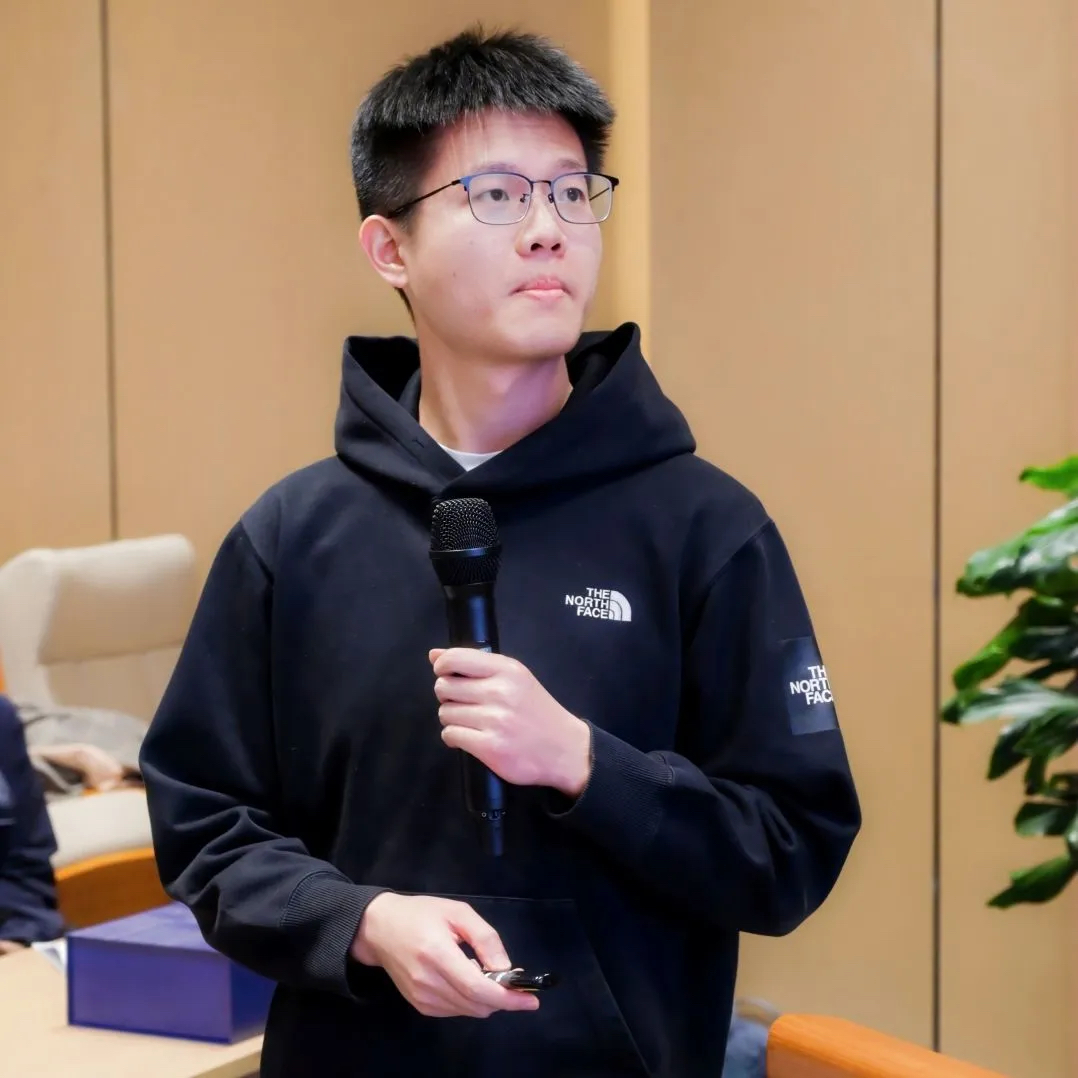
Mingxing Weng
"Research rarely has a single right answer. The biggest growth for me has been learning to think independently and sit with uncertainty."
Mingxing Weng's research uses neural networks to solve partial differential equations more efficiently—enabling computers to simulate complex natural and engineering phenomena faster and more accurately, lowering the cost of scientific computing and improving performance. When his research direction shifted early in his doctoral studies, he felt real pressure. But the open atmosphere of his EIT team helped him find his footing, and he went on to publish a first-author paper in a leading SIAM journal in computational mathematics.
"My supervisor, Professor Jie Shen, brought me into computational mathematics. He trusted me completely and gave me the freedom to shape both my research and my daily life," Mingxing Weng said.
Outside the lab, he is also the office's go-to person for peeling fruit—a small ritual that keeps things warm amid the intensity of academic life.
With his supervisor's recommendation and support, Mingxing Weng will soon join the Institute of Computational Mathematics at the Chinese Academy of Sciences as a postdoctoral researcher. Over the next three to five years, he hopes to make more innovative advances in using neural networks to tackle high-dimensional problems.
Yongkang Shi: Gauging the Ups and Downs of Offshore Solar with Resilience
Ph.D Research focus: Large-scale offshore floating photovoltaic system
Next stop: Zhejiang University, Postdoctoral Researcher
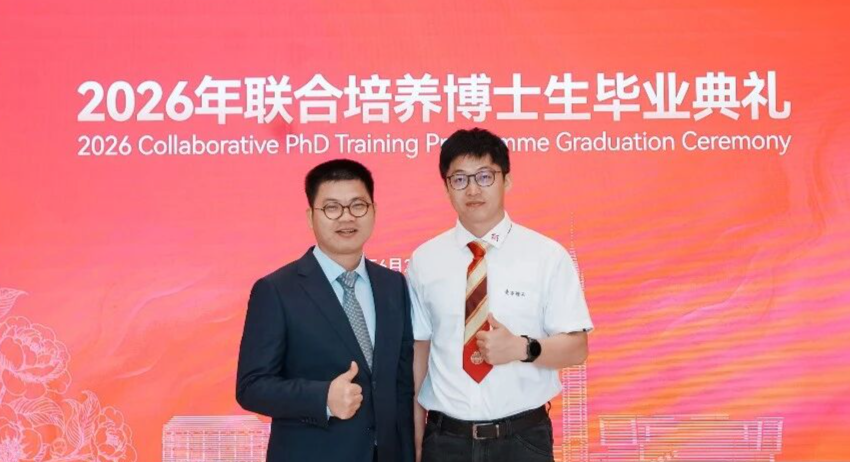
Yongkang Shi (right) with his supervisor Yanji Wei
"Exploration, resilience, and an open-mind."
That's how Yongkang Shi sums up his doctoral journey.
His research is highly interdisciplinary and forward-looking: when offshore photovoltaic platforms flex and move with the waves, how do we predict the impact on structural safety and power output? His time at EIT, at Shanghai Jiao Tong University, and as a visiting researcher at the University of Queensland in Australia broadened his perspective considerably.
Yongkang Shi recalls that during academic presentations at EIT, faculty most often asked not about technical details, but questions like "Why does this problem matter?" and "Where can this line of inquiry lead?"
Looking back, he is proud not of any single paper, but of building a systematic method for analyzing the hydroelastic response and power generation performance of offshore floating photovoltaic systems.
Beyond his passion for the work, sports are how he likes to recharge—and his key piece of advice for younger students.
"Sometimes you can sit at your computer stuck on a problem for hours. Then you go out, play a game, go for a run, and suddenly a new idea shows up," he said.
With that open, positive mindset, Yongkang Shi has started his postdoctoral research at Zhejiang University. He knows that in the face of complex, unpredictable ocean conditions, resilience is what will help the research find real-world footing.
Weike Peng: Solving for the Optimal Path to Urban Grid Decarbonization
Ph.D Research focus: Decarbonization planning and analysis for high-density urban power grids
Next stop: The Hong Kong Polytechnic University, Postdoctoral researcher
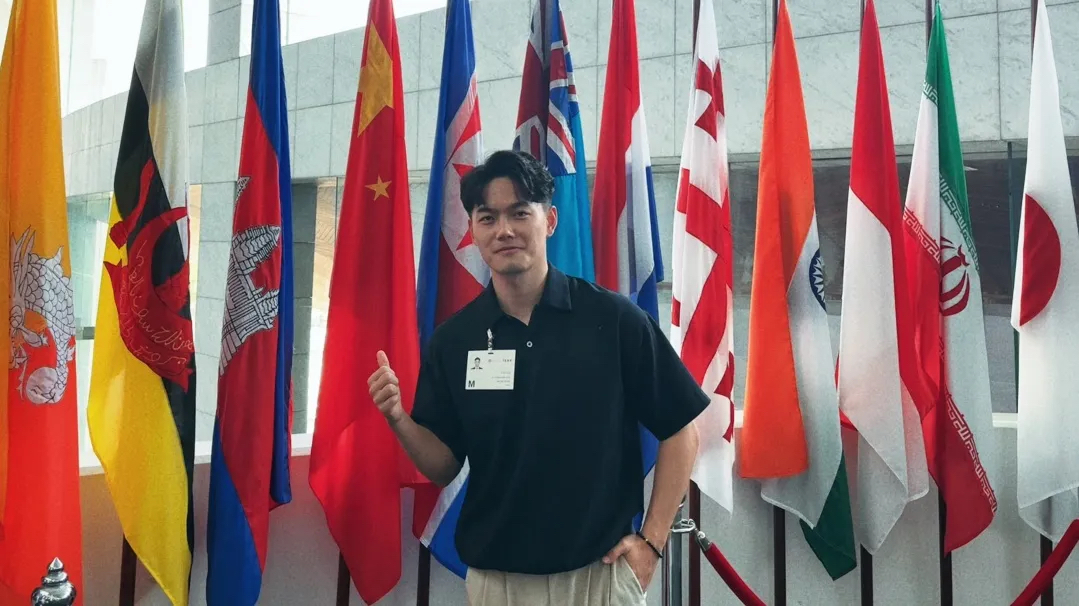
Weike Peng
"Choice matters more than effort—but effort is what earns you choices."
As a member of the first cohort of collaboratively trained doctoral student, Weike Peng benefited from the dual-campus model at EIT and The Hong Kong Polytechnic University. He also watched EIT grow from an advanced research institute on Tongxin Lake into a full-fledged new type of research university on the banks of the Yong River.
Walking along the East Boulevard with the Yong River shimmering in the sunlight, "I felt like I was growing right along with the university," he said.
His doctoral research focused on a pressing climate question: under a regional coordination framework, how can high-density cities lower the cost of achieving carbon neutrality?
His case study on Hong Kong and Guangdong, published in leading international energy journals, offers new ways to think about extending one country, two systems into energy and power systems. He also presented at conferences overseas and studied energy models in different countries, which broadened his international outlook.
Weike Peng is quick to credit his mentors: "At EIT, I owe the most to Professor Yuntian Chen, Academician Dongxiao Zhang, and their team. They guided me step by step and helped shape the overall direction of my work."
Peng is quick to thank his mentors. “At EIT, I’m especially grateful to Professor Yuntian Chen and Academician Dongxiao Zhang, along with their team. They guided me step by step and helped shape the direction of my research.”
Even with several job offers in hand, he chose to join The Hong Kong Polytechnic University as a postdoctoral researcher, continuing to work closely with his EIT colleagues. His goal: to reduce carbon emissions in high-density cities and their surrounding regions and contribute to global climate action.
Fangyuan Wang: Exploring the Road to Robot Autonomy
Ph.D Research Focus: Long-horizon complex tasks for robots
Next stop: The Hong Kong Polytechnic University, Postdoctoral researcher
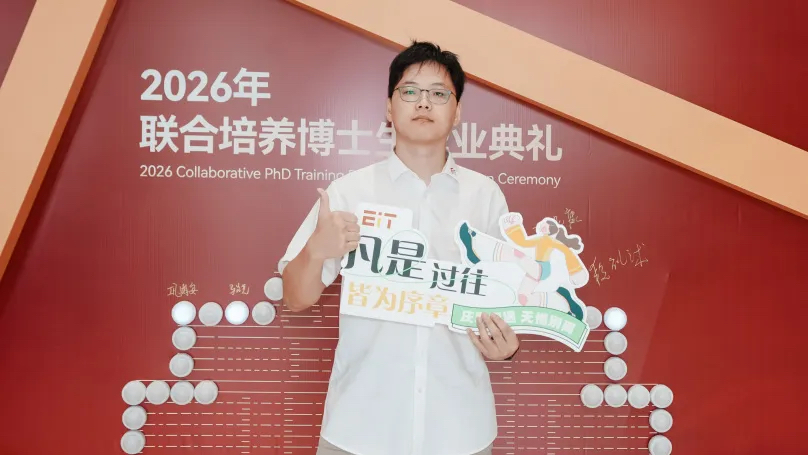
Fangyuan Wang
"Doctoral studies is not just about running experiments and writing papers. It's also about learning to manage uncertainty."
Fangyuan Wang's research aims to make robots more than machines that execute simple commands. He wants them to understand goals in complex environments, plan a sequence of steps, and complete tasks from start to finish. One of his papers on long-horizon task planning for embodied mobile manipulation was accepted as an oral paper at AAAI, a leading AI conference.
What he valued most at EIT was the high degree of freedom.
"Students have a lot of autonomy in choosing their research direction and can explore what genuinely interests them," he said. That relaxed, supportive environment—plus access to high-performance computing—kept his experiments on track and taught him to stay balanced over the long arc of a research project.
He chose to continue as a postdoctoral researcher because the questions that drive him are still open. "What I most want to solve is enabling robots to complete complex tasks truly on their own, rather than always waiting for human instructions."
Mingqi Yuan: Staying Composed in the Endless Pursuit of Research
Ph.D Research focus: reinforcement learning
Next stop: University of Hong Kong, Postdoctoral researcher
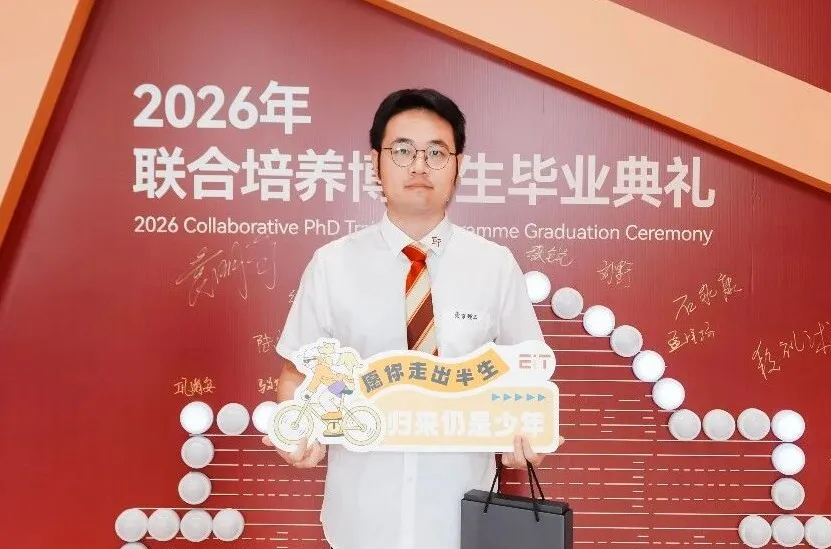
Mingqi Yuan
"Research has no finish line. The biggest growth is learning to handle things with more maturity and calm."
Mingqi Yuan's research focuses on reinforcement learning—how intelligent agents learn through interaction with their environment. It is both a frontier in AI and a fitting metaphor for a doctoral student's own learning curve.
At EIT, a diverse academic environment, ample computing resources, and steady support from his supervisors and colleagues in the lab allowed Mingqi Yuan to immerse himself in exploration. Outside the lab, he likes to explore good food with friends—a rhythm of focus and downtime that keeps him energized.
As he prepares for a postdoctoral fellowship at the University of Hong Kong, Mingqi Yuan seems at ease with what lies ahead. He’s not one for lofty pronouncements—just a quiet determination to keep learning and moving forward.
Since 2022, EIT has established collaborative Ph.D Training programs with four leading universities—Shanghai Jiao Tong University, The Hong Kong Polytechnic University, University of Science and Technology of China, and University of Warwick—and has enrolled five consecutive cohorts of doctoral students.
The graduation of the first cohort from EIT's collaborative Ph.D Training programs marks a key milestone in its growth as a new type of research university with a distinctive model. It is also the first tangible outcome of a new doctoral training model built on dual supervision, dual-campus experiences, and interdisciplinary study.
The postdoctoral years are a critical leap from student to independent researcher—a time to build strength for work of greater depth and originality. These graduates will carry with them the innovative spirit and global outlook forged at EIT, sharpening their skills in leading research environments around the world as they set out from the Yong River to take on deeper, longer-term questions.